The Trump Administration, which for months denied seeking regime change in Venezuela, is moving to assert control over the country’s political future.
The U.S. carried out a series of strikes on the Venezuelan mainland on Saturday, killing at least 40 people and capturing Nicolás Maduro, whom the U.S. considered an illegitimate President. Maduro was taken to New York, along with his wife, to face drug charges, leaving the Latin American country’s leadership in question.
[time-brightcove not-tgx=”true”]
Read More: A President Captured: How the Elite Delta Force Raid in Caracas Unfolded
“Don’t ask me who’s in charge, because I’ll give you an answer, and it’ll be very controversial,” President Donald Trump told reporters aboard Air Force One on Sunday night. “We’re in charge.”
“We’re going to run the country until such time as we can do a safe, proper, and judicious transition,” Trump said Saturday, signalling longer-term U.S. involvement in the country.
Read More: Donald Trump Is Risking His MAGA Base on Venezuela
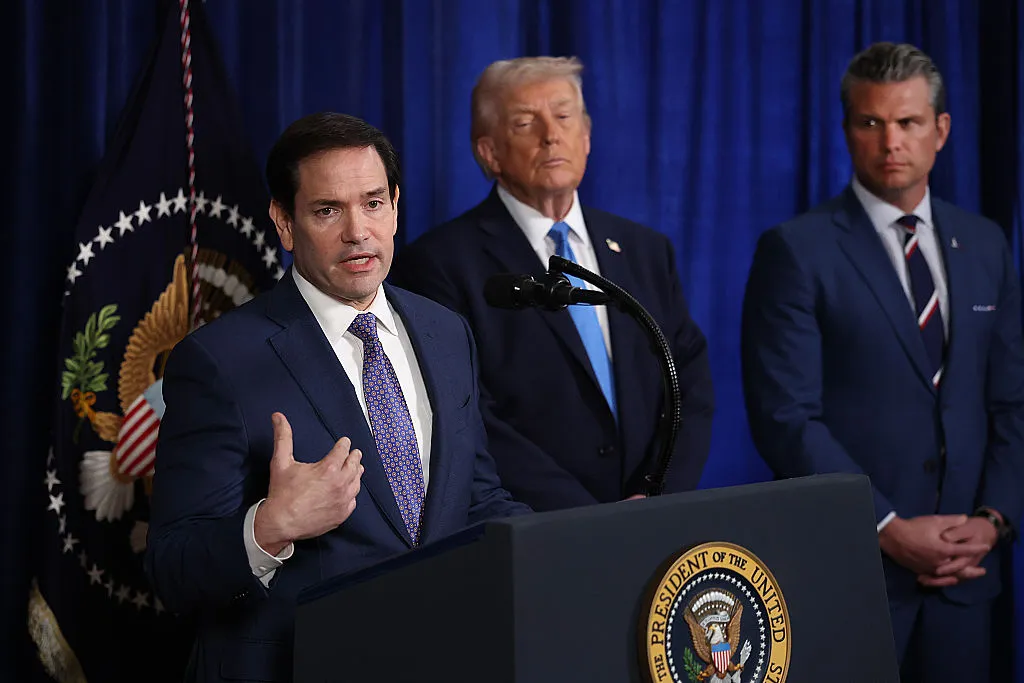
Secretary of State Marco Rubio, who has led the Administration’s policy on Venezuela, seemed to try to clarify to NBC on Sunday that the U.S. is seeking a democratic transition in Venezuela but that a timeline for elections would be “premature.” Rubio also insisted that the U.S.’s military operations against Venezuela—which have consisted of months of strikes on alleged drug boats that have killed at least 115 people—do not constitute a war, which would require congressional authorization.
Officials have suggested that the U.S. government will leverage American military presence and an oil blockade to influence the direction of the Venezuelan government, including ending drug trafficking, increasing U.S. access to Venezuelan oil, and expelling Cuban elements. A U.S. official told CNN that Rubio, alongside White House Deputy Chief of Staff Stephen Miller and War Secretary Pete Hegseth, is developing a structure for an interim government in the country, while Secretary of the Interior Doug Burgum and Secretary of Energy Chris Wright are working on persuading American oil companies to invest in Venezuela’s deteriorating and long-sanctioned oil industry.
Here’s what to know.
Who’s in charge right now?
The deposition of Maduro has already led to a scramble for power among Venezuelan opposition leaders. Venezuelan opposition figure Edmundo González Urrutia, who is recognized by the U.S. as the winner of Venezuela’s 2024 presidential election, called himself the President of Venezuela in a video posted Sunday. Venezuelan opposition leader Maria Corina Machado, the recipient of the 2025 Nobel Peace Prize, has thrown her support behind him, as have some foreign leaders including French President Emmanuel Macron.
Read More: How the World Is Reacting to the U.S. Capture of Nicolas Maduro
Urrutia must be “recognized as Commander in Chief of the National Armed Forces by all officers and soldiers,” Machado said on Saturday.
Machado, who has close ties with Trump and has cheered his Administration’s military campaign against the Maduro government, was thought to be a potential replacement for Maduro. But the U.S. President ruled her out on Saturday, suggesting that she does not command enough “respect within the country” needed to govern it.
Instead, for now, the Trump Administration appears to be backing Maduro’s Vice President Delcy Rodríguez.
That backing, however, is contingent, Trump said Saturday, on Rodríguez doing “what we want.” He warned on Sunday: “If she doesn’t do what’s right, she is going to pay a very big price, probably bigger than Maduro.”
“When the President said the United States is going to be running Venezuela, it means that the new leaders of Venezuela need to meet our demands,” Senate Intelligence Committee Chair Tom Cotton told CNN on Sunday. “We want them to expel the Cubans and the Iranians and the Islamic radicals, and we want them to return to the civilized world and be a good neighbor that contributes to stability, order and prosperity.”
Rodríguez was not immediately pliant. After Rodríguez was sworn in as Venezuela’s new leader, she asserted that Maduro is the country’s “only President” and called the U.S. military operation “barbarity.”
“We had already warned that an aggression was underway under false excuses and false pretenses, and that the masks had fallen off, revealing only one objective: regime change in Venezuela,” Rodríguez said. “This regime change would also allow for the seizure of our energy, mineral and natural resources. This is the true objective, and the world and the international community must know it.”
A former official familiar with Rodríguez told CNN that she is a “very committed leftist” and would not “put her head on the block and say, ‘Hack away.’”
Still, the Trump Administration appears confident that Rodríguez will be more amenable to the U.S.
“We’re going to control what happens next because of this brave decision. President Trump has shown American leadership, and he’ll be able to dictate where we go next,” Hegseth told CBS on Saturday.
“We expect to see more compliance and cooperation than we were previously receiving,” Rubio told NBC on Sunday. “We’re going to make an assessment on the basis of what they do, not what they say publicly in the interim, not what we know what they’ve done in the past in many cases, but what they do moving forward,” Rubio told CBS on Sunday.
Rodríguez already appeared to soften her tone Sunday night in a social media statement that said her government extends “an invitation to the U.S. government to work together on a cooperative agenda, oriented toward shared development, within the framework of international law, and to strengthen lasting community coexistence.”
‘Leverage’ and oil
When asked what it meant for the U.S. to “run” Venezuela—and under what legal authority—Rubio suggested that the U.S. was not directly in charge of the country, but had power over its “direction.”
“What we are running is the direction that this is going to move moving forward,” he told ABC on Sunday. “And that is, we have leverage.”
Read More: How Trump’s Venezuela Takeover Could Change the World
That includes an ongoing U.S. blockade of oil tankers going in and out of Venezuela. “The important thing to point out is that the key to what that regime relies on is the economy fueled by oil,” Rubio told CBS. “There’s a quarantine right now in which sanctioned oil shipments—there’s a boat, and that boat is under U.S. sanctions, we go get a court order—we will seize it.”
Oil has historically accounted for more than 80% of Venezuela’s exports. Experts previously suggested that cutting off this economic lifeline would amount to an “act of war.”
Rubio said the oil blockade will continue “until we see changes that not just further the national interest of the United States, which is number one, but also that lead to a better future for the people of Venezuela.”
The Trump Administration is also acting on its interest in forcing unfettered access to Venezuela’s oil industry, which the Maduro government had alleged was the reason behind U.S. military aggression towards Venezuela.
Venezuela is home to the world’s largest oil reserves, but its oil industry has been hit by sanctions and riddled with problems from corruption to fires that have dramatically reduced its output. The country produces around one million barrels of oil per day, down from peak levels of around four million barrels 50 years ago.
The Trump Administration is hoping that U.S. companies will rebuild Venezuela’s oil industry.
“Venezuela right now is a dead country. We have to bring it back, and we’re going to have to have big investments by the oil companies to bring back the infrastructure ready to go,” Trump said on Sunday night.
Some analysts, however, are skeptical of the feasibility of this plan. “For any oil companies to actually get serious about investing in Venezuela would require that there will be a new congress or National Assembly,” Lino Carrillo, a former manager at Venezuela’s state oil company, Petroleos de Venezuela SA, told Bloomberg. “Not what’s happening now. Definitely not.”
Francisco Monaldi, director of Latin American energy policy at Rice University’s Baker Institute for Public Policy, told Bloomberg that Trump’s plan could require investments to the tune of $100 billion over the next decade.
Chevron is the only U.S. oil producer still operating in Venezuela under a special license issued by former President Joe Biden exempting it from U.S. sanctions on Venezuelan oil. Exxon Mobil and ConocoPhillips, the two other biggest U.S. oil companies, exited Venezuela after former Venezuelan President Hugo Chávez, Maduro’s predecessor, nationalized the oil industry nearly two decades ago.
“I haven’t spoken to U.S. oil companies in the last few days, but we’re pretty certain that there will be dramatic interest,” Rubio told ABC on Sunday. “I think there will be tremendous demand and interest from private industry if given the space to do it.”
Trump also warned that further military action is still on the table.
“We can’t take a chance that somebody else takes over Venezuela that doesn’t have the good of the Venezuelan people in mind,” Trump said at a news conference in Florida on Saturday.
“We are ready to stage a second and much larger attack if we need to do so,” he added. “We’re not afraid of boots on the ground.”
Trump reiterated the point aboard Air Force One on Sunday, telling reporters of the Venezuelan government: “If they don’t behave, we will do a second strike.”
The post Rubio Attempts to Clarify Trump Claim That U.S. Will ‘Run’ Venezuela: What to Know appeared first on TIME.