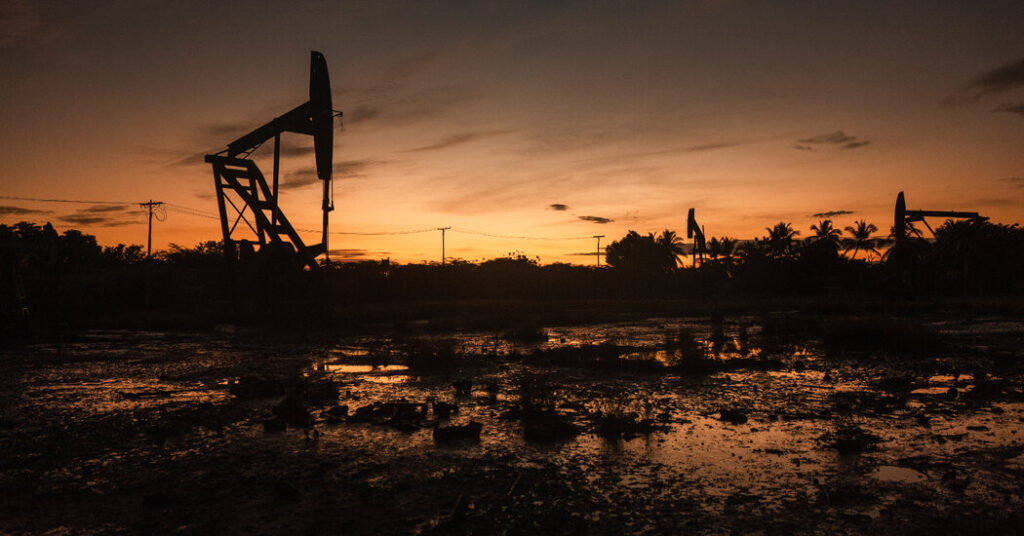
President Trump painted a picture over the weekend of how U.S. oil companies would dive into Venezuela after the ouster of President Nicolás Maduro and “spend billions of dollars, fix the badly broken infrastructure” and “start making money for the country.”
But Mr. Trump’s oil goals face formidable challenges.
A handful of Western producers with operations or deals in place in Venezuela could ramp up relatively quickly if the political conditions were right. But a more substantial revitalization of the country’s flagging oil and gas industry most likely would take years and tens of billions of dollars in investment.
The potential prize is huge — Venezuela boasts the largest oil reserves in the world — but so are the risks, and U.S. energy companies like Exxon Mobil and ConocoPhillips have been burned in Venezuela before. Oil prices are also low, having fallen more than 20 percent in the past year, making it harder for companies to justify new spending.
For now, two of the big questions facing oil companies are how Venezuela’s government will rebuild after Mr. Maduro’s capture, and whether the United States lifts the sanctions it has imposed to weaken the country’s economy.
“Not many companies are going to rush to go into an environment where there’s not stability,” said Ali Moshiri, who oversaw Chevron’s operations in Venezuela until 2017 and now runs a private oil company that has interests in the country.
Chevron, the largest private oil producer in Venezuela, and smaller operators could potentially help increase the country’s oil output to as much as 1.5 million barrels a day within 18 months, Mr. Moshiri said. That would cost up to $7 billion, assuming an estimated current level of around one million barrels a day, he said.
Still, that would leave Venezuela producing little more than 1 percent of the oil the world uses and less than half of what it was pumping in the late 1990s.
Further expansion most likely would take years. That is because a lot of Venezuela’s oil infrastructure is in disrepair, and even if producers express interest in returning, it would take time for them to negotiate contracts and reestablish a footprint in the country.
“So much depends on politics and who’s in charge,” said Daniel Yergin, a Pulitzer Prize-winning energy historian and vice chairman of the research firm S&P Global.
Some analysts drew parallels to Iraq, where it took years for oil production to recover after the United States invaded in 2003.
For now, Venezuela’s oil industry remains under U.S. sanctions, crippled by an aggressive campaign against many of the tankers used to export the country’s oil. Those restrictions will remain as the United States leans on the Venezuelan government to make policy changes, Secretary of State Marco Rubio said on Sunday.
“That’s a tremendous amount of leverage that will continue to be in place until we see changes, not just to further the national interest of the United States, which is No. 1, but also that lead to a better future for the people of Venezuela,” Mr. Rubio said on “Face the Nation” on CBS News.
Only Chevron has been able to regularly export oil in the weeks since the United States seized a vessel, called Skipper, on Dec. 10, according to TankerTrackers.com, which monitors global shipping.
The company holds a unique license from the Trump administration that has allowed it to continue operating in Venezuela and sending oil to refineries on the U.S. Gulf Coast. For that reason, it is widely seen as best positioned to increase production should conditions in the country stabilize.
Other energy companies that have maintained a presence in Venezuela include Italy’s Eni and Spain’s Repsol, which produce natural gas offshore from Venezuela, though U.S. sanctions mean they have not been able to export since last year. The U.S. Treasury Department also issued a license last year that would have allowed Shell, based in London, to restart work on an offshore Venezuelan gas field, although Venezuela later cut off negotiations.
Others, like Exxon Mobil and ConocoPhillips, left Venezuela after Mr. Maduro’s predecessor, Hugo Chávez, partly nationalized the country’s oil industry around 2007. Those companies have spent years trying, to little avail, to get Venezuela to pay them billions for the assets that the government seized.
More recently, Venezuelan officials have tried to smooth relations with some Western oil companies. Mr. Maduro’s government was negotiating an oil trading deal with ConocoPhillips as recently as last year, The New York Times has reported.
After Saturday’s seizure of Mr. Maduro, ConocoPhillips said “it would be premature to speculate on any future business activities or investments,” and did not specifically address the negotiations. Chevron has said it continues to operate in Venezuela “in full compliance with all relevant laws and regulations.”
Mr. Moshiri, the former Chevron executive, said that as a first step toward encouraging more foreign investment, the Trump administration would need to lift sanctions on Venezuela.
“The only silver bullet for turning around the economy today is oil investment,” he said.
Anatoly Kurmanaev contributed reporting.
Rebecca F. Elliott covers energy for The Times.
The post Reviving Venezuela’s Flow of Oil Will Not Come Easily or Cheaply appeared first on New York Times.