Dailenys Herrera left Venezuela as a teenager, dissatisfied with her higher education and job prospects. Now 21, she yearns to return to help her country rebuild and grow.
Virginia Ponte, 75, dreams of being able to regularly visit family in her home country without worrying about crime and corruption.
Gliver Ordosgoitti, 51, would like for Venezuelan consulates and embassies in the United States to reopen, and for U.S. airlines to be allowed to fly direct routes to Caracas once more, as they did before 2019.
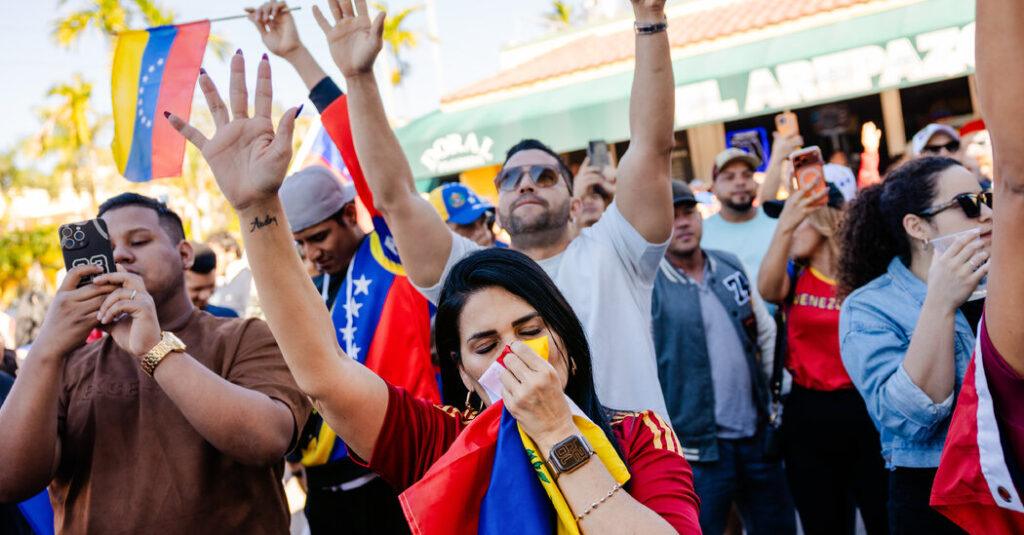
The American government’s seizure and removal of Venezuela’s leader, Nicolás Maduro, has instilled hope in Venezuelans and Venezuelan Americans in South Florida that they might go home again. It is a dream shared by many who have fled to the United States from other countries led by autocrats, where economies have crumbled and crime affects an outsized portion of the population.
What a return would look like is unclear, and for now, exists mostly as an embryonic thought among those celebrating Mr. Maduro’s removal. Few Venezuelans and Venezuelan Americans in Doral, the Florida city west of Miami with such a robust Venezuelan population that it is often nicknamed “Doralzuela,” spoke in concrete terms this weekend about moving back permanently. That was especially true for those who immigrated decades ago.
But if returning to their homeland once seemed impossible for Venezuelans, as it has for Cubans, Haitians and other immigrants who have fled to South Florida, it now suddenly appeared within reach.
“I dreamed of this every day,” said Yanira Ollarves, 53, a former flight attendant who left Venezuela two years ago.
That many Venezuelans and Venezuelan Americans welcomed Mr. Maduro’s seizure may have surprised President Trump’s critics.
Some world leaders and many Democrats questioned the legality of the American military action and expressed further alarm when Mr. Trump declared that the U.S. would “run” Venezuela for an indefinite period. Secretary of State Marco Rubio appeared to soften that assertion by Mr. Trump on Sunday, saying that the administration would keep a military “quarantine” in place on the country’s oil exports to exert leverage on the new leadership there.
Protests against Mr. Maduro’s extraction arose in several U.S. cities over the weekend.
South Florida, however, has more Venezuelans than anywhere in the United States. And with Latin American immigrants comprising much of the region’s population, there may be no force more powerful driving its culture, politics and identity than the shared longing for a home left behind.
Cuba has shaped Miami’s demographics and idiosyncratic politics for 67 years, as the island’s 1959 revolution and ensuing communist regime prompted waves of political exiles fleeing repression and immigrants seeking a better life across the Florida Straits. For decades, Cuban Americans have toasted on New Year’s Eve with, “Next year in Havana!” Disappointment with a failed C.I.A.-backed attempt in 1961 to invade Cuba’s Bay of Pigs and depose Fidel Castro remains palpable.
Miami’s remaining Cuban exiles and influential Cuban American Republican politicians — including Mr. Rubio, a former Florida senator and an architect of Mr. Maduro’s removal — have embraced Venezuelans fleeing the left-wing presidencies of Hugo Chávez and his successor, Mr. Maduro.
In some ways, the Venezuelan cause became the Cuban cause, though the comparison is imperfect. Many Venezuelans, unlike the earliest Cuban exiles, are allowed to return to their country; in practice, concerns about insecurity and possible political persecution keep many from going back.
The renewed conservative fervor among Cubans and Venezuelans in South Florida has also attracted immigrants from other Latin American countries with left-wing leaders, such as Nicaraguan Americans. That support helped Gov. Ron DeSantis of Florida and Mr. Trump flip Miami-Dade County from Democratic to Republican control in recent elections. Democrats have started to claw back some voters, winning the Miami mayor’s race last month in part because of apparent dismay with Mr. Trump’s immigration crackdown.
Miami-Dade County’s three Cuban American Republican members of Congress said they saw Mr. Maduro’s capture as a way of cementing Venezuelan American and other Hispanic political support for Republicans — and of putting the Cuban government on notice.
Representative Mario Diaz-Balart said at a news conference on Saturday night that he was convinced that the Cuban and Nicaraguan governments would not survive the last three years of the Trump administration.
Neither the members of Congress nor the Venezuelans and Venezuelan Americans who were euphoric about Mr. Maduro’s removal wanted to dwell on crucial outstanding questions regarding Venezuela’s future.
What would happen to the members of Mr. Maduro’s government who remain in power? What would any American involvement look like, and for how long? Would the United States government support the Venezuelan opposition leader and Nobel Peace Prize winner María Corina Machado, whom Mr. Trump seemed to dismiss on Saturday as not strong enough to lead the country?
Many people said they feared for the safety of their relatives and of political prisoners in Venezuela.
Fernando León, 61, predicted an onslaught of disinformation on social media. Jesús Naranjo, 57, said he worried that the old political establishment that dominated Venezuelan politics before Mr. Chávez would try to regain power.
But with no answers readily available, a new beginning was enough reason to celebrate.
“This is not something that is going to be resolved overnight, but at least we are on the right track,” said Jesús Roberto López Castillo, 58, a Venezuelan doctor who immigrated 10 years ago after what he described as political persecution and now lives in Miami Springs.
Monica and Justin Pease were among those who made their way on Saturday to a Chevron gas station in Doral that is home to El Arepazo, a well-known Venezuelan arepa shop. Accompanied by their dogs, Nutella and Marshmallow, Ms. Pease, who is from Venezuela, waved an American flag, and Mr. Pease, who is from the United States, waved a Venezuelan one.
Though the couple now lives in Charlotte, N.C., they had returned to Doral a few weeks ago to celebrate their marriage, which took place earlier last year, with family and friends. They had planned to return to Charlotte on Saturday but delayed their trip after learning of the military action in Venezuela through a family group chat on WhatsApp in the middle of the night.
“Everybody was a little afraid until we learned he had been captured,” Ms. Pease, 40, who immigrated in 2014, said of Mr. Maduro.
Her 97-year-old grandmother still lives back home.
“Two days ago, we never would have thought that I might be able to meet her,” said Mr. Pease, 42. “Now, I might.”
Patricia Mazzei is the lead reporter for The Times in Miami, covering Florida and Puerto Rico.
The post Returning Home No Longer Seems Out of Reach for Venezuelans in Florida appeared first on New York Times.