Maybe you’ve heard that the top of Mount Everest is garbage. Hopefully not metaphorically, especially since it’s pretty tricky to get up there from what I hear. It would be a shame if it were a disappointment.
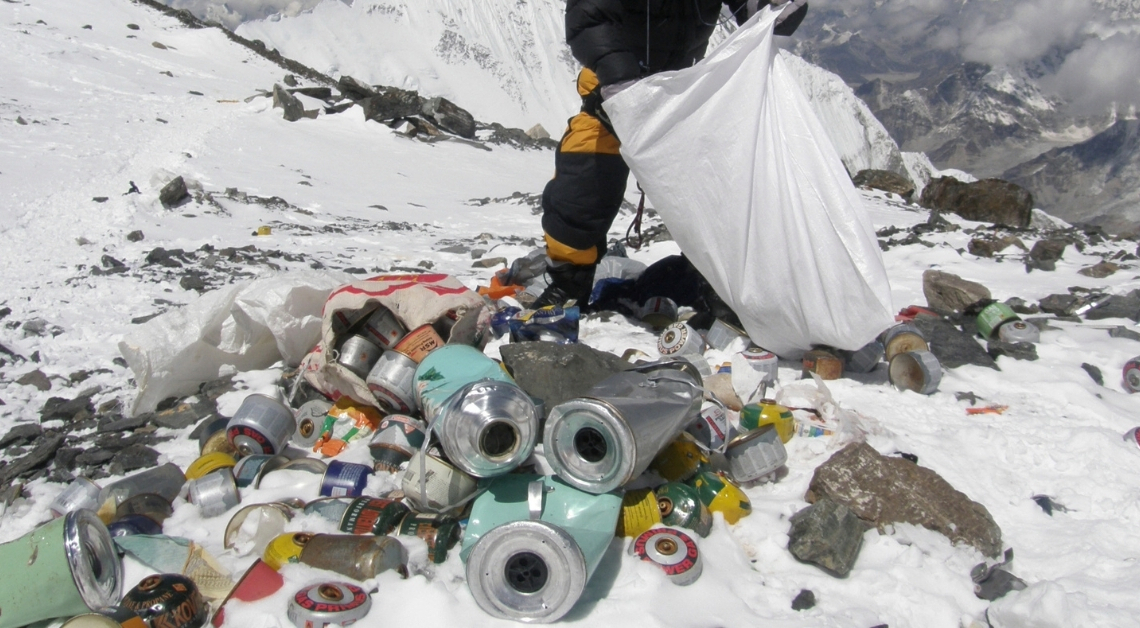
But, in a very literal sense, the peak of Mount Everest is littered with trash left behind from countless expeditions. Nepal tried to clean up the peak by implementing a fairly simple idea: require climbers to put down a $4,000 deposit, with a refund only if they carried at least 18 pounds of trash back down the mountain.
It didn’t work, so now Nepal is trashing that plan and starting over because it was way too much paperwork and bureaucracy—all for a mountain top that was still covered in trash after it all.
Nepal’s Attempt to Clean Up Everest’s Trash Fell Apart Fast
The BBC reports that Nepalese authorities are now admitting the program hasn’t worked. After 11 years, Everest is still estimated to hold 40 to 50 tons of waste, much of it concentrated at the highest and most dangerous camps. 40 to 50 tons of trash at a place supposedly hard to get to.
According to officials, the deposit system became an “administrative burden” and failed to produce measurable results. Most climbers got their money back, which means they technically complied. But mostly by hauling trash from lower camps, not the upper zones where debris is hardest to remove and most visibly piling up.
So that’s one loophole exploit. Here’s another: the average climber produces around 26 pounds of waste during a six-week ascent to the summit. The rule only required them to bring down 18, so you can see the discrepancy.
On top of that, enforcement was barely there because I don’t think there are many baton-swinging cops loitering up and down Mount Everest, fining litter bugs. There’s a checkpoint above the Khumbu Icefall, and then no one is keeping anyone in check after that.
Climbers are left to their own devices. According to a member of an organization that runs an Everest checkpoint, who spoke with the BBC, the only thing climbers are almost guaranteed to break down is oxygen containers.
Food containers, tents, and human p—s and s—t all stayed up there for other expeditions to clamber over.
Nepal is trying to pivot to a non-refundable $4,000 cleanup fee. That money would go into a dedicated conservation fund used to install monitoring checkpoints at higher camps, deploy mountain rangers, build waste-processing facilities, and, hopefully, restore a little gravitas to a once-lofty ambition that humans have, quite literally, s—t all over.
The change is part of a new five-year mountain cleanup plan aimed at making sustainability more realistic. And they better hope it works, because with 400 climbers every year and hundreds of support staff, the problem is only going to get worse.
The post Nepal Tried to Clean Up the Trash on Mount Everest. It Did Not Go Well. appeared first on VICE.