The cases of Nicolás Maduro, the Venezuelan president, and his wife will move on Monday from the secretive realm of military special operations into the mundane world of Federal District Court in Lower Manhattan, where at noon they are to stand before a judge and face charges of drug-trafficking conspiracy and other crimes.
Their appearance will be the first step in what undoubtedly will be a yearslong prosecution, after a stunning change of scene from Mr. Maduro’s presidential palace in Caracas to the grim and grimy reality of pretrial detention in a Brooklyn federal jail.
Because of the extraordinary nature of the case, what happens next will be predictable in some ways, and perhaps far less so in others.
The arraignment on Monday will occur before the presiding judge in the case, Alvin K. Hellerstein, and Mr. Maduro and his wife, Cilia Flores, are expected to enter pleas of not guilty. The judge will almost certainly order them detained. And it could be well over a year before a jury is seated to weigh the evidence against them.
But the prosecution of a leader of a sovereign nation snatched from his country in a highly choreographed military operation will most likely lead to arguments seldom heard in an American courtroom. Mr. Maduro’s lawyers might challenge, for example, the legality of his arrest and removal to the United States. They also could argue that as Venezuela’s leader, he is immune from prosecution.
What to Expect
Such initial hearings are often brief. Although the proceedings can vary, the judge will advise Mr. Maduro and Ms. Flores of their rights and ask how they plead.
The indictment released on Saturday charges Mr. Maduro with narco-terrorism conspiracy and conspiracy to import cocaine, among other counts. Ms. Flores is charged in the cocaine conspiracy. The charges carry stiff sentences if the defendants are convicted.
At the hearing, a prosecutor typically summarizes the evidence, such as recordings, documents and other materials seized in searches. There may be discussion of what kinds of motions the defense will file to challenge the government’s case.
The judge is likely to address the issue of pretrial detention, and under the circumstances, almost certainly will order that the defendants be held without bond pending trial. The defense can also raise concerns about conditions at the Metropolitan Detention Center, a troubled lockup that has held other high-profile detainees.
And the judge will ask the prosecutors and the defense lawyers how much time they will need to prepare for trial.
The Setting
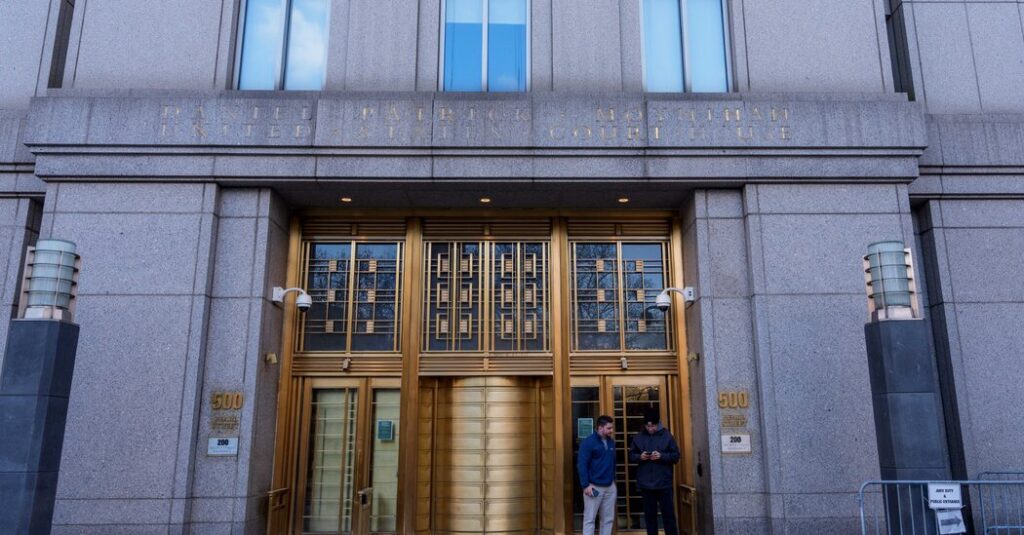
The case will play out in the Daniel Patrick Moynihan United States Court House, an imposing 27-story tower of granite, marble and oak on the edge of Chinatown. Security is always tight in and around the building, and Mr. Maduro’s presence there will doubtless bring a marked increase.
The court is part of the Southern District of New York, which has been the site of trials of accused terrorists, Mafia figures and corrupt politicians. A former Honduran president, Juan Orlando Hernández, was extradited to New York in 2022 and tried and convicted two years later in the courthouse. (Mr. Hernández was pardoned recently by President Trump.)
The Players
Prosecutors with the U.S. attorney’s office for the Southern District, led by Jay Clayton, will handle the case of Mr. Maduro and Ms. Flores. The charges stemmed from a lengthy and extensive investigation by the U.S. Drug Enforcement Administration.
Defense lawyers play a pivotal role in any criminal case. But because the Maduro prosecution is sure to raise difficult and complex issues — from the legality of his arrest to sovereign immunity to disputes over the possible role of classified evidence — his choice of lawyers and the strategy they chart will be crucial.
It is unclear who will represent Mr. Maduro and Ms. Flores. .
Judge Hellerstein, 92, was appointed to the federal bench in 1998 by President Bill Clinton and recently presided over President Trump’s attempts to move his Manhattan criminal conviction into federal court, a matter that is still pending.
The Stakes
For the government, the stakes of the prosecution of Mr. Maduro could hardly be higher. The Trump administration has made it clear that it went to extraordinary lengths to capture him in Caracas and bring him to New York to face trial, unleashing the full might of the U.S. military.
And the case is interwoven with aspects of President Trump’s domestic and foreign policies — which, like the attack Saturday morning, have come under harsh criticism.
His focus on immigration has leaned heavily into a narrative that frequently cites the Venezuelan gang Tren de Aragua — which Mr. Trump has tied to Mr. Maduro — as one of the reasons to pursue mass deportations. At the same time, the administration has pointed to the gang to justify its campaign of deadly military strikes on small boats in the Pacific and Caribbean hauling drugs it says are linked to Venezuela. The administration has designated Tren de Aragua as a foreign terrorist organization.
At stake for Mr. Maduro is his freedom. If convicted, he could face between 30 years and life in prison.
William K. Rashbaum is a Times reporter covering municipal and political corruption, the courts and broader law enforcement topics in New York.
The post Maduro and His Wife to Be Arraigned in Manhattan Federal Court appeared first on New York Times.