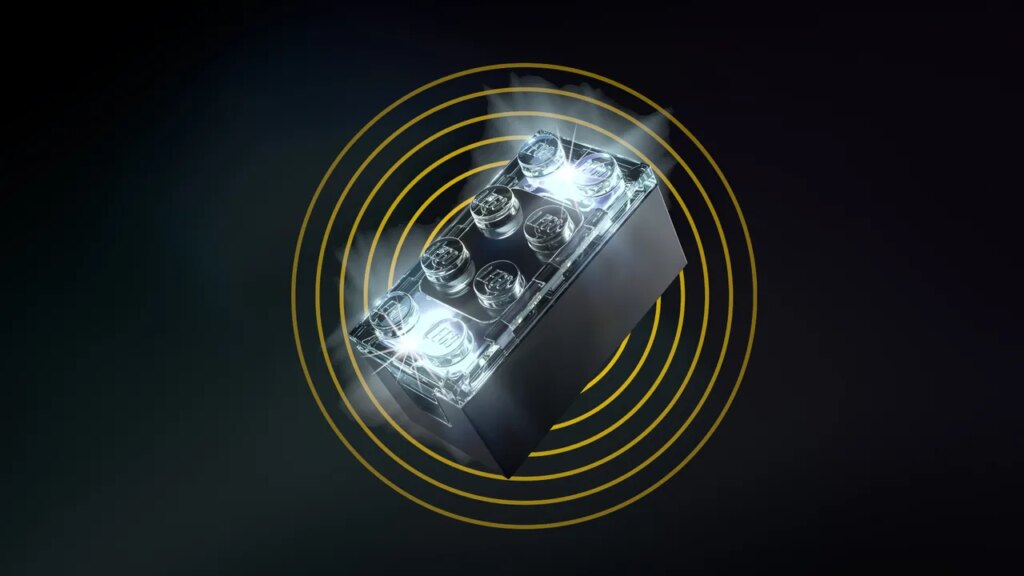
At CES in Las Vegas today, Lego has unveiled its new Smart Play platform, aimed at taking its distinctly analog plastic blocks and figures into a new world of tech-powered interactive play—but crucially one without any reliance on screens.
Smart Play revolves around Lego’s patented sensor- and tech-packed brick. It’s the same size as a standard 2×4 Lego brick, but it is capable of connecting to compatible Smart Minifigures and Smart Tags and interacting with then in real time. By pairing these components, kids big and small can create context-appropriate sounds and light effects as they play with the Danish company’s toys.
For example, launching on March 1, the $100 Lego Star Wars Smart Play Luke’s Red Five X-Wing 584-piece building set will feature two Smart Minifigs—Luke Skywalker and Princess Leia—plus five Smart Tags that will offer up laser-shooting sounds, engine sounds, and light effects, as well as refueling and repair sounds. All of the sounds are coordinated by the set’s central Smart Brick brain.
Two more Lego Star Wars Smart Play sets drop on the same day, but all three are available for preorder from January 9. One is a 473-piece Darth Vader’s TIE Fighter kit ($70) with ion engine sound effects, but the pick of the three could well be the $160, 962-piece Throne Room Duel set with three Smart Minifigures of Darth Vader, Emperor Palpatine, and Luke Skywalker. The combination of the brick brain plus connected figures will apparently let players recreate (or indeed rewrite) the final lightsaber battle—complete with humming laser sword sounds—between Luke and Vader at the end of Star Wars: Return of the Jedi. You can even listen to “The Imperial March” as Emperor Palpatine watches the fight from his throne.
Lego is claiming this Smart Play platform developed in house by the company’s Creative Play Lab team in collaboration with Capgemini’s Cambridge Consultants “features more than 20 patented world-firsts within its technology.”
The heart of the system is the Smart Brick’s custom-made chip, measuring smaller than a standard Lego stud. Other elements crammed into the eight-stud brick are an LED light array, accelerometers, light sensors, and sound sensor, and even a miniature speaker.
The internal battery will supposedly work even after years of inactivity, and to avoid any need for cable access to the Smart Brick once it’s built into a beloved creation, Lego has also added wireless charging. Indeed, Lego has made a charging pad that will power up several Smart Bricks simultaneously.
That all-important brain chip is a 4.1-millimeter custom mixed-signal ASIC chip running a bespoke Play Engine, which interprets motion, orientation, and magnetic fields. A copper coil assembly enables the brick’s tag recognition, while a proprietary “Brick-to-Brick position system” uses these coils to sense distance, direction, and orientation between multiple Smart Bricks.
Moreover, Lego claims this use of multiple Smart Bricks creates a “self-organizing network” that requires no setup, no app, no central hub, nor external controllers—and so no screens. A Bluetooth-based “BrickNet” protocol shares the data between the Smart Bricks.
Sounds are handled by a tiny analog synthesizer putting out real-time audio (thus minimizing memory load) via the brick’s miniature speaker, which uses the brick’s internal air spaces to amplify sound. As a result, the audio effects are apparently immediate and can be used to enhance play with real-time sound. Lego insists there are no pre-recorded clips of lightsabers or other pieces of audio being used as a cheat.
Just like the Smart Minifigs, the 2×2 studless tile tags trigger sounds, lights, or behaviors tied to where they are placed or how they are played with. They communicate with other components through near-field magnetic connections. Each tile has a unique digital ID, which is read by the brain brick, while the Minifigures—outwardly identical to standard Minifigs—carry their unique digital ID on an internal chip.
Of course, putting tech in famously analog children’s toys, especially in the LLM age, has led to worrying situations such as Kumma the AI bear that spoke of sex and pills when prompted in certain ways. Lego’s system, however, is not internet connected, and the company claims “enhanced encryption and privacy controls … meeting the high safety standards of the LegoGroup” have been employed to stop hackers attempting to program, say, sexual noises or saucy speech into the Smart Bricks.
History tells us that no system is completely safe, and while smaller scale toys and low-volume AI cuddly animals might not attract particular attention from the hacking community, something like Smart Play—where firmware updates and diagnostics are handled via a proprietary app—from a global company like Lego may well be an enticing target.
Katriina Heljakka, a researcher in play learning at the University of Turku, Finland, and a member of the International Toy Research Association, agrees that while any Lego tech will likely be as safe as possible, there is still cause for concern. “There has been a lot of conversation about ‘internet of toys’ and the risk of hacking into these systems, especially with AI. I can see a similar threat being introduced with hackers spying for opportunities to hack everyday items,” she says. “Lego will have done its utmost trying to make this not happen once these toys get in use, but the threat is looming.”
However, Heljakka feels that Lego’s Smart Play system could help the brand with criticism the company has been getting regarding leaning towards the adult consumer in recent years, making sets that seem to be more for display than play. The interactive and responsive elements in this new brick not only should encourage continual play of the same sets, but also multi-generational family play, too.
“Lego entered this market where they see adults can build decoration things, where it goes on the shelf, and that’s it. But I would say this kind of product could be successful as an intergenerational play item,” Heljakka says. “It connects parents and children to do something together, to make these kind of discoveries with the materials and technology. This might be the way to connect technology with a traditional toy like Lego and get families doing toy play together.”
The post Lego’s Smart Brick Gives the Iconic Analog Toy a New Digital Brain appeared first on Wired.