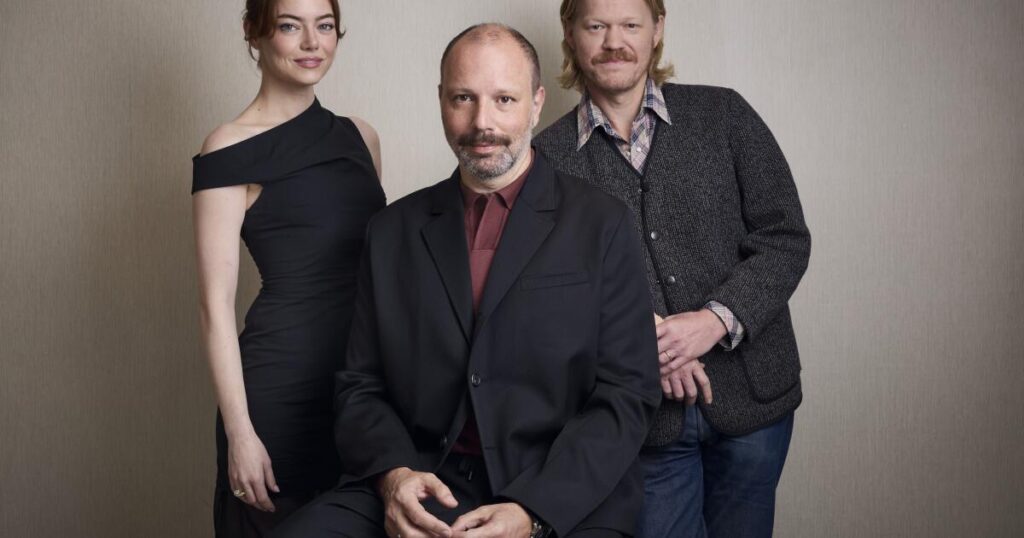
Jesse Plemons, in his thoughtful baritone, admits, “In hindsight, I think she kept me off-balance for the majority of the shoot in a way that I don’t think I could comprehend in the moment.” Then he turns to the other two people sharing the couch: “Why are you guys laughing?”
“No, I’m not,” says Emma Stone, failing to stay exactly stone-faced while pointing at a snickering Yorgos Lanthimos: “He thinks that I’m …”
“No, she — she —,” Lanthimos protests, trying unconvincingly to blame her.
Stone pulls it together and says, facing down her director, “I’m laughing because you’re thinking it’s funny. Because I knew immediately that Yorgos was going to be like — ” she (accurately) imitates his snicker in anticipation of what Stone was going to say in response to Plemons. Lanthimos looks indignant, but he’s caught.
“I laughed because she did,” he weakly claims, and there are more giggles.
And Plemons, suddenly the new kid in class again, outside the in-joke despite his second film with these two, declares, “That’s the end of the interview.”
These three very professional cinematic artistes are populating the couch in a swanky West Hollywood hotel suite to discuss their latest collaboration, “Bugonia,” Lanthimos and screenwriter Will Tracy’s adaptation of the 2003 Korean feature “Save the Green Planet!” In the film, the intelligent but troubled Teddy (Plemons) and his naive cousin Don (newcomer Aidan Delbis) kidnap Michelle (Stone), the chief executive of a major pharmaceutical company. They don’t want money; Teddy is convinced Michelle is an Andromedon — an alien from another star system who is an enemy to humanity.
The film is essentially a three-hander, Teddy going to harrowing extremes to force Michelle to confess, with poor, loyal Don caught in the middle. Its constantly shifting tactics and power balances live in the liminal space between wild theories and actual conspiracies. It’s a comedy.
“They’re all comedies,” Stone says, archly, looking for Lanthimos’ reaction to her assessment of his oeuvre. (He gives her nothing.) But she agrees with Plemons’ comments on common themes in the filmmaker’s work:
“Power dynamics, social control; the actual themes the films are exploring seem very simple and universal to me,” he says, “but the ways in which he’s exploring them are always askew.”
Stone adds, “Isolation and extremes. All three people are extremely isolated in different ways, whether it’s Michelle’s big house and being alone as CEO of this company, or the very different socioeconomic background of Teddy and Don and how their isolation can breed more extreme viewpoints, and vice versa.”
Sounds like hilarious stuff. But yes, there is plenty of humor in the high-stakes, high-tension, high-wire act that is “Bugonia,” with much conveyed in ways the actors relate through inflection or even without dialogue. This is a by-product of working in what feels like the Lanthimos Repertory Company (repeat offenders include Colin Farrell, Olivia Colman, Willem Dafoe and Rachel Weisz).
Stone says when she was the new kid, on “The Favourite,” she was daunted at first, but “We all bonded so quickly because of [his] rehearsal process. I fell in love with the way it all felt and the freedom of it.”
Stone and Lanthimos followed that with “Poor Things” and a role requiring utter fearlessness, freedom and trust. As the creature who hoists men on their own petards in the ferociously feminist Frankenstein fable, Stone won her second Oscar.
Lanthimos says, “I knew after working with her [on ‘The Favourite’] that it was something we could build on and go further. I always hated that notion that there’s a character written a certain way, and you’re looking for someone that can fit that thing. I like to find people that I like in general and I like their work and make the character fit them.
“It was the same with Jesse. We did ‘Kinds of Kindness’ and there was no second thought of whether to ask him to do ‘Bugonia.’ When you find something so valuable, you don’t let it go easily. You make everything work around that. People are the most important thing in filmmaking.”
The director sent Stone “Bugonia” before agreeing to do it because “I trust her judgment and her opinion.” Lanthimos and Stone have now made four features together, though the three joke it’s more like six because “Kinds of Kindness” is a triptych. So Plemons has either made two or four films with them, though Lanthimos is quick to point out he’d cast him in another the actor had to back out of, so “You could have had a fifth film in the bag!”
“We’re not unique at all,” says Stone of her and Lanthimos’ desire to get Plemons in the fold. “All great directors want to work with Jesse. [Every] actor wants to work with Jesse.”
When Plemons got the script for “Kinds,” as eager as he was to work with Lanthimos and Stone, he says, “Part of me was like, ‘G—, why couldn’t it have been just one part, something easier?’ But I loved the script. I didn’t know why it affected me, but it really did in a visceral and confusing way. I had heard a bit about this rehearsal process, and the part of my mind that needs to understand was just haywire during those first few days.”
He says the vets helped him, then “maybe the third day, something shifted in my mind. When you’re seeing these other actors throw themselves into these silly games with full abandon, it encourages you to do the same.”
Lanthimos explains, “First, there’s warming up; it is more like a dance theater company troupe. During that, you get people interacting with each other, finding their rhythm.”
He thinks up a possible exercise: “You could have people walking next to each other really closely and doing rounds within the room and they do it faster and faster and they have to be exactly the same distance to each other. And then we read a scene and someone mentions water and I go, ‘Both of you pretend you’re drinking water; you’re swallowing the whole time as you’re saying the text.’
“It makes it light. You don’t take yourself too seriously. You don’t take the material seriously. You’re gargling and doing lines, whatever. It’s a way of the actors getting the dialogue in them in an unconscious way, not fixed with a kind of intellectual baggage, so it’s freer and it has more possibilities. And they feel comfortable with each other.”
“There’s some mirroring too,” Plemons says. “It forces you to get out of your head and be more focused on the other actors.”
The intense scrutiny under which the characters in “Bugonia” place each other as they jockey for position demands extreme trust and listening.
“A lot of these stories require a fair amount emotionally but also physically,” adds Stone. “We become comfortable physically with each other and emotionally — not feeling embarrassed at being close, or whatever. It feels like you’ve been there already.
“If the four of us were to do that [walking exercise Lanthimos just dreamed up] right now, we would have a slightly different relationship 10 minutes from now.”
The post Inside the ‘silly games’ that fueled ‘Bugonia’ behind the scenes appeared first on Los Angeles Times.