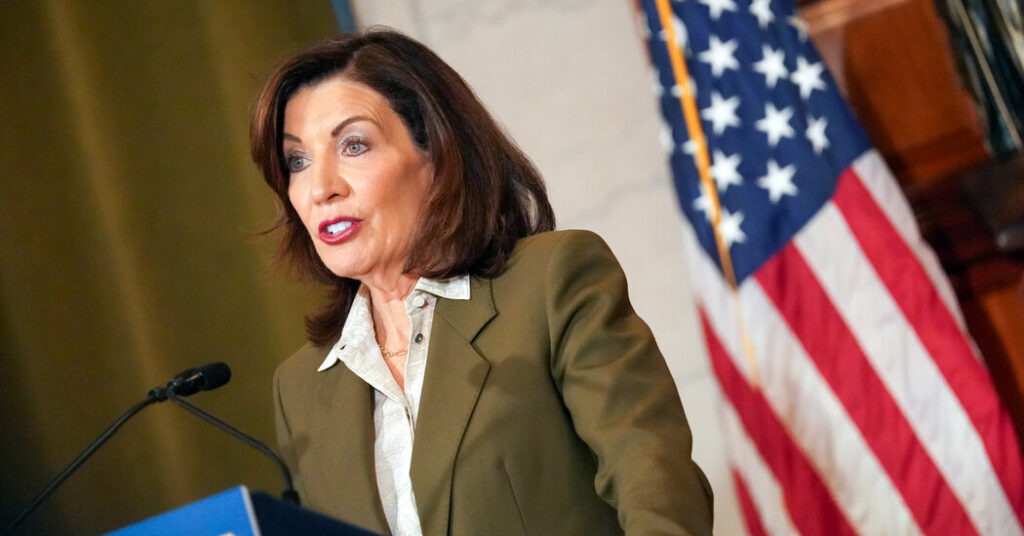
Gov. Kathy Hochul will propose new privacy standards for young New Yorkers online, including safeguards that would automatically bar strangers from viewing, tagging or messaging minors.
The proposed restrictions, which would be among the most stringent in the nation, come after numerous reports of children facing enticement and exploitation from adults on platforms like Roblox and Discord.
The proposed legislation would require parental approval to override the limits on strangers interacting with minors. It would also impose new restrictions on minors connecting with A.I. chatbots after tragedies like the suicide of a Florida teenager who fell in love with a chatbot.
“The well-being and safety of our children is personal to me,” Ms. Hochul said in a statement. “Today, we are breaking new ground to give kids the tools and safeguards they need to navigate unprecedented mental health challenges and real-world dangers in today’s digital landscape.”
The measures will be a part of the governor’s State of the State proposal on Jan. 13, when she unveils her agenda for the year.
Ms. Hochul, a Democrat, is aiming to build on her record of creating safeguards for children as she runs for re-election in November. During her first term New York, she has passed nation-leading legislation to regulate social media companies’ use of algorithms on children, advanced A.I. restrictions and banned the use of cellphones in schools.
This proposal would expand some of those safeguards by extending the requirement that social media platforms verify users’ ages to online gaming platforms, and by requiring that children under the age of 13 receive parental approval before they can accept friend requests.
It would also create new safeguards around financial transactions. To keep children from racking up large on-platform bills, Ms. Hochul has proposed monthly spending caps for minors.
She is also pushing for new restrictions on the kind of financial gifts that minors can receive on platforms like Roblox, where abusers have been able to groom and exploit children by requesting pictures in exchange for online currency. Roblox, which is based in California, has been the subject of dozens of lawsuits from families, nearly 80 of which were consolidated into one San Francisco case in December of last year.
Those plaintiffs say that child predators use online games on platforms like Roblox to identify and connect with young people, ultimately coercing them into sharing sexually explicit content. Many lawsuits also name other apps including Discord and Snapchat, where they say the conversations continued.
Representatives for Meta, Discord, Roblox and Snap did not immediately respond to requests for comment.
State attorneys general in Texas, Kentucky, Florida and Louisiana have also filed lawsuits against gaming platforms, which they say have not taken sufficient action to protect minors.
State Senator Andrew Gounardes, a Democrat who has proposed legislation that partly inspired Ms. Hochul’s proposal, said that while some companies had protections in place, they were inconsistent.
“A conversation on Roblox might transition to Facebook Messenger, might transition to Discord, or whatever else,” he said, “We should have the same consistent standard across the board.”
On top of the regulatory framework, the package would also include additional funding to expand a program that trains teenagers to recognize mental and substance abuse crises.
Ms. Hochul is hoping to make this emotional first aid training available to all 10th graders across the state.
It is a proposal that is broadly popular across partisan lines. Previous online safety measures like the Safe for Kids Act passed the State Legislature nearly unanimously, and even President Trump’s executive order on A.I., which was seen by many as deferential to industry, mentioned the importance of protecting children.
Even so, Mr. Gounardes, who sponsored both the Safe for Kids Act and the RAISE Act, both of which faced significant objections from industry, said he was prepared for a fight.
“These companies do not like being told what to do,” he said.
Instead, they liked to do what was best for them, he added, “by trying to convince us that it’s the best thing for us.”
Grace Ashford covers New York government and politics for The Times.
The post Hochul to Press for New Safeguards to Protect Children Online appeared first on New York Times.