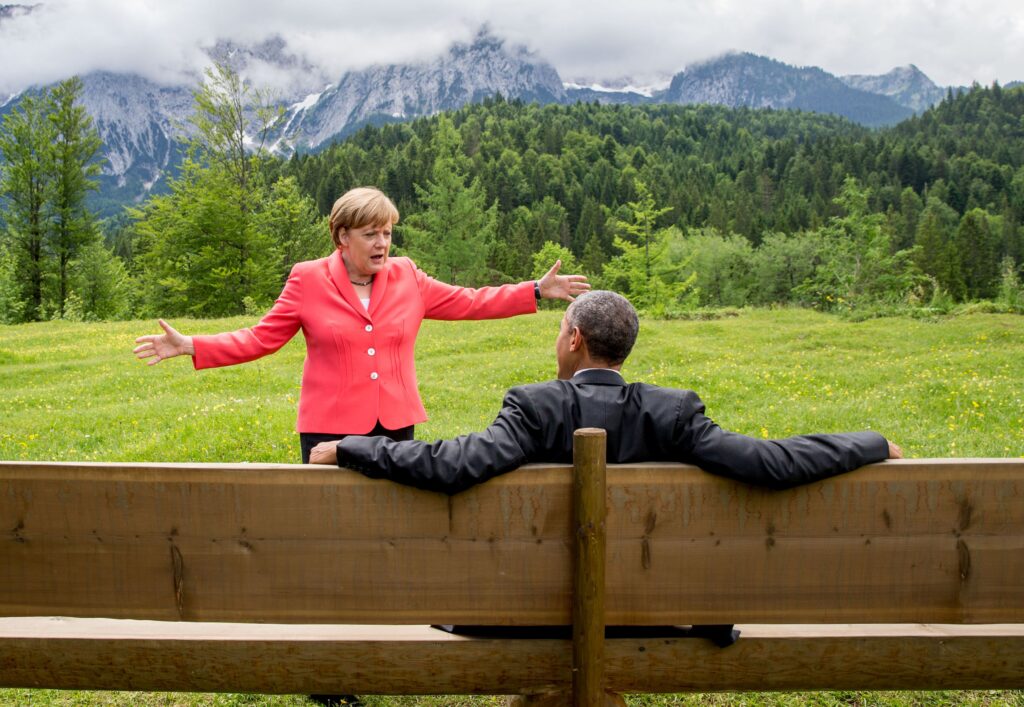
German political leaders were incensed when they learned in 2013 that U.S. intelligence had been eavesdropping on Chancellor Angela Merkel’s phone calls. “Spying among friends, that just does not work,” Merkel said.
At roughly the same time, however, Germany’s foreign intelligence agency was listening in on some of President Barack Obama’s calls on Air Force One, according to a new book about the relationship between Germany and the United States.
The intelligence agency, called the Bundesnachrichtendienst (BND) discovered that some calls on Air Force One were unencrypted and it was able to tap into radio frequencies that were used for those calls, according to the book, “The Grown-Up Country: Germany Without America — A Historic Opportunity,” by Holger Stark, a German journalist.
As a part of a reporting team for Der Spiegel, Stark revealed the eavesdropping on Merkel based on information leaked by CIA contractor Edward Snowden, who fled to Russia. In the new book, published Monday in German, Stark writes that transcripts of Obama’s intercepted calls were presented to the BND’s president in a secret folder. The book cites sources who told Stark that they saw the transcripts before the documents were shredded.
A former senior German administration official confirmed to The Washington Post that verbal reports of the Air Force One surveillance circulated in the chancellor’s office at the time. The intelligence gained was described as “incidental bycatch,” rather than a deliberate operation targeting the president, according to the official, who spoke on the condition of anonymity to discuss sensitive matters.
Stark, who is now deputy editor of the newspaper Die Zeit and a former U.S. correspondent for the paper, writes in his book that encrypting calls aboard Air Force One was technically difficult, so in-flight calls were made on about a dozen frequencies. The BND monitored these frequencies, Stark writes: “not always all of them, and not around the clock — but systematically enough to intercept conversations of the U.S. president (and other American government and military officials) on several occasions.”
“Eavesdropping on the president, even if only occasionally, had the potential to become a foreign policy scandal of considerable proportions,” Stark writes, noting that Merkel’s office was not initially informed of the intelligence-gathering.
The existence of the secret folder became public during a German parliamentary inquiry committee into the BND in 2014 and 2015. But according to Stark, “the BND managed to keep its biggest and most politically sensitive target under wraps: Barack Obama.”
Aides to Obama did not respond to a request for comment.
BND spokeswoman Julia Linner said in an email that the BND “generally does not comment publicly on matters concerning potential intelligence findings or activities,” and that the agency instead reports on these topics only to the federal government and to parliamentary committees in closed-door meetings.
German intelligence is known to have monitored other U.S. politicians in the past.
In 2014, German media reported that the BND had wiretapped at least one of Hillary Clinton’s conversations when she was secretary of state, based on documents given to the CIA by a BND spy who was arrested that year for allegedly passing intelligence to Americans.
According to the reports, then-Secretary of State John F. Kerry and Obama’s Chief of Staff Denis McDonough raised this alleged wiretapping with their German counterparts.
Eavesdropping on the U.S. president, however, represents a more controversial level of spying on a close ally especially because relations between the United States and Germany were not nearly as strained as today. It was also a time when Germans and other Europeans were widely critical of U.S. surveillance of European leaders and citizens.
After reports emerged that she had been spied on, Merkel told Obama in a phone call that if the allegations were confirmed, she “unequivocally disapproves of such practices and sees them as completely unacceptable,” her spokesman said at the time.
“Spying on close friends and partners is totally unacceptable,” German Foreign Minister Guido Westerwelle said the next day after meeting with U.S. Ambassador to Germany John B. Emerson.
Privacy is sacred to Germans, some of whom lived in the surveillance state of the East German Stasi. Germany and the European Union have taken a tougher approach to regulating tech giants than the United States, drawing the ire of top officials in the Trump administration.
After the Merkel spying news broke, the chancellor attempted to smooth over relations between the Americans and the Europeans. “The United States and Europe face common challenges,’’ she said, sounding much like European leaders today. She added, “Trust has to be restored.’’
The post Germany eavesdropped on some Obama calls from Air Force One, book says appeared first on Washington Post.