

Recruiting new Marines can be so challenging in parts of the US that some recruiters have resorted to fraud to meet their monthly goals.
Business Insider obtained a 2023 Marine Corps investigation into one area of the Rust Belt that found widespread rule-breaking, including fabricated police records and fake medical notes. Two recruiters who were fired as part of the probe spoke to Business Insider about the pressures of recruiting and what drove them to fake records. One of them, Staff Sgt. Calvin Grimes, shared a collection of electronic templates that helped fellow recruiters forge doctors’ notes, high school diplomas, and other documents.
“You have to live with that feeling that your heart’s beating out of your chest ready to explode,” former Gunnery Sgt. Logan Krivak said of falsifying records. “You know it’s wrong, and you just have to live with that.”
Overall, 10 Marines who recruited in the region between 2018 and 2024 told Business Insider they faced a desperate struggle to hit their quotas of signing up two new recruits each month. Five admitted to taking shortcuts or falsifying records. The others said they knew fraud was happening within recruiting ranks. In 2021, all the leaders in one recruiting hub were relieved for fraud, or for failing to catch it, sources told Business Insider.
The Rust Belt issues spotlight a problem that persists in some areas today, recruiters told Business Insider.
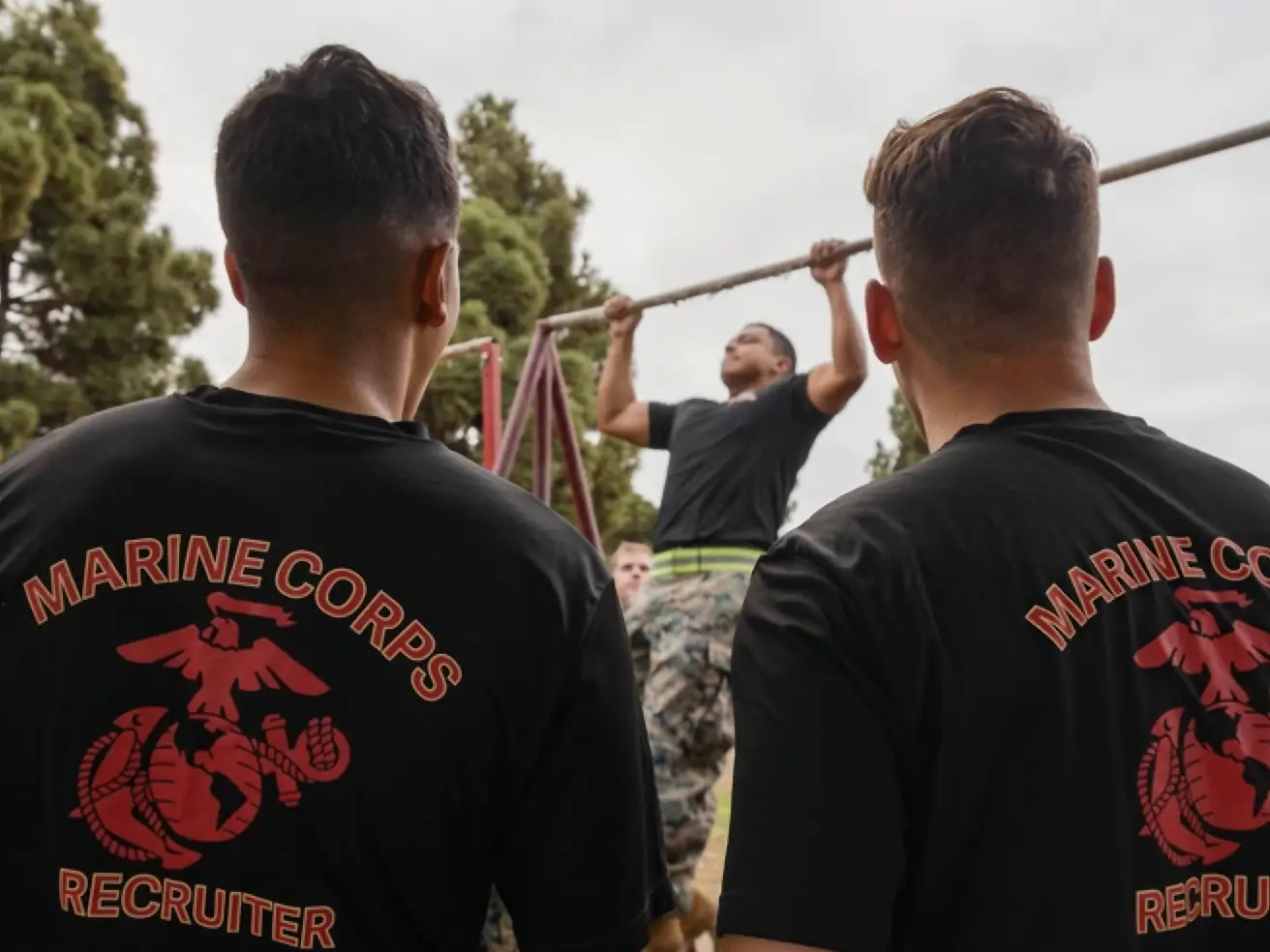
Fraudulent enlistment, or “fraud,” involves false claims in the recruiting process by a recruit or recruiter. It can include hiding the truth, forging a missing signature, fabricating official documents, or bypassing waivers.
These shortcuts can help recruiters avoid delays that could stop them from meeting their goals. But they carry risks: They can derail a recruit’s career or jeopardize their health, and for recruiters, falsifying records is a violation of military law.
“It weighs on anybody who has a conscience,” one current recruiter working in the Northeast said of such rule-breaking. “You start walking that line into that gray area, and you have to figure out where your hard line is in the sand.”
A forged police document kicks off an investigation
The 2023 investigation, being revealed for the first time by Business Insider, focused on the 4th Marine Corps District, which covers the Rust Belt and parts of Appalachia.
It was a tough region for recruiters to meet their monthly goal; then the pandemic hit, making it even more of a challenge, said Krivak, who recruited in the region from 2015 to 2018 and returned in 2020.
He said his first stint was brutal but survivable. He recalled regularly meeting his quotas, at times even exceeding them. Krivak said he never engaged in fraud on his first tour — his superiors rigorously condemned it. When he returned during the pandemic, motivated by the stability the job could provide, things had changed.
This story is part of a Business Insider investigation into Marine recruiter welfare. Read the first installment:
Stay tuned for parts three and four:
- ‘Burden of command’: How a brutal recruiting mission broke some Marines leading the charge
- The military is running out of teenagers to recruit — and old-school methods to reach them are failing
A fresh source of stress was Military Health System Genesis, a newly rolled-out medical data system that flagged potential recruits’ medical histories. The system halted processing for applicants with issues that could make service dangerous, such as asthma or heart problems. It also flagged seemingly minor problems — such as surgical scars or broken bones from a decade earlier, which tangled recruiters in a web of administrative roadblocks.
In the crunch to hit monthly recruiting quotas, recruiters like Krivak felt they couldn’t afford to wait weeks for medical waivers that would override the Genesis flags. COVID had already restricted access to high schools, straining relationships with teachers and students, and making recruiting even more difficult. Krivak’s territory proved dismal hunting grounds.
Even solid candidates could present unexpected challenges, Krivak said. For example, he said, in areas riddled with drug problems, recruiters could struggle to get a teen’s non-sober parent to sign off on enlistment.
He recalled being asked for a police document in 2022 to verify that an applicant’s tattoos weren’t gang-related. He said he was given several hours to obtain the document, and that the short timeline made it feel like he was expected to fake the document.
“That’s not asking you to do this the right way,” he said.
Krivak forged the document, he said, arousing suspicion at a higher level upon inspection, the investigation found. Later relieved of duty and punished for the forgery, he ultimately left the Marine Corps.
Widespread rule-breaking is uncovered
Krivak’s forged document helped kick off a deeper examination into fellow recruiters, including Grimes, who maintained the electronic templates for falsifying documents.
The templates, which were referenced in the investigation, could be modified to create false hearing test results, high school diplomas, or doctors’ notes clearing applicants of old medical issues. Grimes shared the templates with Business Insider.
In his statement for the 2023 investigation, Grimes said that he had been tacitly encouraged to engage in such deceit from his very first month on the job. He said a supervising recruiter told him, “You have to do what you have to do to be successful.”
For Grimes, who was also relieved of duty, fraudulent activity had become the norm, a response to what he and others described as dismal recruiting conditions exacerbated by the pandemic. Fraud, he said, was a way to process applicants faster and give exhausted and overworked subordinates a break.
“Talk to Grimes,” some fellow recruiters would say when a tricky case needed help, Grimes and others recalled.
Both Grimes and Krivak now work in the private sector.
How the Corps addresses fraud
Fraud isn’t ubiquitous across the Corps, recruiters said; it tends to be concentrated in areas where recruiting pressures are highest.
Some current and former recruiters outside the Rust Belt told Business Insider that they had never witnessed fraud. Others said fraud has always existed, though only in small circles. All condemned it and agreed that most of the time, fraud involved shortcuts that didn’t jeopardize health or safety.
Fraud only works with a level of plausible deniability, recruiters said, and must be tightly guarded. When others outside the circle, especially officers, get wind of it, things can unravel quickly. The Corps is swift to punish those who are caught.
Some fraud, like a fudged signature or a fabricated diploma, is unlikely to harm an applicant’s health. Rarer, more serious examples — which Grimes confessed to in the investigation and to Business Insider — risked putting a recruit’s health in jeopardy, such as fake lung or heart health assessments.
Recruiters told Business Insider that committing fraud left them with guilt, anxiety, and regret. Some described becoming numb to it, saying that shipping fraud-tinged applicants to boot camp earned them a pat on the back for helping their unit reach its goals. Other Marines who refused to engage in fraud said they struggled, facing pressure to succeed when others seemed to be cheating the system.
Business Insider is reporting on how recruiting practices and policies are evolving across the US military. If you have insight into current challenges, emerging trends, or future-focused initiatives, we’d like to hear from you. Reach this reporter securely on Signal at kelseybaker75.75 or by email at [email protected].
Grimes and Krivak said they struggled to reconcile their punishment with the belief that their supervising officer knowingly allowed fraud to thrive — though the investigation disputes these beliefs.
“I think there is a cultural acceptance in some areas that is willing to sacrifice the Marine for the mission,” when it comes to fraud, said a former recruiting supervisor who remains on active duty.
A Marine Corps Recruiting Command spokesman told Business Insider that “independent quality control” checks throughout the enlistment process serve as guardrails to help mitigate fraud, along with a “rigorous” records review for recruits upon arrival at boot camp.
“The Marine Corps does not condone or allow fraud by Marines or by applicants seeking to enter the Marine Corps,” the service told Business Insider. “Those who violate ethical regulations or law are held to account.”
Some things have improved since the pandemic, insiders said, which has helped to alleviate pressure on recruiters. Over the last two years, MCRC underwent an overhaul, opening more hubs in the “Southern Smile,” like Florida and Texas, where a prevalence of young people means a broader pool of potential recruits.
The military has also streamlined the waiver process for Genesis, a spokesman said, acknowledging “early implementation contributed to delays and uncertainty at a time when the recruiting environment was already under extraordinary pressure.” Several current recruiters confirmed to Business Insider that the process has improved.
Recruiters and their immediate supervisors — “career recruiters” who stay on the job after a yearslong appointment — told Business Insider that records fakery in one form or another is often still present in areas facing the toughest recruiting conditions — driven by pressure to succeed, meager recruiting pools, and above all, desperation and stress.
“You tell somebody, ‘Hey, this is your job. And if you don’t do it, your career’s over.’ There’s a pressure there,” said a former senior official, who likened it to quicksand drawing Marines into dark places.
“The answer that comes down from higher on how we are going to make mission is to do more prospecting and to find better qualified applicants like we used to before” the pandemic, Grimes wrote in his statement as part of the 2023 investigation. The reason many recruiters engage in fraud, he said, is to reduce excess pressure. But such relief never came.
“The answer,” he wrote, “is always ‘do more.'”
Read the original article on Business Insider
The post Fake records and forged signatures: Marines say recruiting pressure fueled a culture of fraud appeared first on Business Insider.