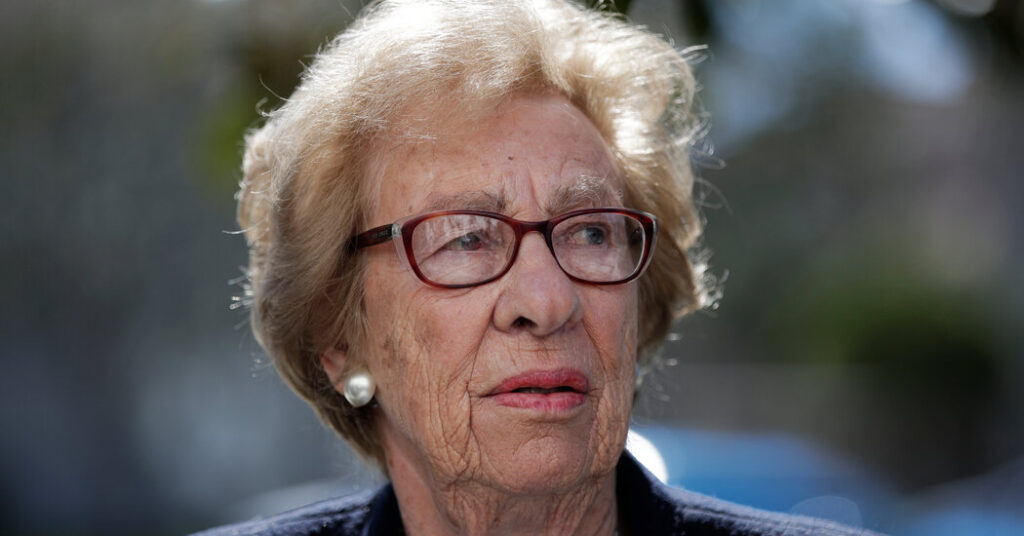
Eva Schloss, an Auschwitz survivor who dedicated her life to speaking out against prejudice and to preserving the legacy of her stepsister Anne Frank, died on Saturday at a care home in London. She was 96.
“We hope her legacy will continue to inspire through the books, films and resources she leaves behind,” Ms. Schloss’s family said in a statement published by the Anne Frank Trust UK, an organization she co-founded to challenge intolerance and educate young people about the Holocaust. After World War II, her mother married Anne Frank’s father, Otto, the sole survivor of the Frank family.
For more than 40 years, Ms. Schloss remained silent about the horrors she endured at Auschwitz, the Nazi death camp to which she had been deported as a teenager. When her grandchildren once asked about the tattoo on her arm that she had been branded with at Auschwitz, A5272, she told them it was her telephone number, she wrote in her memoir, “After Auschwitz.”
It was not until 1986, when she was invited to speak at the opening of a traveling Anne Frank exhibition in London, that she began to tell her story publicly. From that point on, and into her 90s, she traveled widely to speak about the dangers of injustice, particularly to young people in schools and prisons.
In 2019, when she heard about students at a school in California who had been photographed giving a Nazi salute while standing in front of several dozen red cups arranged in the shape of a swastika, she decided to have a private meeting with them.
“I think they really didn’t think about the consequences, but I think they have learned a lesson for life,” Ms. Schloss, then 89, said at the time. She had been on a tour of the United States for several weeks speaking out against prejudice.
King Charles III, in a statement on social media on Sunday, wrote that the horrors that she endured as a young woman were “impossible to comprehend and yet she devoted the rest of her life to overcoming hatred and prejudice, promoting kindness, courage, understanding and resilience through her tireless work for the Anne Frank Trust UK and for Holocaust education across the world.”
Eva Geiringer was born in Vienna on May 11, 1929, to Jewish parents. Her father, Erich, a shoe manufacturer, married her mother, Elfriede, known as Fritzi, in 1923.
Ms. Schloss recalled in her memoir the night of the German annexation of Austria in 1938, when German troops rode into Vienna. She remembered how German soldiers were welcomed into the city with ringing church bells and cheering crowds, while flags with red swastikas were unfurled from buildings.
The family fled to Amsterdam, where they became neighbors of the Franks. Ms. Schloss and Anne Frank, who were a few months apart in age, would play together, according to the Anne Frank Trust UK.
The Geiringer family was forced into hiding in 1942, on the same day as the Franks. Ms. Schloss’s family evaded capture for two years, until May 11, 1944 — Ms. Schloss’s 15th birthday. The Gestapo stormed into the home after a Dutch nurse pretending to help them had reported them, and the family was sent to Auschwitz.
Ms. Schloss and her mother were freed by Soviet forces in 1945. Ms. Schloss found out that her father, Erich Geiringer, had been killed on May 4, 1945, days before the Germans surrendered, and that her older brother, Heinz Geiringer, was killed the month before that, according to the U.S. Holocaust Memorial Museum.
In an interview with the Jewish magazine Lilith, Ms. Schloss said that her brother, on the deportation train to Auschwitz, had told her about paintings that he had made while in hiding that he had hidden under the floorboards. Ms. Schloss recovered her brother’s paintings after the war and donated them to the Dutch Resistance Museum.
Ms. Schloss’s second book, “The Promise,” one of three she wrote about the Holocaust, was about her brother. “Nobody knows about his life, what he has achieved in his short life,” she told Lilith in the 2017 interview. “So I realized I’d write a book about him, so that he is remembered.”
After the war, Ms. Schloss moved to London, where she studied photography. She married Zvi Schloss, an Israeli economics student, in 1952. A year later, her mother, Fritzi, married Otto Frank. The two were bonded by their grief. Otto gave Ms. Schloss, who became a professional photographer, the Leica camera that he had used to photograph Anne and her sister, Margot.
Ms. Schloss said in the interview with Lilith magazine that she became an atheist and stopped believing in God after her release from Auschwitz.
“If our God is powerful and a ‘good’ God, how could he tolerate that? So, I also didn’t believe in humanity,” she told the magazine. “I was rudderless and I was very, very, very miserable.”
But Otto Frank was not bitter, she said, adding that she learned from him. “He would say, ‘Hate won’t take you anywhere,’” she recalled. “I eventually experienced that this was true and that’s what I’m trying to do — to see the good in people. You will find kind and amazing people.”
Ms. Schloss’s survivors include her daughters Jacky, Caroline and Sylvia, as well as grandchildren and great-grandchildren.
Jenny Gross is a reporter for The Times covering breaking news and other topics.
The post Eva Schloss, Anne Frank’s Stepsister and Auschwitz Survivor, Dies at 96 appeared first on New York Times.