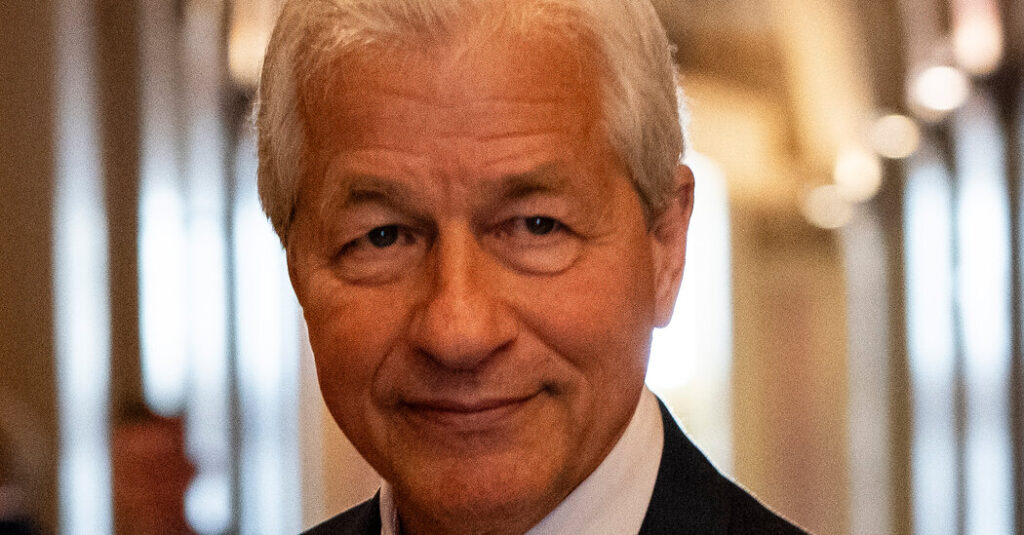
For nearly 15 years, Jamie Dimon, the bank chieftain, has carried around what might as well be a talisman when he sees regulators, elected officials and journalists.
At just the right time in meetings, he breaks out a single-page printout that he calls a “spaghetti chart.” On it, Mr. Dimon’s underlings have crammed, in tiny type, a comically complicated flowchart meant to represent the various laws and regulations to which his company, JPMorgan Chase, is subject.
The theatrics have finally worked.
The Trump administration is not just taking apart regulations but attacking whole regulatory agencies that date back to the 2008-9 financial crisis and were meant to keep banks from giving in to their worst impulses. Regulators have also made it easier for banks to peddle in risky assets again, like cryptocurrency, and President Trump paused enforcement of foreign anti-bribery rules.
The deregulatory bonanza alone makes it the best time in a generation to be a banker.
But there’s more! Falling interest rates and a permissive set of antitrust overseers are helping reverse a lull in the lucrative business of arranging mergers and acquisitions, as the $100 billion bidding war between Netflix and Paramount for Warner Bros. Discovery shows. Once imperiled real estate loans look steadier, thanks to the rebound of in-office work. Stocks are near record levels, the bond market had its best year since 2020, and gold and silver have soared — all of which feeds the trading businesses that keep Wall Street’s profit machine humming.
In other words, as analysts at Keefe, Bruyette & Woods recently put it, there is “something for everyone.” Big bank stocks rose 29 percent in 2025, almost doubling the gain of the U.S. market overall. Smaller lenders and community banks, which tend to have a narrower focus on areas such as residential mortgages and consumer checking accounts, also gained, but performed considerably less well.
For Mr. Dimon and his counterparts, this means paydays closer to the scale of hedge fund managers or Silicon Valley start-up founders than the caretakers of old-line lenders.
A combination of salary, bonuses, dividends, stock grants and appreciation in his allotment of the bank’s shares yielded roughly $770 million in 2025 for JPMorgan’s chief executive, according to the company’s disclosures. The bank’s stock rose 34 percent last year.
For the chief executives of Citi, whose shares rose more than 65 percent in 2025 after the bank slashed tens of thousands of jobs in a yearslong restructuring, and Goldman Sachs (shares up 53 percent), the paydays were more than $100 million each. The chief executive at Capital One (shares up 36 percent), Richard Fairbank, made more than $300 million, including proceeds from stock he sold during the year. His compensation included a $30 million bonus after the Trump administration waved through the lender’s acquisition of Discover Financial.
For all the executives, the totals include some amount of gains from stock that they haven’t yet sold and that they will have to remain in their jobs to fully collect. Most of Mr. Dimon’s haul, for example, came from a combination of dividends and appreciation on the company stock he owns; for Goldman’s chief, David M. Solomon, and Citi’s Jane Fraser, last year’s earnings were more evenly split between salary and bonuses, and appreciation in shares they already owned.
A spokesman for JPMorgan said a portion of Mr. Dimon’s gains could be traced to shares that he bought voluntarily as far back as two decades ago, as opposed to his regular awards from the bank’s board, which he leads. Representatives for Citi, Goldman and Capital One declined to comment.
It’s not yet clear what the hundreds of thousands of lower-level employees will earn in total, as banks typically give out annual bonuses in January. Johnson Associates, a pay consultancy, expects that tally to be higher than it was last year, with bumps ranging from 5 percent to 25 percent, depending on the exact role.
“This has been brewing for a long time,” said Glenn Schorr, a longtime bank analyst at Evercore. He compared the atmosphere to the optimistic years two decades ago before the housing crash and the economic spike in 2021 when Covid-19 pandemic lockdowns eased.
To Mr. Schorr, this period feels “sustainable and un-bubblelike,” in part because of near-bottomless demand for banks to finance booming sectors such as artificial intelligence and related data centers. That’s hardly certain in the face of mounting worry that the A.I. hype may be overheating.
Wall Street’s biggest names in private equity and “private credit,” which borrow heavily from the major banks, have invested hundreds of billions in the A.I. rollout. If reality doesn’t match the big dreams for the nascent technology, banks and other asset managers will wind up paying dearly for it.
Bankers, like real estate agents, will almost always tell you it’s a great time to do a deal. This time around, however, they have also been peppering their public remarks with unease about the economy — particularly for low-income Americans — and high-profile bankruptcies of companies that were earlier assumed to be solid.
Though banking may appear to be the very stereotype of a high-flying career, it has been slipping in prominence and prestige for decades.
Enthusiasm for the profession — and money — began to shift toward Silicon Valley in the first internet frenzy, and the industry took a further hit for helping propagate debacles such as the Enron fraud. Less than 10 years later, they were Public Enemy No. 1 for their roles in financing the subprime mortgage implosion.
Since 2009, politicians of both parties have pushed regulations like the Dodd-Frank Act to discourage banks from making profit-seeking punts with money from deposits. That made banking both less lucrative and less exciting, and new college and business school graduates interested in finance began to treat the industry as a pit stop preceding more remunerative careers elsewhere. The financial world’s most recent superstars are lenders who brand themselves as private credit.
In the more mundane world of regional and community banking, roughly 1,000 of the 5,300 banks that existed in 2015 have closed, according to federal data. Just seven were started in 2025.
Now, however, Mr. Trump’s appointees are making it less onerous than ever to operate a bank. They have all but killed a long-running effort by international regulators to require large banks to hold more cashlike reserves to protect against bank runs and unexpected losses.
Two days before Christmas, a key U.S. bank regulator proposed lifting by 14 times the asset threshold for a bank to receive extra oversight — essentially exempting all but a handful of lenders from the maximum scrutiny.
Newcomers are applying to become banks — including PayPal, which previously said explicitly that it did not want to be one, and Erebor, a start-up backed by two prominent boosters of Mr. Trump, Palmer Luckey and Joe Lonsdale.
But it’s not just Mr. Trump’s associates who are scoring fortunes. Mr. Solomon has pointedly avoided weighing in on politics, and Mr. Dimon privately supported Kamala Harris in the 2024 presidential race.
The JPMorgan spokesman said his boss wasn’t resting, either. Mr. Dimon continues to show off the spreadsheet of JPMorgan’s regulators, arguing that even more should be done.
Rob Copeland is a finance reporter for The Times, writing about Wall Street and the banking industry.
The post Dimon’s $770 Million Windfall Shows How Banking Is Great Again appeared first on New York Times.