The bargain was struck when China was thirsty for oil and Venezuela was hungry for cash. Now, with the ouster of Venezuela’s leader, Nicolás Maduro, the partnership’s future is in question.
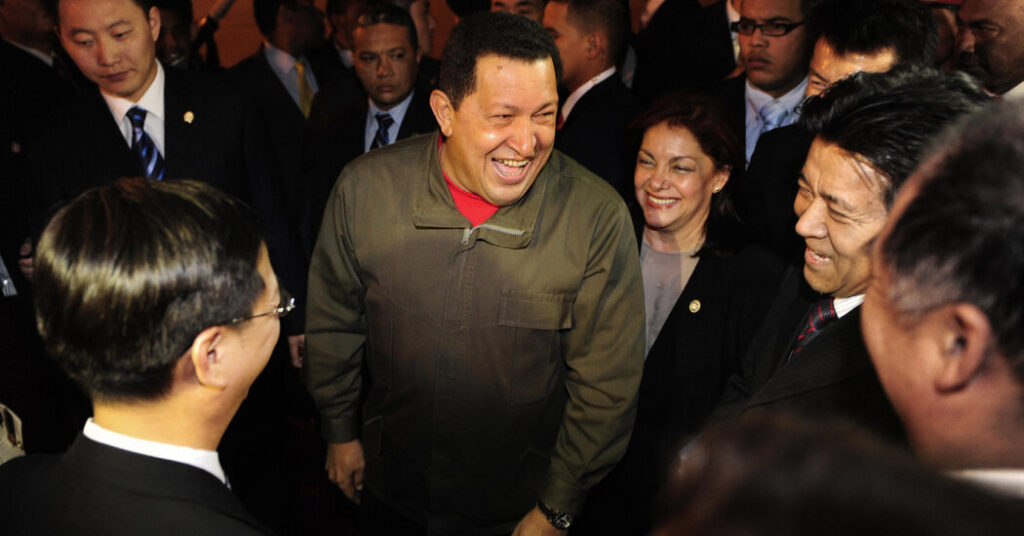
In the early 2000s, China’s economy was expanding at such a voracious pace that it needed more energy to power its growth. Beijing, which imports most of its oil, sent its companies to scour the world to secure access to resources. They found a willing partner in Venezuela, where its leader at the time, Hugo Chávez, was looking to diversify his country’s economic ties away from the United States.
The two countries struck a trade partnership that would yield more than $100 billion in financing promises from China in exchange for Venezuelan oil.
The Chinese money financed railways and power plants and gave Caracas much-needed cash. Venezuela, in exchange, paid the money back with “all the oil that China needs for its growth and consolidation as a power,” as Mr. Chávez put it in 2010.
The deal continues today under far more challenging circumstances and a lack of clarity over what happens next. Over the years, Venezuela has worked to pay down its debt to Beijing and is estimated to owe around $10 billion, according to AidData, a research institute at the College of William and Mary in Williamsburg, Va.
China, for its part, has stopped making new loans and, in many ways, is far less reliant on both Venezuela and oil more generally.
The United States has been imposing increasingly restrictive sanctions on Venezuela for years. Then on Saturday, U.S. forces captured the country’s leader, Nicolás Maduro. President Trump claimed shortly thereafter that the United States was ready to take over Venezuela’s oil industry.
Secretary of State Marco Rubio asserted on Sunday that the U.S. military would prevent oil tankers on a U.S. sanctions list from entering and leaving until the Venezuelan government opens up the state-controlled industry to foreign investments, providing Washington with a “tremendous amount of leverage.”
It was already hard for Beijing to get payment on what it was owed, which stood at $44 billion in 2017 when the United States announced increasingly restrictive sanctions on Venezuelan oil and Venezuela defaulted on its government bonds, according to AidData. The country’s economy had collapsed, violence and poverty was widespread, and millions of Venezuelans have fled the country.
The squeeze on the country has gotten only tighter in recent months as U.S. forces have struck and seized oil tankers and imposed a quasi-blockade of ships coming and going from Venezuelan ports.
The loans-for-oil financial arrangement was novel for Beijing when it was introduced in the 2000s. China agreed to lend huge sums but protected those loans with collateral from the proceeds of oil. Instead of sending payments for oil to Caracas, Beijing would deposit money into an account in China that was used to pay off the interest on Venezuelan loans.
Beijing was the biggest buyer of Venezuelan oil and its largest investor for nearly a decade until 2016, when Venezuela could no longer make good on its end of the deal. The price of oil had crashed, and Venezuela was forced to send China much more oil to repay its loans.
“The Achilles’ heel of this lending agreement is that you have to agree to the quantities of oil in the original deal,” said Brad Parks, the executive director of AidData, which has calculated China’s total lending to Venezuela since 2000 at $106 billion.
U.S. sanctions in 2017 complicated things further for Beijing. “It has had this knock-on effect on Venezuela’s ability to service its debt to its Chinese creditors,” Mr. Parks said.
China’s pattern of energy consumption has also changed drastically. The country is still a major user of fossil fuels, but it has poured billions of dollars into the development of renewable energy such as electric vehicles and solar power.
It is possible that Mr. Trump’s push to revive Venezuela’s oil sector could help China get its money back, even as a broader shift toward a more interventionist approach by the United States in Latin America would pose a bigger problem for Beijing.
“If we do see sanctions lifted then we see Venezuela becoming a less important oil supplier to China, especially after those loans are repaid,” said Erica Downs, a senior research scholar at the Center on Global Energy Policy at Columbia University.
When Chinese oil companies went overseas in the late 1990s, the country’s leaders were deeply concerned about energy security, Ms. Downs said.
“But if you fast forward to China today, there is this big push to electrify everything,” she said. “So while China is still going to need to import oil for quite some time, I do wonder to what extent does that shift China’s thinking on Venezuela.”
Alexandra Stevenson is the Shanghai bureau chief for The Times, reporting on China’s economy and society.
The post China Needed Oil. Venezuela Needed Cash. Their Deal Faces a Turning Point. appeared first on New York Times.