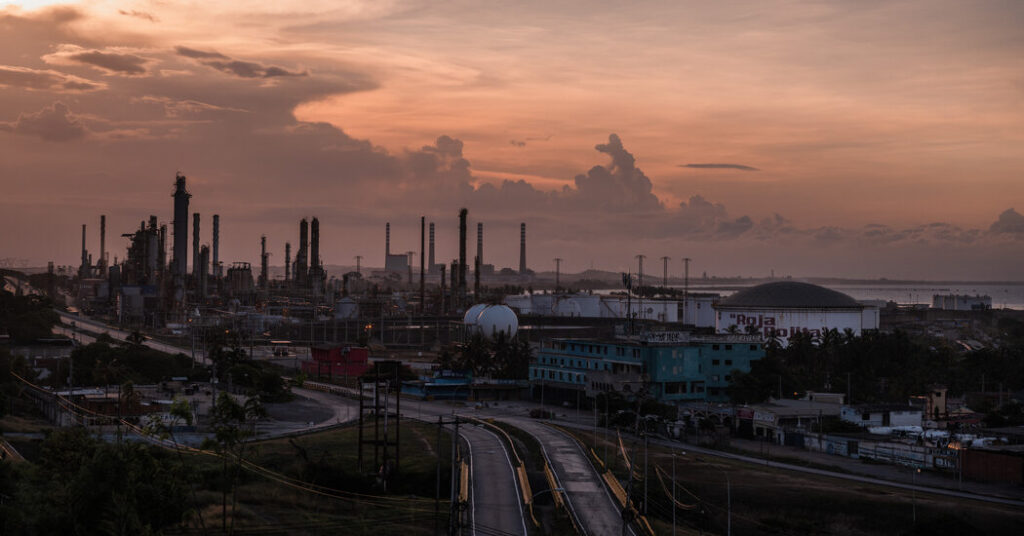
Last winter, Chevron appeared to be running out of time in Venezuela.
The company was the last major U.S. oil company still producing oil in the South American country, many years after others, like Exxon Mobil and ConocoPhillips, had left. For years, Chevron muddled along under short-term exemptions from U.S. sanction policies. Then, in late February, President Trump said he would effectively block the company from producing in Venezuela.
Ten months later, the situation could not look more different. Mr. Trump reversed course over the summer, allowing Chevron to continue operating in Venezuela. Now the company is in prime position to benefit after U.S. forces captured President Nicolás Maduro over the weekend in Caracas and ramped up pressure on the country to welcome greater investment from U.S. energy businesses.
That remarkable turnaround is due in part to a spirited lobbying effort that included several conversations over the past year between Mr. Trump and Mike Wirth, Chevron’s mild-mannered chief executive.
But it was a big bet roughly two decades ago that set Chevron apart from other American producers in Venezuela. Hugo Chávez, the country’s president at the time, was nationalizing parts of Venezuela’s oil industry, forcing foreign investors to accept smaller stakes in projects without compensating them.
Exxon, the largest U.S. oil company, and ConocoPhillips walked away and have been pursuing, with little success, billions of dollars in claims against Venezuela. Chevron saw opportunity.
“If we left every time we had a disagreement with the government, we would be leaving everywhere, including this country,” Mr. Wirth told The Wall Street Journal last month.
Venezuela is widely believed to have the world’s largest reserves of crude oil, and, for a time, the country exploited its resources with aplomb — in 1997, it pumped almost 5 percent of the world’s oil. But mismanagement, corruption and neglect have withered away its industry, and the country now produces around 1 percent of global oil supplies.
For Chevron, the rationale for staying in Venezuela was simple, said Ali Moshiri, who oversaw the company’s operations in the country at the time. Under a new contract in 2006, the company received an ownership stake in a key Venezuelan project, rather than being paid a fee to produce oil there, said Mr. Moshiri, who was close with Mr. Chávez.
Other companies were against the changes that Mr. Chávez was pursuing because they would make less money than their contracts called for. But Mr. Moshiri saw an upside: Chevron’s profits could increase if oil prices rose in the future.
“We owned the equity of the reserves, and we also took the upside,” Mr. Moshiri said in a recent interview with The Times, recalling how he had framed the issue to Chevron’s board of directors. “The alternative to that would have been do what Conoco did: Leave the country and wait to get paid.”
Chevron has taken a long-term view in many countries besides Venezuela, including Kazakhstan, a Central Asian nation with some of the world’s largest oil fields, and Israel, where the company is developing two big gas fields.
Staying the course in Venezuela could pay off for Chevron in even more ways. As the only Western oil company with U.S. government authorization to export oil from Venezuela, it is positioned, given the right political conditions, to increase production more quickly than companies that have no presence in the country.
Investors are optimistic. Shares in Chevron climbed more than 5 percent on Monday, outpacing the broader stock market by a wide margin, as Mr. Maduro was being arraigned in New York. The company, which did not make Mr. Wirth available for an interview on Monday, has said it continued to operate in Venezuela “in full compliance with all relevant laws and regulations.”
Shares in SLB and Weatherford, companies that do a lot of the drilling and other physical work on behalf of producers like Chevron, posted even bigger gains of around 9 percent. Investors were betting that these service businesses would benefit a lot from greater access to Venezuela’s oil fields.
Any meaningful increase in oil flows from Venezuela will take years, however, not to mention tens of billions of dollars in investment. For now, U.S. sanctions remain in place, as does a “quarantine” on many of the tankers used to export Venezuela’s oil.
There is also the matter of oil prices, which remained below $60 a barrel on Monday, even after a rally of almost 2 percent. Without much higher prices, companies are unlikely to rush into new projects, much less ones with as much political risk as those in Venezuela.
Even if it becomes easier to operate in Venezuela, U.S. oil companies are unlikely to commit significant sums without assurances that they will be able to operate there for years to come without a risk of having their contracts changed or their assets nationalized.
Mr. Wirth explained the dilemma on a 2023 earnings call, saying that because Chevron was operating under a short-term license from the Treasury Department, it was not making “major capital commitments” in Venezuela.
Stanley Reed contributed reporting.
Rebecca F. Elliott covers energy for The Times.
The post Chevron’s Risky Bet to Stay in Venezuela May Now Give It an Advantage appeared first on New York Times.