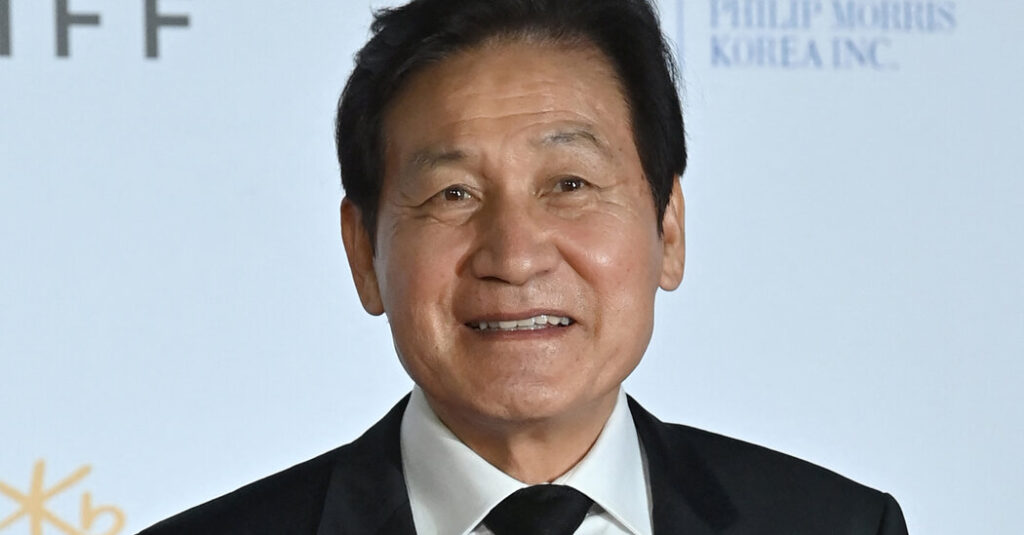
Ahn Sung Ki, a South Korean actor whose a gentle, friendly public image made him a beloved figure over a career that lasted more than 60 years, died on Monday. He was 74.
His management agency, Artist Company, announced Mr. Ahn’s death on social media. It did not specify a cause, but local news outlets reported that he died in Seoul and had been hospitalized last week after choking on a piece of food.
Mr. Ahn revealed in 2022 that he had been battling blood cancer since 2019,Korean news outlets said.
Mr. Ahn, who made his film debut at age 5, appeared in more than 180 films, according to the Busan International Film Festival, where he served as deputy executive chairman from 2005 to 2015. The Korea Film Actors Association called him a “true ‘nation’s actor’” who valued “dignity and responsibility over everything else.”
South Korea’s president, Lee Jae Myung, said on social media that Mr. Ahn had “left a great footprint in Korean film history.” Noting his reputation for humility, Mr. Lee added that Mr. Ahn did not “discriminate between the lead and supporting roles.”
One of Mr. Ahn’s best-known films was “A Fine, Windy Day,” released in 1980, about three working-class friends navigating their way through early adulthood. He played a deliveryman for a Chinese restaurant. He is also remembered for “Two Cops,” a 1993 film in which he played a corrupt police officer.
Mr. Ahn was born in Daegu, South Korea, on Jan. 1, 1952, and first appeared onscreen as a child actor in the 1957 film “The Twilight Train,” according to Artist Company. Mr. Ahn played an orphan in the film, a melodrama about romantic rivalries at an orphanage.
His father, Ahn Hwa-young, was a film producer, Mr. Ahn said in an interview with the Korea Joongang Daily newspaper in 2011. Mr. Ahn had nearly a dozen film roles in his childhood and teenage years before attending Hankuk University of Foreign Studies in Seoul, where he majored in Vietnamese.
After graduating, he resumed his acting career. His wide gamut of roles included a Buddhist monk, in the 1981 film “Mandala,” and two different fictional presidents of South Korea, in the films “The Romantic President” in 2002 and “Hanbando” in 2006. He won more than 20 South Korean film awards.
Since 1993, Mr. Ahn had been a good-will ambassador for the Korean Committee for UNICEF, according to the organization. In the late 1990s, he joined other actors and filmmakers in pushing for a quota system for domestic films in South Korean cinemas, amid concern about competition from Hollywood.
“Everyone in the world knows that he has contributed greatly to the development of Korean movies,” Professor Seo Kyoungduk, who teaches the globalization of Korean history and culture at Sungshin Women’s University in Seoul, said of Mr. Ahn on social media. He added that Mr. Ahn had also contributed to promoting Korean history and culture overseas, through advocacy campaigns as well as his film roles.
“While it’s a given to approach a film set with sincerity, it’s also important to have fun,” Mr. Ahn said in a 2006 interview with the Korea Broadcasting Service on reaching his 50th year as an actor.
Mr. Ahn had a supporting role in “Last Knights,” a 2015 film that starred Clive Owen and Morgan Freeman.
His last film, “Noryang: Deadly Sea,” in which he played a 16th-century naval commander, was released in 2023.
He is survived by his wife, Oh So-young, whom he married in 1985, and two sons, Da-bin and Philip, South Korean news outlets reported.
Jin Yu Young is a reporter and researcher for The Times, based in Seoul, covering South Korea and international breaking news.
The post Ahn Sung Ki, Towering Figure in South Korean Film, Dies at 74 appeared first on New York Times.