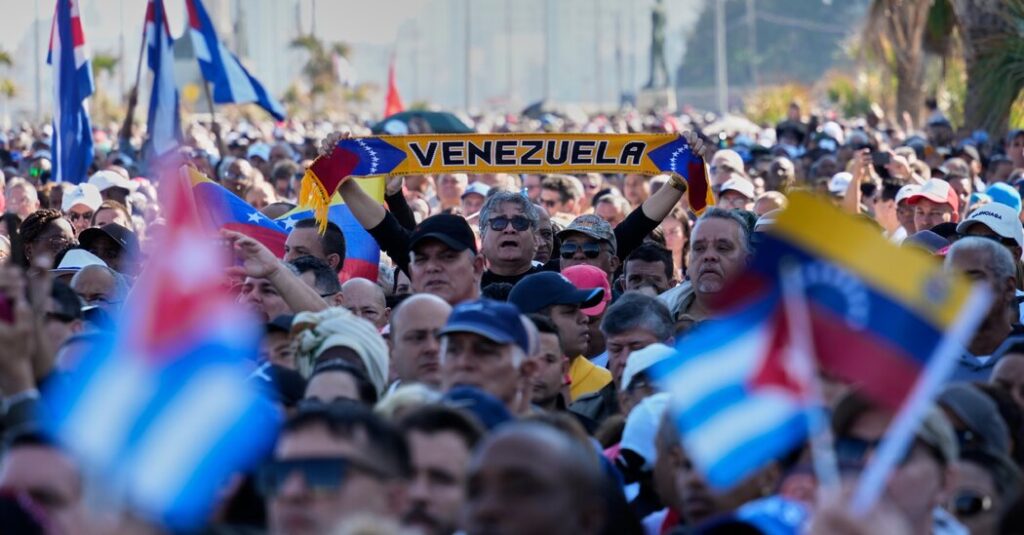
Shortly after U.S. forces captured Venezuela’s leader, President Trump said that Cuba’s days were numbered and that his administration may turn its sights on the Communist island next.
“Cuba looks like it is ready to fall,” Mr. Trump said to reporters on Air Force One. “I don’t know if they’re going to hold out, but Cuba now has no income. They got all their income from Venezuela, from the Venezuelan oil.”
Pressed about the prospect of the United States intervening militarily in Cuba, Mr. Trump said he did not think it was necessary because “it looks like it’s going down.”
Whether Washington does move against Cuba remains to be seen. President Trump has surrounded himself with Cuba hawks, including Secretary of State Marco Rubio, a Cuban American who as a U.S. senator was famous for his longstanding antipathy toward Havana. Mr. Rubio has long signaled his belief that a change in Venezuela’s government would weaken Cuba, which he has said would be a welcome outcome.
The Cuban government finds itself in a precarious situation with the capture of Mr. Maduro, a crucial political and economic partner, as it faces an economic crisis at home and growing political dissatisfaction.
The nations were so close that nearly three dozen Cubans were killed on Saturday when U.S. forces invaded Caracas. Mr. Maduro leaned heavily on Cuban bodyguards for his protection in recent weeks, as Mr. Trump ramped up threats.
Washington may not have to do much to foster political change in Cuba. The ongoing U.S. blockade of Venezuelan oil is cutting off an economic lifeline for the island, which it used to keep the lights on domestically and sold on international markets in exchange for hard currency to buy staples like medicine and food.
On Sunday, Havana swiftly responded with concern.
Mr. Maduro’s overthrow “places us in a critical existential dilemma for our survival as nation states and independent, sovereign nations,” Bruno Rodríguez Parrilla, Cuba’s foreign minister, said Sunday at an emergency meeting of the Community of Latin American and Caribbean States, a bloc of regional nations. He appealed to neighboring countries to stand together in the face of Washington’s threats.
“It’s a death sentence if tomorrow Venezuela shuts off oil to Cuba,” said Jorge Piñon, a former Mexican oil executive and Cuban energy expert who works at the University of Texas at Austin.
Venezuela and Cuba have had a 25-year political and economic partnership, which has long eclipsed Havana’s reliance on Moscow or Beijing. When Hugo Chavez came to power in 1999, he ushered in a socialist revolution seeking to empower millions of poor, disenfranchised Venezuelans, much like Fidel Castro had done for Cuba.
Mr. Castro personally intervened to provide protection to Mr. Chavez during a 2002 coup attempt against him, according to former U.S. diplomats. The Venezuelan leader repaid his gratitude by propping up Cuba financially, providing an economic lifeline in the form of oil, a policy continued by Mr. Maduro.
In the fourth quarter of 2025, on average Cuba received 35,000 barrels a day of oil from Venezuela, and about 7,000 barrels each from Mexico and Russia, according to Mr. Piñon. He analyzes satellite images of oil vessels docking in Cuba for his estimates, as the governments involved do not release such data.
Mexico was sending about 22,000 barrels a day to Cuba last year, but that figure dropped to 7,000 after Mr. Rubio visited Mexico in August to press the Mexican government on a host of bilateral issues, Mr. Piñon said.
It is unclear whether Mexico cut oil shipments to Cuba because of political pressure from Washington or because of its own declining crude oil production. Since the start of his administration, Mr. Trump has threatened Mexico with unilateral military action against drug cartels if the country did not cooperate on a host of issues, including trade and reducing the amount of fentanyl crossing the border.
Republicans, specifically, have for years demanded Mexico cut oil shipments to Cuba.
“There’s a belief among Republicans like Rubio that once Venezuelan oil is cut off, the Cuban economy will collapse and trigger a popular uprising,” said Ricardo Zúñiga, a former U.S. official who helped broker former President Barack Obama’s deal with Cuba and who also served under Mr. Trump. “What we’ve seen in Cuba is there appears to be no limit to how bad the situation can get, without an uprising.”
What may save Cuba from U.S. intervention is that it has nothing to offer Washington economically, analysts say. Venezuela has the world’s largest oil reserves — which Mr. Trump has brought up repeatedly. Cuba has few resources.
And Cuba is only 90 miles away from the coast of the United States. If it collapses, it could trigger more migration into the United States and security concerns.
“If Rubio or others are gunning for a ‘Cuba next’ approach here, it will be harder for them to make the case to Trump,” said Michael Bustamante, a Cuba expert and an associate professor at the University of Miami.
Already, citizens line up for hours or even days to get the most basic items like cooking fuel or milk and endure rolling electricity blackouts that spoil what little food they do have when their refrigerators shut off. The medical system — a gold lining of the revolution — is now barely able to provide the most basic care. Patients and their families report shortages of medicine and people are now expected to bring their own sheets to the hospital, according to Cubans in the U.S. who have sent money to help family members.
The situation has prompted a mass migration of Cubans: the island has lost 10 percent of its population, or 1 million people, since 2021. Part of the downward spiral is because of sanctions imposed by the United States, but analysts say a larger culprit is poor economic management by the Cuban government.
Still, the idea of American intervention in Cuba is deeply unpopular, even for Cubans who may want change.
“We don’t like to be bullied and we don’t like it from people like Rubio,” said Carlos Alzugaray Treto, who served Mr. Castro’s government as a Cuban diplomat until retiring in 1996. “Most people here want change, but they want change here, not imposed from outside.”
Mr. Alzugaray, who is now a reformer in favor of opening up Cuba, said the changes in Venezuela will affect Cuba “very much. But this is an opportunity for the Cuban government to reform.”
Mr. Bustamante, like Mr. Piñon, said that for now Washington may have its hands too full with Venezuela to tackle Cuba. They both added that there is no natural partner for Washington to ally with in Havana, as it has in Caracas — with Mr. Maduro’s vice president who is seen as a pragmatist, inviting the United States to work with her government on Sunday night.
“Rubio’s intentions have always been clear. But he’ll have to answer: Who can they cut a deal with? And the answer is no one,” Mr. Bustamante said. “Cuba is much more a one-party state in a way that Venezuela never was.”
Maria Abi-Habib is an investigative correspondent reporting on Latin America and is based in Mexico City.
The post After Venezuela, Trump Says Cuba Is ‘Ready to Fall’ appeared first on New York Times.