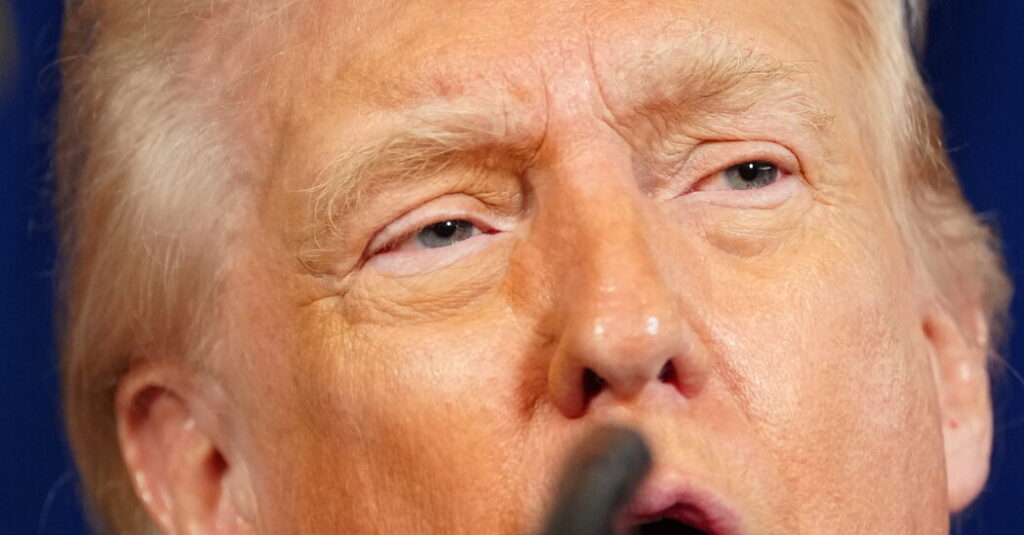
Barely 48 hours after toppling the leader of Venezuela and asserting U.S. rights to the country’s oil, President Trump threatened Colombia with a similar fate, declared that Cuba was not worth invading because “it’s ready to fall,” and once again claimed that Greenland needed to come under American control as an issue of national security.
Mr. Trump’s claims, in interviews on Sunday and then a lengthy back-and-forth with reporters aboard Air Force One as it returned from his private club in Florida, offered a glimpse of how emboldened he felt after the quick capture of Nicolás Maduro, the strongman who was seized on narco-trafficking charges.
“We’re in charge” of Venezuela, Mr. Trump claimed, as he described his plans to breathe new life into the Monroe Doctrine, the 1823 foundational statement of U.S. claims over the Western Hemisphere.
Or, more specifically, he invoked a more recent update that he refers to, characteristically, after himself: the “Donroe doctrine.”
Mr. Trump never described his philosophy in detail, or whether it applied beyond the Saturday attack on Caracas. But he certainly suggested that he could use the forces amassed in the Caribbean for new purposes, this time aimed at Colombia and its president, Gustavo Petro.
The country, he claimed, was “run by a sick man who likes making cocaine and selling it to the United States.”
“He’s not going to be doing it for very long,” Mr. Trump told reporters on Air Force One. “He has cocaine mills and cocaine factories. He’s not going to be doing it.” Asked whether the United States would conduct an operation against Colombia, the president said: “It sounds good to me.”
It may have been an empty threat, an effort to use the swift precision of the snatching of Mr. Maduro from his well-protected bedroom to bring Mr. Petro to heel. But the core of Mr. Trump’s argument was about American power, and what the Maduro operation said about his willingness to use it.
“American dominance in the Western Hemisphere will never be questioned again,” Mr. Trump told reporters as he announced the Venezuela attack from Mar-a-Lago, his private club in Florida.
Mr. Trump talks in blunt declarations, which is why his secretary of state, Marco Rubio, spent much of Sunday gently walking back his boss’ declaration — which he had repeated multiple times — that the United States planned to “run” Venezuela for the foreseeable future. But a more nuanced position about the U.S. role in the Western Hemisphere is described on page 15 of the Trump administration’s recent National Security Strategy, a document that appears to have been written with this moment in American territorial adventurism in mind.
A close reading could point to what Mr. Trump is thinking about beyond Venezuela — from Colombia to Mexico to Cuba and Greenland, the ice-covered territory that Mr. Trump asserted again over the weekend must come under some form of U.S. control.
“The Monroe Doctrine is a big deal,” said Mr. Trump, who keeps a pensive portrait of the fifth U.S. president near his desk in the Oval Office, squeezed between Alexander Hamilton and Andrew Jackson. “But we’ve superseded it by a lot, a real lot.”
He appeared to be referring to what the National Security Strategy called the “Trump Corollary” of Monroe’s famous declaration that sought to stop European powers from meddling in the Americas.
The Trump Corollary asserts a U.S. right to “restore American pre-eminence in the Western Hemisphere” and to deny “non-Hemispheric competitors” — namely, China — “the ability to position forces or other threatening capabilities, or to own or control strategically vital assets.”
That last phrase, about taking command of “strategically vital assets,” has echoes of Mr. Trump’s explanation for why the United States is claiming rights to Venezuela’s vast oil reserves, the largest in the world. He referred to oil roughly 20 times in his remarks on Saturday, talking about the need to rebuild long-neglected facilities, control production and provide remedies for U.S. companies, because Venezuela’s leaders “stole our oil.”
“We built that whole industry there, and they just took it over like we were nothing,” Mr. Trump said of the oil sector.
“And we had a president that decided not to do anything about it,” Mr. Trump added, appearing to refer to his predecessor, Joseph R. Biden Jr. “So we did something about it. We’re late, but we did something about it.”
As Richard Haass, the president emeritus of the Council on Foreign Relations and a former national security and State Department official, put it: “This is the unvarnished essence of the Trump doctrine.”
It does fall far short of a global strategy. Mr. Trump has not said whether, if he claims the Western Hemisphere, China is free to do the same in Asia. But by declaring the hemisphere off limits to outsiders seeking its oil riches, Mr. Trump is looking to guarantee that only U.S. companies — some owned or operated by his supporters — will be able to exploit Venezuela’s vast reserves. (He did say, in response to a question from a reporter, that he expected to keep selling Venezuelan oil to China, which imports between half and three-quarters of the country’s paltry output.)
Mr. Trump’s intense focus on using Mr. Maduro’s overthrow to claim U.S. sovereignty over the oil reserve was predictable for a transaction-based presidency. But it was also revealing because he never once discussed promoting and restoring democracy in Venezuela as an American objective, even though the country had a decades-long tradition of democratic practices and freely conducted elections, until Hugo Chavez took power in 1999.
That omission was hardly a surprise: Even though the promotion of democracy was a staple of the national security strategies of Democratic and Republican presidents, including during Mr. Trump’s first term, it was largely missing from the November White House document.
And as Mr. Trump mused about a post-Maduro government, he notably did not call for the installation of Edmundo González as president, even though the United States, and other nations, recognized him as the legitimate winner of the 2024 election that Mr. Maduro falsely claimed to have won. Mr. González, now 76, was the proxy presidential candidate for the more popular opposition leader, María Corina Machado, who was barred from running.
“The omission causes an immediate problem for the political legitimacy of the Venezuelan government,” Richard Fontaine, the chief executive of the Center for a New American Security and a former aide to Senator John McCain, said over the weekend. “Many would-be supporters of the U.S. operation hoped for freedom, not just a different approach on drugs and oil.”
But, he added, “the restoration of democracy in Venezuela is not obviously among them.”
Mr. Trump seems perfectly happy to deal with the remnants of the Maduro government, as long as it follows his commands and gives him access to the oil — and compensation for nationalizing the assets of U.S. firms. That is a very different nation-building mission than, say, the types that George W. Bush pursued in Afghanistan and Iraq. Mr. Bush claimed, at least, that he was creating models of democracy in the Middle East. Mr. Trump is claiming nothing more than transactional rights to Venezuela’s underground riches.
While Mr. Trump and his allies are eager to revitalize the Monroe Doctrine, its intent two centuries ago was far different from the situation the United States faces today.
When the original doctrine was declared by Monroe, a friend and neighbor of Thomas Jefferson’s, the United States was a nation of roughly 10 million people. Its Navy was limited to a few dozen ships, manned by about 3,500 sailors and 500 officers — roughly a fifth of the size of the force the Pentagon massed offshore of Venezuela to oust Mr. Maduro.
And the context was entirely different, too. Latin American countries were shaking off their distant masters, Spain and Portugal. Monroe and his political allies were worried that the European powers would seek to make them colonies again. And so the declaration was an effort to block that avenue of influence. But there was reason to doubt whether Monroe, or his successors, John Quincy Adams, Andrew Jackson and Martin Van Buren, could stave them off, barely 35 years after the ratification of the Constitution.
It is unclear how much of this history is familiar to Mr. Trump. But as he revived the Monroe Doctrine on Saturday, he said: “We sort of forgot about it. It was very important, but we forgot about it. We don’t forget about it anymore under our new National Security Strategy. American dominance in the Western Hemisphere will never be questioned again.”
Presumably Mr. Trump was thinking about China and Russia. Those are certainly the two countries he has in mind as he renews his calls for Greenland to come under American rule, a topic that he raised at Mar-a-Lago during a news conference almost exactly a year ago, and then went quiet about for months. (He has also stopped discussing taking control of the Panama Canal and making Canada a 51st state.)
But the logic of this past weekend would suggest that Mr. Trump now believes the way is clear to claim resources that, in his view, the United States cannot live without. He is already setting up a parallel argument for Greenland which may — or may not — have substantial, recoverable rare earths.
“We need Greenland from the standpoint of national security,’’ Mr. Trump told reporters on Air Force One on Sunday night. “Greenland is covered with Russian and Chinese ships all over the place.”
“Denmark is not going to be able to do it,” he added. He said that to boost security for Greenland, “it added one more dog sled.”
Denmark’s prime minister, Mette Frederiksen, was clearly rattled earlier in the day by Mr. Trump’s renewed interest in the vast, if frozen, territory.
“It makes absolutely no sense to talk about the U.S. needing to take over Greenland,” Ms. Frederiksen wrote on social media. “The U.S. has no right to annex any of the three countries in the Danish Kingdom.”
Mr. Trump would not have the easy pretense to go after Greenland that he did in the case of Venezuela. And it is not clear the economic gains would be worth the breach with a NATO ally, in part because exploiting those resources would be wildly expensive.
But so will restoring Venezuela’s oil system.
“The infrastructure is rotten, rusty,” Mr. Trump told reporters on Air Force One on Sunday evening.
Yet despite Mr. Trump’s constant search for a good deal, the daunting price tags do not seem to matter much to him. Venezuela, Greenland, Gaza, maybe Canada: These are legacies that will, over time, pay for themselves, he believes.
In the meantime, he appears to be playing a bit of one-upsmanship with James Monroe.
David E. Sanger covers the Trump administration and a range of national security issues. He has been a Times journalist for more than four decades and has written four books on foreign policy and national security challenges.
The post After Venezuela, Trump Offers Hints About What Could Be Next appeared first on New York Times.