Dance in Georgia is as dazzling as it is ancient. In the fourth century B.C., the Greek military leader and historian Xenophon described Georgian soldiers dancing on the battlefield, a brazen form of intimidation.
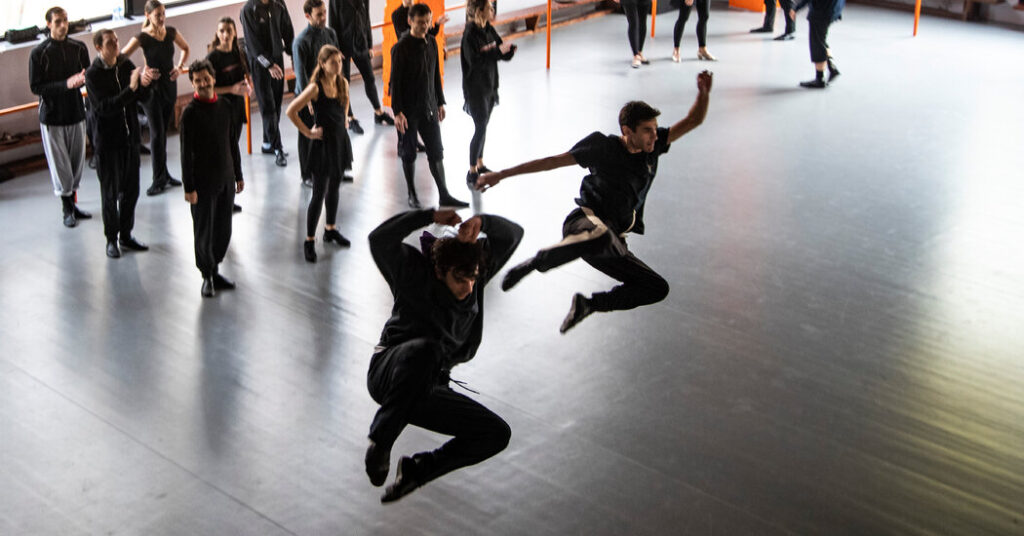
You can see why their opponents might have been impressed. Georgian dance is an art of outrageous virtuosity and athleticism, often meant to indicate prowess at war and in the hunt. The dances are characterized by fiery leaps, sudden drops to the knees, swordplay, spinning jumps and men dancing on the tips of their toes.
A vibrant dance culture has flourished in Georgia, a small country tucked between the Caucasus Mountains and the Black Sea, as far back as the Bronze Age. And it remains central to Georgia’s cultural identity, alongside polyphonic singing and winemaking, its prestige rooted in what it projects about the national character: bravery, spirit, wit, strength, elegance, self-respect.
“Georgian dance, it’s not only dance,” said Nino Sukhishvili, the director of the Georgian National Ballet Sukhishvili, in a video call from Tbilisi, the capital. “It is a reflection of our traditions and our history. It’s part of our dignity. We Georgians want to make the world know who we are.”
Sukhishvili’s company, one of the country’s best known dance ensembles, will visit New York this month. Its first stop is Carnegie Hall on Jan. 17, for a large-scale performance with 60 dancers and live music. A smaller, more cabaret-style show called “Assa” follows on Jan. 18 at the Brooklyn Monarch, a club in Williamsburg. That’s fitting: Brooklyn, where many Georgians live, has become an outpost of Georgian dance.
The tour comes at a politically delicate moment for Georgia. The country’s elections in 2024 returned an autocratic-leaning, less Western-friendly party to government and led to widespread protests and a slowdown of the process of gaining membership to the European Union. The ruling party had already instituted a crackdown on media and put limits on civil liberties, including L.G.B.T.Q. rights. (By 2008, after conflicts with Russia, Georgia had lost two of its regions, South Ossetia and Abkhazia, roughly 20 percent of its territory.)
“It’s a hard time for Georgia, but actually it’s always a hard time for Georgia,” Sukhishvili said. “The political climate in our country presents significant challenges for everyone.”
The company is no stranger to difficult times. It was created at the end of the Second World War by Iliko Sukhishvili and Nino Ramishvili, a husband and wife who are grandparents of the company’s current directors, the siblings Nino and Iliko Sukhishvili. (The company is not to be confused with the State Ballet of Georgia, which performs classical ballet and was founded in 1935.)
The older Iliko was a folk dancer who choreographed for the Tbilisi Opera and Ballet in the 1930s and ’40s. Ramishvili was a classical ballerina at the same company. Together they decided to form a national troupe that would gather dances from the different regions of Georgia, then a part of the Soviet Union.
“They traveled around the villages to collect movements,” Nino said, observing dances at festivals, weddings and celebrations. Georgia is made up of mountainous areas and coastal regions and major metropolitan centers, each with its own style of music and dancing, reflecting the terrain and lives and occupations of its people.
Dances from Adjara, on the Black Sea coast, are lighter in spirit and feature more interaction between men and women. Mountain dances, like the khanjluri, are competitive and virtuosic, and often showcase men balancing or dancing on the tips of their soft leather boots. (An impressive feat: In classical ballet, only women dance on their toes.)
Courtly dances like the kartuli are formal and elegant, performed with upright backs and delicate, gliding footwork. Eighteenth-century male dances from Tbilisi, like the kintouri, are teasing and playful.
And then there are the war dances, like the khorumi, which reflect Georgia’s long history of trying to fend off invaders. “There were periods of Arab, Mongol, Persian, Ottoman and Russian rule in the country,” the Georgian historian Lado Mirianashvili wrote in an email from Tbilisi. “These dances were probably inspired by dances that were used for training soldiers for action in battle.”
With the material the Sukhishvilis collected, the older Iliko created his own choreography, mixing folk dance movements with ballet technique and ensemble patterns reminiscent of a corps de ballet. “My grandfather understood that he had to make the dances more artistic, more theatrical,” Nino said. In a way, the Sukhishvilis created their own genre, halfway between the folk and classical traditions.
Some of Iliko’s dances, like the Samaia, a dance for three women inspired by a fresco of the 12th-century queen Tamar, were based more on a poetic interpretation of history than any pre-existing dance steps.
The younger Iliko, who serves as the company’s current choreographer, has continued in his grandfather’s footsteps, creating new work, and even dabbling in crossover dances set to jazz and tango. These more informal dances will be featured in the show at the Brooklyn Monarch.
The Sukhishvili company has been popular in New York since it first visited, in 1960. After its debut, the Times dance critic John Martin gushed about the dancers: “Their energy is tremendous, and their variations from high tensions to low are contagious and exciting.” When dancers from the company returned in 1974, New York City Ballet’s founding choreographer George Balanchine, whose father was Georgian, threw them a party at Le Poulailler, a French restaurant near Lincoln Center.
“These are my people,” Balanchine told a reporter from The New Yorker. “They are just about the fastest-moving people on earth.” Peter Martins invited them back to perform at New York City Ballet in 2004, the centenary of Balanchine’s birth.
What is it about these dances that has so captivated audiences? One of the most popular, the khorumi, is a depiction of the stages of battle. In Sukhishvili’s version, the dancers advance in tight formations, like the figures on a frieze. They leap aggressively, crouch, stand on each other’s shoulders. They face off in simulations of hand-to-hand combat, with acrobatic lifts. It’s not just a dance, it’s a whole story.
Then there are the mountain dances, with their competitive solos full of spins on the knees, in the air, and on toe tips, as well as giant leaps and hard landings onto the knees.
In the popular kartuli, a courtship dance that dates back to the Middle Ages, a man and a woman walk lightly on the balls of the feet; she glides, as if on wheels, her upper body swaying, while he performs tiny, quick shuffling steps with an upright back. Even when he is very close to her, she never looks at him.
Traditionally, the gender roles in Georgian dance are well defined: The women glide and perform fluid arm movements. “It is like they are floating on water, like a swan,” Nino Sukhishvili said. The men hold themselves proudly — chest forward, arms extended — and do aerial tricks.
Even so, some of those differences are beginning to erode just a bit. “In recent years, women’s dances have become more technical, more athletic,” Nino said.
This was reflected on a recent trip to Brooklyn to visit two different Georgian dance academies, Pesvebi and Dancing Crane. In a class at Pesvebi, a Georgian cultural center in Brooklyn that includes a school and a professional dance ensemble, girls joined in one of the mountain dances, doing vigorous, rhythmic footwork.
“The girls want to do the more exciting stuff too,” Pesvebi’s director, Shorena Barbakadze, said during the rehearsal.
Visits to Pesvebi and the Dancing Crane Georgian Cultural Center illustrated the devotion of even the youngest generation to this ancient art. Both schools draw dancers from the age of 5 to the midteens. Both were packed with students — including lots of boys, an anomaly in dance classes — even on a frigid Sunday afternoon after a snowstorm.
Both are in the Gravesend section of Brooklyn, an area with a large Georgian population. All of the instruction was conducted in Georgian. Classes, which last an hour and a half, are held three times a week, a big commitment.
“Their parents are busy, but they bring their kids to Georgian dance classes — why?” said Lika Sirelson, who directs Dancing Crane with her husband, Victor. “Because that way they keep the Georgian culture in them.”
This is true in Georgia, too. Nino Sukhishvili said the Georgian National Ballet’s six schools serve 10,000 students across the country. Summer performances at the company’s open-air theater near Tbilisi are packed.
It seems that neither politics, nor the encroaching lure of sports or pop culture have managed to dent the draw of these dances. They are, as Sirelson and the others said, too deeply embedded in the national spirit. “Sometimes Georgia is big, sometimes we are small,” Nino Sukhishvili said. “We are a small nation now, but still, we try to get the world to talk about us.”
The post A Dance Company of ‘Just About the Fastest-Moving People on Earth’ appeared first on New York Times.