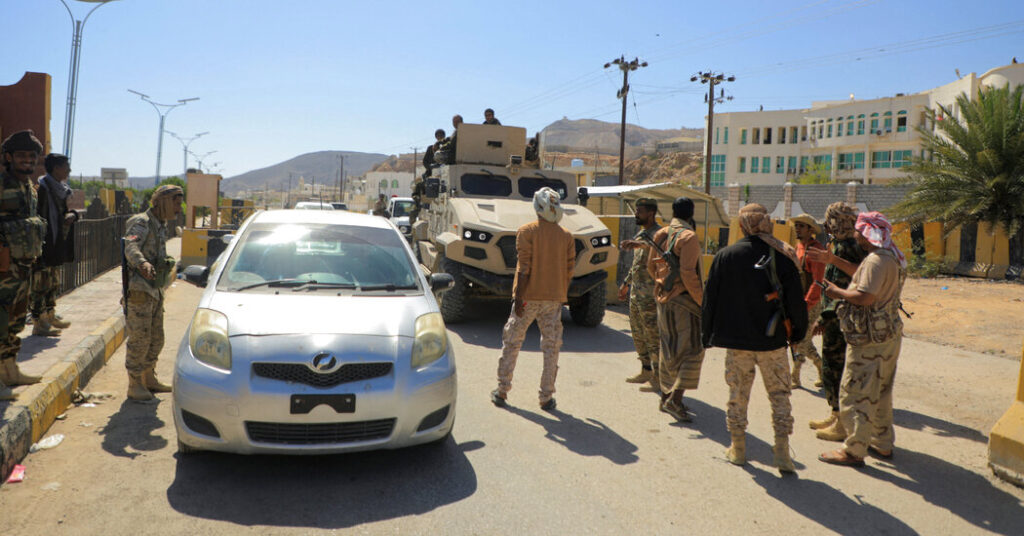
With backing from Saudi Arabia, Yemeni government-allied forces recaptured an oil-rich region of their country this weekend from armed separatists who were trying to form a breakaway state.
The military operation appears to have turned the tide in a conflict that has effectively become a proxy clash between Saudi Arabia and the United Arab Emirates, with Yemen’s sovereignty hanging in the balance.
The separatist group, the Southern Transitional Council, seized control of most of southern Yemen in a swift offensive last month. The separatists are supported by the Emirates.
Saudi Arabia and the Emirates, two oil-rich U.S. allies, are increasingly at odds. The Saudi government initially appeared to stand down as the separatists swept into the Yemeni provinces of Hadramout and al-Mahra — a stretch of strategically-located territory that includes Saudi borderlands.
But last week, Saudi Arabia bombed an Emirati shipment as it arrived in Yemen. The Saudi Foreign Ministry described the separatist group’s moves as a security threat to the kingdom and accused the Emirates of taking “highly dangerous” steps.
In recent days, fighters allied with Saudi Arabia and Yemen’s internationally recognized government retook Hadramout and “assumed positions” in al-Mahra, according to Moammar al-Eryani, the Yemeni information minister.
Mr. al-Eryani told The New York Times by phone on Sunday that the de facto capital of Aden and other Yemeni provinces could be next. He called for local forces in those areas to surrender “as the state reasserts authority.”
Mr. al-Eryani represents the Presidential Leadership Council, the internationally recognized and Saudi supported government. Southern Transitional Council separatists have also laid claims to govern southern Yemen and seek to create a state called South Arabia.
Anwar al-Tamimi, a Southern Transitional Council spokesman, confirmed in a phone interview that its forces had been “forced to withdraw under Saudi bombardment, which left us without vehicles in some areas and unable to move, and resulted in many casualties.”
“To protect the lives of our fighters, we pulled back after advancing, under immense pressure,” he said. “Al-Mahra and Hadramout are now outside our control.”
Several Saudi officials and the Saudi government’s Center for International Communication, which handles queries from international media, did not respond to requests for comment.
Hadramout residents told The Times that they had heard and seen explosions consistent with airstrikes. Salem Madfaa said that he was at a football stadium in the valley city of Seiyun on Friday when three explosions shook the city and he saw smoke rising.
“I hope peace prevails again in Hadramout and that its people can govern themselves,” he said. “We have moved into a new phase, and it may take time for stability to return.”
The conflict’s outcome could reshape the map of Yemen, the poorest country in the Arabian Peninsula.
Northern Yemen is ruled by the Houthis, an Iran-backed militia that gained global notoriety by shooting missiles and drones at Israeli targets, which it described as an effort to support Palestinians in Gaza.
When the Houthis seized the Yemeni capital of Sana a decade ago, the internationally-recognized government fled south. Since then, Yemen has been effectively divided — with two state news agencies, two central banks and two currency valuations.
The internationally recognized government had limited authority on the ground. Major cities including Aden and al-Mukalla — the provincial capital of Hadramout — had long been under separatist control.
But by Sunday, a large convoy of vehicles had entered al-Mukalla, taking control of key government institutions. The convoy flew the flag of the Nation Shield Forces, a group that is backed by Saudi Arabia but that is technically subordinate to the Yemeni government.
The next step is likely to be a diplomatic conference, convened by Saudi Arabia, to discuss the future of southern Yemen. The Saudi Foreign Ministry said that the kingdom was ready to hold such a conference in the Saudi capital, Riyadh, bringing together Yemeni factions “to discuss just solutions to the southern cause.”
The Southern Transitional Council welcomed that proposal, adding that any “serious dialogue must start from the recognition of the will of the people of the South.”
It is unclear why the Emirati government supports the group, but analysts speculate that Emirati leadership could want to hold sway in Yemeni port cities located on global trade routes. Emirati officials say that they merely support Yemenis’ rights to security and self-determination.
On Saturday, the Emirati Foreign Ministry expressed “deep concern” over developments in Yemen.
“We call on our Yemeni brothers to prevail with wisdom, exercise restraint and prioritize the establishment of security,” the ministry said in a statement.
Ismaeel Naar contributed reporting from Dubai, United Arab Emirates.
Vivian Nereim is the lead reporter for The Times covering the countries of the Arabian Peninsula. She is based in Riyadh, Saudi Arabia.
The post Yemeni Forces, Backed by Saudi Arabia, Reclaim Territory From Separatists appeared first on New York Times.