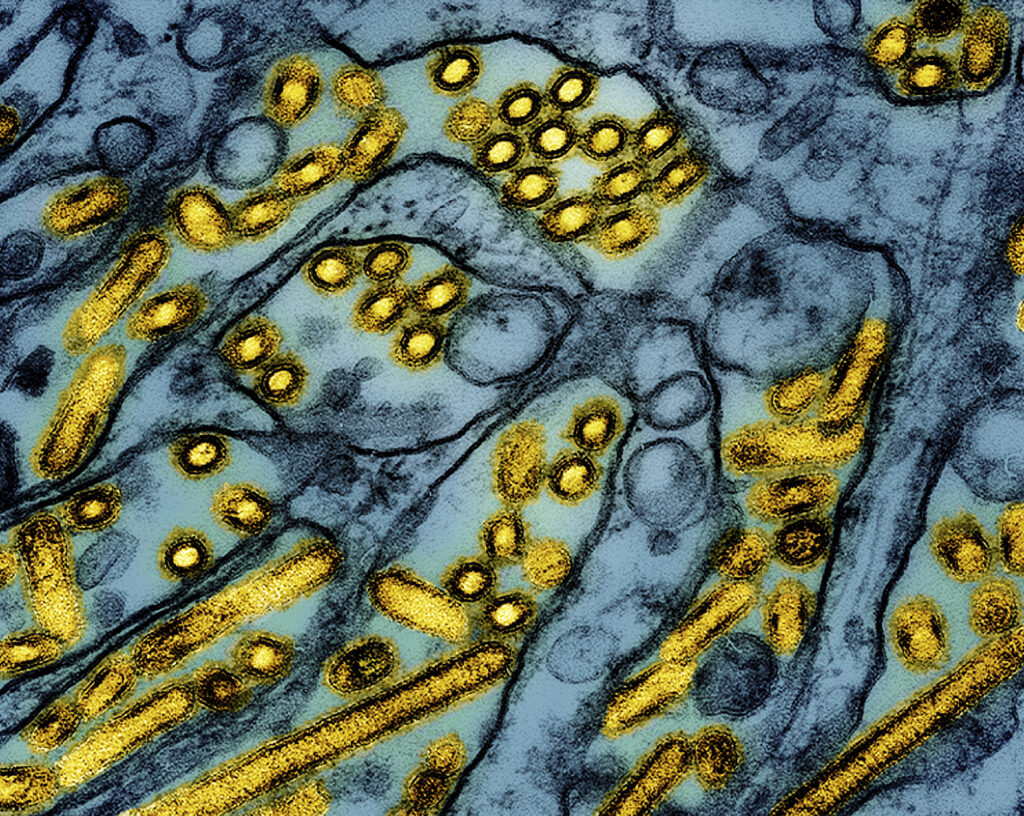
A new year might mean new viral threats.
Old viruses are constantly evolving. A warming and increasingly populated planet puts humans in contact with more and different viruses. And increased mobility means that viruses can rapidly travel across the globe along with their human hosts.
As an infectious diseases physician and researcher, I’ll be keeping an eye on a few viruses in 2026 that could be poised to cause infections in unexpected places or in unexpected numbers.
Bird flu or avian influenza A — on the cusp of a pandemic
Influenza A is a perennial threat. The virus infects a wide range of animals and has the ability to mutate rapidly. The most recent influenza pandemic — caused by the H1N1 subtype of influenza in 2009 — killed over 280,000 people worldwide in its first year, and the virus continues to circulate today. This virus was often called swine flu because it originated in pigs in Mexico before circulating around the world.
Most recently, scientists have been monitoring the highly pathogenic avian influenza H5N1 subtype, or bird flu. This virus was first found in humans in southern China in 1997; wild birds helped spread it around the world. In 2024, the virus was found for the first time in dairy cattle in the United States and subsequently became established in herds in several states.
The crossover of the virus from birds to mammals created major concern that it could become adapted to humans. Studies suggest there have already been many cow-to-human transmissions.
In 2026, scientists will continue to look for any evidence that H5N1 has changed enough to be transmitted from human to human — a necessary step for the start of a new influenza pandemic. The influenza vaccines on the market probably don’t offer protection from H5N1, but scientists are working to create vaccines that would be effective against the virus.
Mpox — worldwide and liable to worsen
Mpox virus, formerly called monkeypox, was first discovered in the 1950s. For many decades, it was seen rarely, primarily in sub-Saharan Africa. Contrary to its original name, the virus mostly infects rodents and occasionally crossed over into humans.
Mpox is closely related to smallpox, and infection results in a fever and painful rash that can last for weeks. There are several varieties of mpox, including a generally more severe clade I and a milder clade II. A vaccine for mpox is available, but there are no effective treatments.
In 2022, a global outbreak of clade II mpox spread to more than 100 countries that had never seen the virus before. This outbreak was driven by human-to-human transmission through close contact, often via sex.
While the number of mpox cases has significantly declined since the 2022 outbreak, clade II mpox has become established around the world. Several countries in central Africa have also reported an increase in clade I mpox cases since 2024. Since August 2025, four clade I mpox cases have occurred in the U.S., including in people who did not travel to Africa.
It is unclear how mpox outbreaks in the U.S. and abroad will continue to evolve in 2026.
Oropouche virus — insect-borne and poised to spread
Oropouche virus was first identified in the 1950s on the island of Trinidad, off the coast of South America. The virus is carried by mosquitoes and small biting midges, also known as no-see-ums.
Most people with the virus experience fever, headache and muscle aches. The illness usually lasts just a few days, but some patients have weakness that can persist for weeks. The illness can also recur after someone has initially recovered.
There are many unanswered questions about the Oropouche virus and the disease it causes, and there are no specific treatments or vaccines. For decades, infections in people were thought to occur only in the Amazon region. However, beginning in the early 2000s, cases began to show up in a larger area of South America, Central America and the Caribbean. Cases in the United States are usually among travelers returning from abroad.
In 2026, Oropouche outbreaks will probably continue to affect travelers in the Americas. The biting midge that carries Oropouche is found throughout North and South America, including the southeastern United States. The range of the virus could continue to expand.
Even more viral threats
A number of other viruses pose a risk in 2026.
Continuing global outbreaks of chikungunya virus may affect travelers, some of whom may want to consider getting vaccinated for this disease.
Measles cases continue to rise in the U.S. and globally against the backdrop of decreasing vaccination rates.
HIV is poised for a resurgence, despite the availability of effective treatments, because of disruptions in international aid.
And as-yet-undiscovered viruses can always emerge in the future as humans disrupt ecosystems and travel around the world.
Across the globe, people, animals and the wider environment are dependent on one another. Vigilance for known and emerging viral threats and the development of new vaccines and treatments can help keep everyone safe.
Dr. Peter Jackson is an assistant professor of infectious diseases at the University of Virginia.
The post What viruses an infectious-disease doctor is watching for in 2026 appeared first on Washington Post.