A day after President Trump declared that the United States planned to “run” Venezuela for an unspecified period, Defense Department officials said there were no U.S. military personnel in the country.
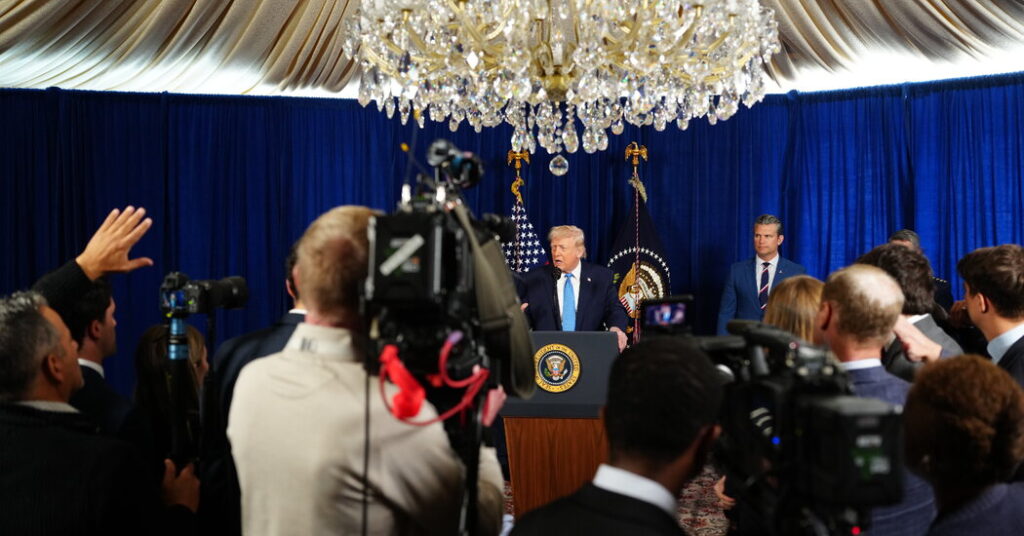
But a force of 15,000 troops on land in nearby countries and on a dozen warships in the Caribbean “remain in the region at a high state of readiness, prepared to project power, defend themselves, and our interests in the region,” Gen. Dan Caine, chairman of the Joint Chiefs of Staff, said at a news conference at Mar-a-Lago on Saturday.
Hours after the commando raid that captured Nicolás Maduro, Venezuela’s president, Mr. Trump suggested on Saturday there would be a “second wave” of military action if the United States ran into resistance on the ground or from Venezuelan government officials.
“We’re not afraid of boots on the ground,” Mr. Trump said after praising Army Delta Force commandos for successfully spiriting Mr. Maduro and his wife out of the country.
Asked who exactly would be running Venezuela, Mr. Trump said “people that are standing right behind me, we’re going to be running it,” pointing to General Caine, Secretary of State Marco Rubio and Defense Secretary Pete Hegseth.
Pentagon officials on Sunday had no ready response to questions about how long the military would keep its sizable force in the Caribbean — the largest naval buildup in the region since the Cuban Missile Crisis in 1962.
The military buildup had been designed initially to help detect and destroy speedboats that the Trump administration claims, without evidence, are trafficking drugs. The military has attacked 35 boats and killed at least 115 people in the Caribbean and Eastern Pacific since early September. A broad range of legal specialists on the use of lethal force have criticized those strikes as illegal.
In recent months, military forces in the region also helped U.S. boardings of tankers under American sanctions that were trying to deliver or pick up oil from Venezuela.
In the days leading to Saturday’s raid, the U.S. repositioned to the area increasing numbers of Special Operations aircraft, specialized electronic warfare planes, armed Reaper drones, search-and-rescue helicopters and fighter jets. Military analysts said at the time that those last-minute reinforcements indicated that the only question about a U.S. military action in Venezuela was when it would happen, not if.
Eric Schmitt is a national security correspondent for The Times. He has reported on U.S. military affairs and counterterrorism for more than three decades.
The post U.S. Has No Troops in Venezuela, Defense Department Says appeared first on New York Times.