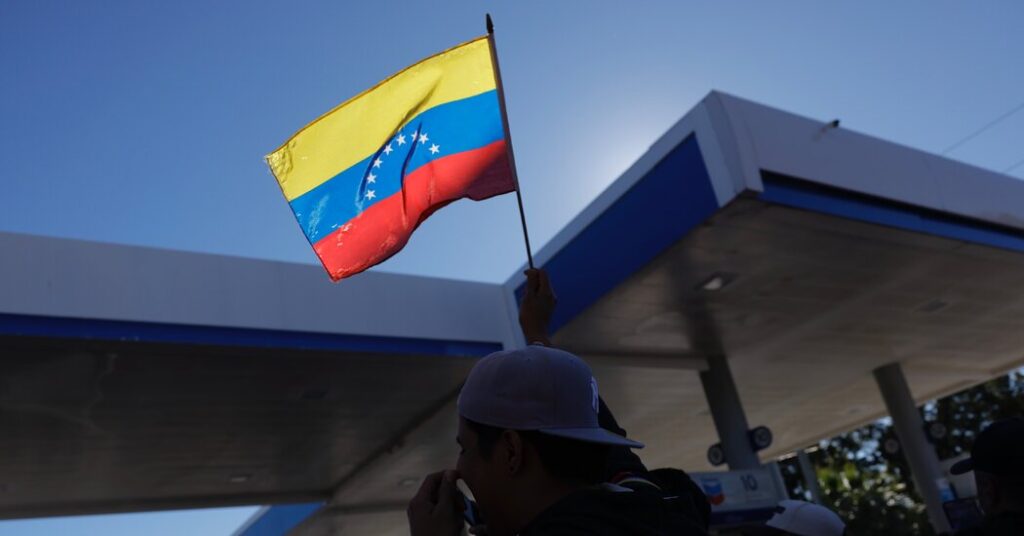
President Trump’s declaration on Saturday that the United States planned to “run” Venezuela for an unspecified period, issuing orders to its government and exploiting its vast oil reserves, plunged the United States into a risky new era in which it will seek economic and political dominance over a nation of roughly 30 million people.
Speaking at his Mar-a-Lago private club just hours after Nicolás Maduro, the leader of Venezuela, and his wife were seized from their bedroom by U.S. forces, Mr. Trump told reporters that Delcy Rodríguez, who served as Mr. Maduro’s vice president, would hold power in Venezuela as long as she “does what we want.”
Ms. Rodríguez, however, showed little public interest in doing the Americans’ bidding. In a national address, she accused Washington of invading her country under false pretenses and asserted that Mr. Maduro was still Venezuela’s head of state. “What is being done to Venezuela is a barbarity,” she said.
Mr. Trump and his top national security advisers carefully avoided describing their plans for Venezuela as an occupation, akin to what the United States did after defeating Japan, or toppling Saddam Hussein in Iraq. Instead, they vaguely sketched out an arrangement similar to a guardianship: The United States will provide a vision for how Venezuela should be run and will expect the interim government to carry that out in a transition period, under the threat of further military intervention.
Even after Ms. Rodríguez contradicted Mr. Trump, Marco Rubio, the secretary of state and national security adviser, said he was withholding judgment.
“We’re going to make decisions based on their actions and their deeds in the days and weeks to come,” he said in an interview with The New York Times. “We think they’re going to have some unique and historic opportunities to do a great service for the country, and we hope that they’ll accept that opportunity.”
Mr. Trump suggested on Saturday that while there were no American troops on the ground now, there would be a “second wave” of military action if the United States ran into resistance, either on the ground or from Venezuelan government officials.
“We’re not afraid of boots on the ground,” Mr. Trump said. Asked who, exactly, would be running Venezuela, he said “people that are standing right behind me, we’re going to be running it,” pointing to Secretary of State Marco Rubio, Defense Secretary Pete Hegseth, and the chairman of the Joint Chiefs of Staff, Gen. Dan Caine.
Mr. Trump paired that with a declaration that a key American goal was to regain access to oil rights that he has repeatedly said had been “stolen” from the United States. With those statements, the president opened a new chapter in American nation building.
It is one in which he hopes to influence every major political decision in Venezuela by the presence of an armada just offshore, and perhaps to intimidate others in the region. He repeated a warning to the president of Colombia, another country targeted by the administration for its role in drug trafficking, to “watch his ass.”
Mr. Trump’s actions on Saturday cast America back to a past era of gunboat diplomacy, when the United States used its military to grab territory and resources for its own benefit.
A year ago this week, he openly mused, also at Mar-a-Lago, about making Canada, Greenland and Panama parts of the United States. Now, after hanging in the White House a portrait of William McKinley, the tariff-loving president who presided over the military seizure of the Philippines, Guam and Puerto Rico, Mr. Trump said it was well within the rights of the United States to wrest from Venezuela resources that he believes had been wrongly taken from the hands of American corporations.
The U.S. operation, in seeking to assert control over a vast Latin American nation, has little precedent in recent decades, recalling the imperial U.S. military efforts of the 19th and early 20th centuries in Mexico, Nicaragua and other countries.
Mr. Trump and his aides claimed they had a legal basis for the immediate action he ordered on Friday, the extraterritorial rendition of Mr. Maduro. An indictment that dates to 2020 charged the Venezuelan leader with a series of acts related to drug trafficking. A refreshed indictment was published Saturday, one that included Mr. Maduro’s wife, Cilia Flores.
But that indictment only deals with Mr. Maduro’s alleged crimes. It did not provide a legal basis for taking control of the country, as the U.S. president declared he was doing.
Mr. Trump was unapologetic about taking that step, and in his justification, he showed he had given much thought to the oil industry.
“Venezuela unilaterally seized and sold American oil, American assets and American platforms, costing us billions and billions of dollars,” he said of resources that were being pumped out of Venezuelan bedrock. “They did this a while ago, but we never had a president that did anything about it. They took all of our property.” He added: “The socialist regime stole it from us during those previous administrations, and they stole it through force.”
Now, he made clear, he was taking it back, and Americans would be compensated before Venezuelans became, he predicted, “rich.”
But that left many open questions. Will the United States need an occupying military force to protect the oil sector while the Americans and others rebuild it? Will the United States run the courts, and determine who pumps the oil?
Will it install a pliant government for some number of years, and what happens if a legitimate, democratic election is won by Venezuelans with a different vision for their country?
All of these questions, of course, could enmesh the United States into exactly the kind of “forever wars” which Mr. Trump’s MAGA base has warned against.
When pressed on that point, Mr. Trump dismissed it. He noted that he had been successful in killing the leader of the Iranian Quds force, Gen. Qassim Suleimani, in January 2020. He cited the success for his attack on Iran’s major nuclear sites, burying its uranium stockpile.
But those were largely one-and-done attacks. They did not involve running a foreign nation, or dealing with the resistance that almost always accompanies an effort like that.
For much of the 20th century, the United States intervened militarily in smaller countries in the Caribbean and Central America. But Venezuela is twice the size of Iraq, with challenges that may prove just as complex.
“Any democratic transition will require the buy-in of pro-regime and anti-regime elements,” John Polga-Hecimovich, a Venezuela scholar at the U.S. Naval Academy, said in an interview.
One crucial test, he said, is how the Venezuelan armed forces react. “If it splinters, with some backing a transition and others not, things could get violent,” he said. “On the other hand, a unified force would help legitimize whatever government comes next.”
Simon Romero contributed reporting from São Paulo, Brazil.
David E. Sanger covers the Trump administration and a range of national security issues. He has been a Times journalist for more than four decades and has written four books on foreign policy and national security challenges.
The post Trump Plunges the U.S. Into a New Era of Risk in Venezuela appeared first on New York Times.