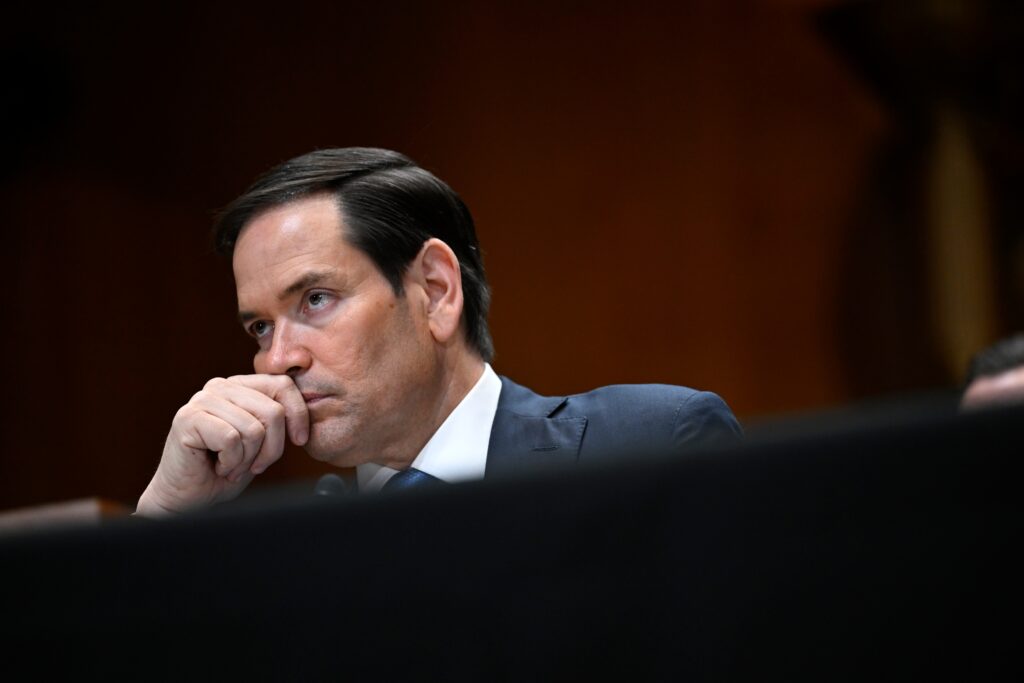
In early November, hours before the Republican-led Senate rejected bipartisan legislation to block the Trump administration from conducting a military attack on Venezuela, Secretary of State Marco Rubio sought to reassure lawmakers it didn’t intend to.
He told them that the U.S. lacked legal authority to invade the South American country and oust its president, Nicolás Maduro, and said that doing so would carry major risks, according to two people who attended the classified briefing.
In the aftermath of Saturday’s stunning raid to capture Maduro and his wife at a fortified military compound in Caracas, top Democrats are accusing Rubio of deliberately misleading Congress.
During a news conference at President Donald Trump’s Mar-a-Lago Club in Florida, Rubio, who also serves as White House national security adviser, told reporters that he and other top officials had planned the Maduro operation for months. The acknowledgment led some on Capitol Hill to conclude that the administration was readying assets for the assault while having told lawmakers that the military buildup in the region was not meant to force a regime change.
“Rubio said that there were not any intentions to invade Venezuela,” Rep. Gregory W. Meeks of New York, the House Foreign Affairs Committee’s top Democrat, told The Washington Post. “He absolutely lied to Congress.”
In an interview with The Post later Saturday, Rubio rejected the assertion. He argued that Maduro is under indictment from a U.S. court, and neither the United States nor the European Union recognized him as the legitimate leader of Venezuela. So rather than an invasion, he cast the attack as a “law enforcement operation” that required military assets to conduct.
Lawmakers previously asked whether the administration “would be invading Venezuela,” Rubio said. “This was not that,” he added.
Democrats were incredulous at the argument.
“It absolutely is one hundred percent regime change,” said Rep. Adam Smith of Washington, the senior Democrat on the House Armed Services Committee.
Smith said he had asked Rubio directly whether the administration’s military buildup in the region would result in attacks on Venezuelan territory and that the secretary had said no.
The Trump administration did not notify key members of Congress of the operation until late Saturday morning, sending a short notice that said the president had approved a “military operation in Venezuela to address national security threats posed by the illegitimate Maduro regime.”
The operation, the notice said, came in response to the Justice Department’s warrant against Maduro, who was transported to New York to await trial.
Sen. Mark R. Warner of Virginia, the top Democrat on the Senate Intelligence Committee, said Rubio tried to reach him after the raid had begun in the early morning hours but that they were unable to connect.
Warner, who has had multiple briefings with Rubio over the past few months, declined to say whether he felt the administration had misled Congress but noted that the timing for the operation — with lawmakers days away from returning to Washington after a holiday break — was not “idle chance.”
“Doing this during a congressional break raises huge questions,” he said in an interview.
Senior Republicans called on the administration to brief lawmakers even while expressing near-unified support for the operation. Senate Majority Leader John Thune (R-South Dakota) and House Speaker Mike Johnson (R-Louisiana) said in separate statements that they had spoken with senior officials early Saturday and wanted the administration to brief Congress in the coming week.
Senate Minority Leader Charles E. Schumer (D-New York) and House Minority Leader Hakeem Jeffries (D-New York) demanded far more information.
“We want to know the administration’s objectives, its plans to prevent a humanitarian and geopolitical disaster that plunges us into another endless war — or one that trades one corrupt dictator for another,” Schumer told reporters.
The Senate is set to vote next week on another war powers resolution that, if passed, would block the administration from conducting further military action in Venezuela. Trump said Saturday that the U.S. could carry out a larger “second wave” of attacks, but that he did not think doing so would be necessary because Venezuela’s interim leader was cooperating with U.S. demands.
Sen. Tim Kaine (D-Virginia) said he hoped the new measure would get more Republican support. He, too, accused the administration of lying to lawmakers and the public.
At least two of the Republicans who considered supporting the measure that was narrowly defeated in November received calls from Rubio on Saturday, according to their public statements.
“Congress should have been informed about the operation earlier and needs to be involved as this situation evolves,” said Susan Collins (R-Maine), one of the lawmakers who signaled that they might support the last resolution but ultimately opposed it.
Shortly after news of the attack broke Saturday morning, Sen. Mike Lee (R-Utah), a skeptic of expansive U.S. military commitments abroad, posted on social media that he wanted to know “what, if anything, might constitutionally justify this action in the absence of a declaration of war or authorization for the use of military force” from Congress.
Hours later, Lee posted again that he had spoken with Rubio and was satisfied that the attack “likely” was within the president’s authority.
John Hudson and Marianna Sotomayor contributed to this report.
The post Trump administration misled Congress before Maduro raid, Democrats say appeared first on Washington Post.