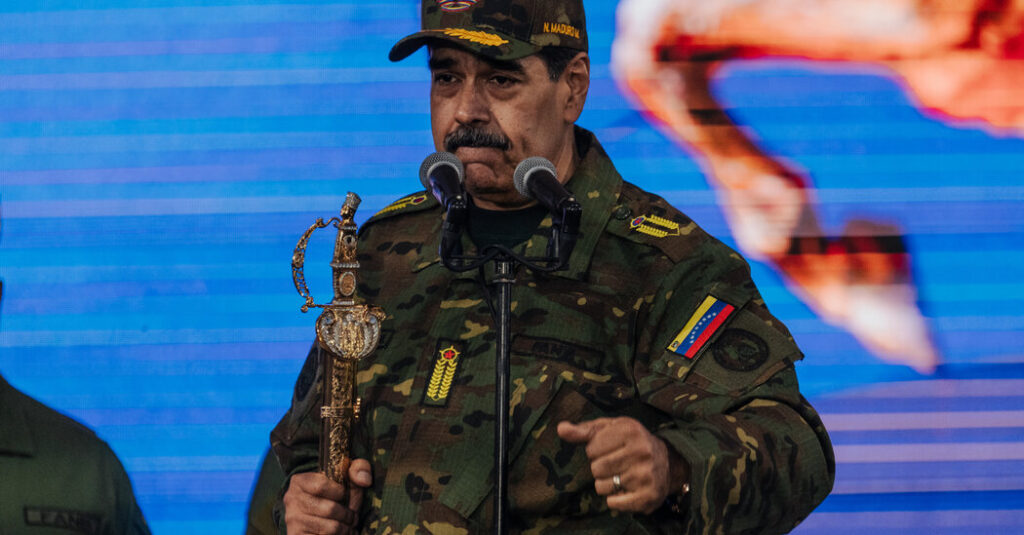
The United States unsealed an indictment on Saturday against Venezuela’s President Nicolás Maduro that charges him with narco-terrorism and conspiracy to import cocaine.
The four-count indictment also charges Mr. Maduro’s wife, his son, two high-ranking Venezuelan officials and an alleged leader of the Tren de Aragua group, a gang that the Trump administration designated as a terrorist organization last year. President Trump has said that Tren de Aragua operates in conjunction with Mr. Maduro’s government, a conclusion that U.S. intelligence agencies have contradicted.
The indictment states that Mr. Maduro and his allies worked for decades with major drug trafficking groups to move large quantities of cocaine to the United States.
It follows months of a steadily escalating pressure campaign against Mr. Maduro, which culminated in his capture by the U.S. military in Caracas, the Venezuelan capital. He arrived in New York on Saturday afternoon and will be flown in a helicopter to Manhattan for prosecution.
The pressure campaign began in September with lethal attacks by U.S. forces on small vessels that the Trump administration has said were carrying drugs from Venezuela to the United States. The administration has justified the attacks by saying the United States was in an armed conflict with drug cartels and vowed to destroy trafficking networks. Many experts say these strikes are illegal.
President Trump has asserted that the campaign is targeting drugs killing Americans, but most U.S. overdoses involve fentanyl, which doesn’t come from South America, experts say.
Fentanyl, which causes tens of thousands of overdoses per year, is almost entirely produced in Mexico using chemicals from China, according to U.S. authorities, and Venezuela plays no known role in its trade, nor does any other South American country.
The indictment unsealed Saturday focuses almost entirely on Venezuela’s decades-long role in the cocaine trade. It accuses Mr. Maduro and co-conspirators of working closely with some of the region’s largest drug trafficking groups, in Colombia and in Mexico. They include groups such as the Revolutionary Armed Forces of Colombia, known by its Spanish acronym FARC, and the Sinaloa Cartel, which are also designated by the United States as terrorist organizations.
Experts, however, have said Venezuela is not a major drug producer and have described it as a minor cocaine transit country, with most of the cocaine flowing through Venezuela heading to Europe, not the United States.
The majority of the cocaine bound for the United States is believed to move not through the Caribbean but through the Pacific, according to data from Colombia, the United States and the United Nations. Venezuela does not have a Pacific Coast.
While the indictment states that Venezuela was shipping 200 to 250 metric tons of cocaine a year by around 2020, that represents only about 10 percent to 13 percent of the global cocaine trade. Other countries play a much larger role. In 2018, 1,400 metric tons passed through Guatemala, according to U.S. data.
There is evidence that Mr. Maduro has benefited from the drug trade to stay in power. Both the indictment and experts say he also used profits from drug trafficking to secure the loyalty of military officials and leaders in his party.
Genevieve Glatsky is a reporter for The Times, based in Bogotá, Colombia.
The post The U.S. has indicted Maduro on charges of cocaine smuggling, but experts say Venezuela’s role in that trade is modest. appeared first on New York Times.