In the In Times Past column, David W. Dunlap explores New York Times history through artifacts housed in the Museum at The Times.
The New York Times turns 175 this year.
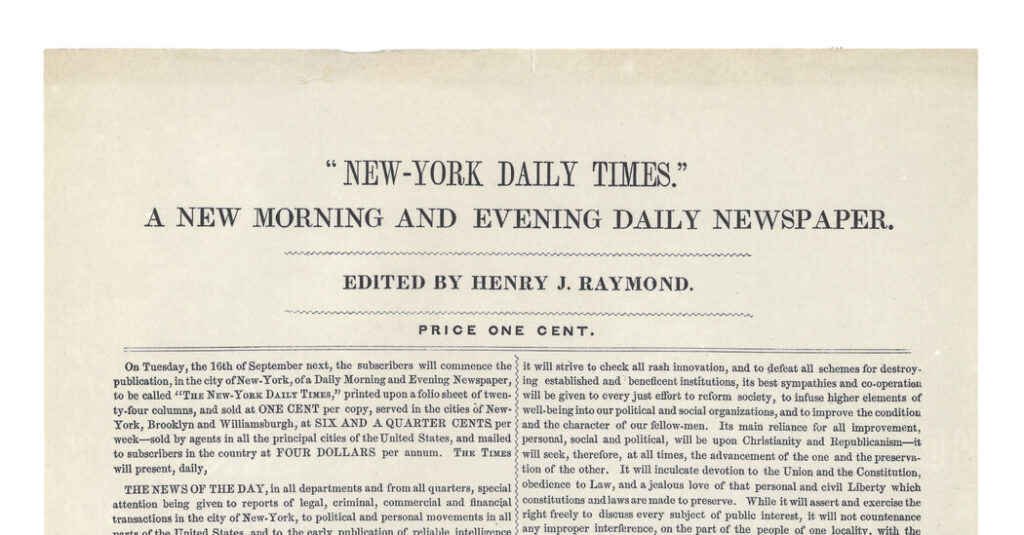
The newspaper’s birth announcement was a prospectus issued on Aug. 30, 1851, by Raymond, Jones & Company, a partnership of Henry Jarvis Raymond (1820-1869), the founding editor of The Times, and George Jones (1811-1891), the founding publisher. “‘New-York Daily Times,’” the prospectus began. “A New Morning and Evening Daily Newspaper. Edited by Henry J. Raymond. Price One Cent.”
The name was changed in 1857 to “The New-York Times” after the evening edition was suspended. The hyphen was dropped in 1896. The price is no longer a penny. And the family of Adolph S. Ochs (1858-1935) has controlled The Times since 1896.
Yet something endures of what Raymond outlined in his prospectus, a facsimile of which is in the Museum at The Times.
He promised that readers of The Times would find “THE NEWS OF THE DAY”; “CORRESPONDENCE from all parts of Europe, from California, Mexico and South America, and from all sections of the United States”; “FULL REPORTS of Congressional and Legislative Proceedings”; “LITERARY REVIEWS AND INTELLIGENCE, prepared by competent persons”; “CRITICISMS of Music, the Drama, Painting”; and “EDITORIAL ARTICLES upon everything of interest or importance.”
But readers should not expect to find articles that expressed support for the abolition of slavery in the South, in particular. Raymond said his newspaper would “not countenance any improper interference, on the part of the people of one locality, with the institutions, or even the prejudices, of any other.”
Raymond was a politician as well as a journalist. He helped found the Republican Party in 1856, five years before the Civil War. He viewed the emancipation of slaves and the abolition of slavery more as means to a political end — preserving and strengthening the union — than as moral imperatives in and of themselves.
Once persuaded that abolition fortified the cause of unionism, Raymond championed the destruction of slavery. On Dec. 19, 1865, after the 13th Amendment was ratified, Raymond confessed in an editorial “to a strange thrill of emotion, and of devout gratitude to Him who orders all things well.”
“Human slavery within the jurisdiction of the United States of America is no more! Thank God! And what a noble prelude to the holy season of Christmas, of ‘Peace on earth, good-will to men.’” He concluded: “It is done! Let us rejoice.”
And with that, the In Times Past column comes to an end. But there is more Times history in store this year as the company celebrates its 175th anniversary.
David W. Dunlap, a retired Times reporter and columnist, is the curator of the Museum at The Times, which houses Times artifacts and historical documents.
The post The Birth of The Times appeared first on New York Times.