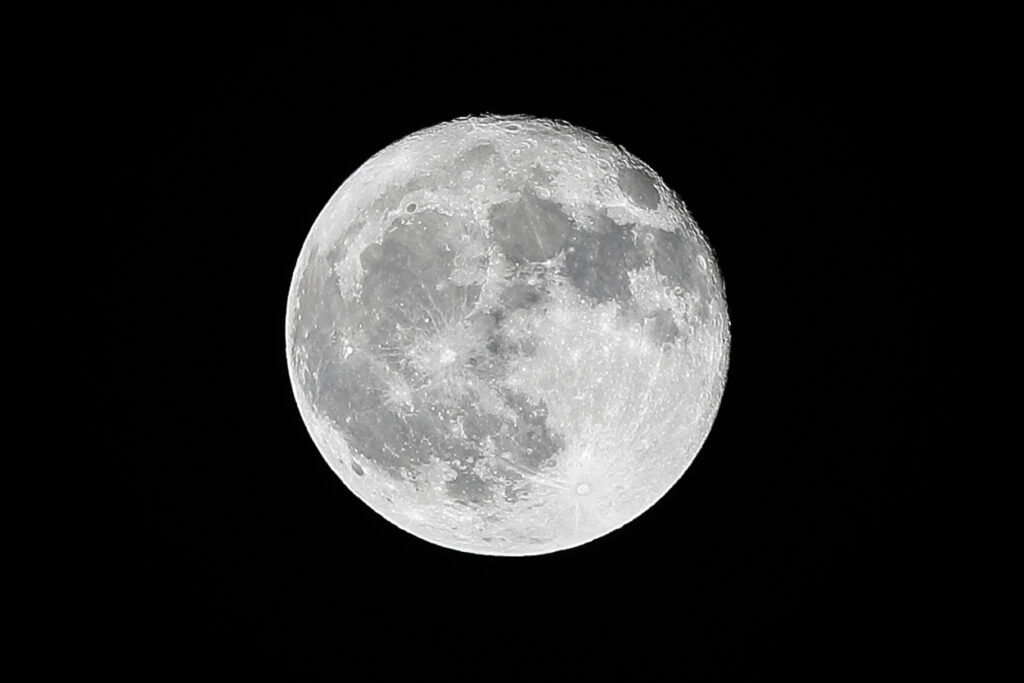
It was another cold day Saturday — and it was cloudy — but in Washington the early morning clouds could not block the sight of the full moon, which was also a super moon, or of the giant planet Jupiter, which seemed almost a lunar suburb.
Clouds can easily and often block many a celestial sight, but on Saturday morning above D.C. they seemed just thin enough, just flimsy enough, just widely enough spaced around 4:45 a.m. to permit a view of the moon.
Under the circumstances, the moon seemed both bright and diffuse.
The same could be said perhaps of Jupiter. It seemed larger than the average star or planet, although a little hazy.
On Saturday it was easier to spot and identify than it may sometimes be. It seemed no more than the width of two or three fingers away from the moon, as the two of them dominated the early morning sky.
Sighting the two through the vaporous blanket above seemed to compensate for being outdoors long after midnight and well before sunrise on a subfreezing morning.
As of 4 p.m. Saturday, it appeared that the day’s temperatures had spent the day straddling the freezing mark. The morning low was 27 degrees, five below freezing, and the afternoon high was a still-frosty 35, only three above.
Both of those readings fell well below normal in their respective categories for the third day of January in the District. Little cause exists to confuse the District with the Arctic, and the normal high in D.C. for Saturday’s date is 45 degrees, 10 degrees warmer than anything recorded as of late afternoon.
The sun on Saturday did not seem a reliable source of winter warmth. Clouds seemed often to cover it. At many moments, however, it seemed to work its way through the grayness, finding seams or penetrating thin spots.
Often during daytime Saturday it almost seemed as if dawn were about to break as the sun found its way through the clouds, and a pale sort of illumination began to seep over the landscape. It almost seemed as if a bright new day was about to begin.
But these moments did not last, as the curtain of cloud seemed to close again.
Nevertheless, in the early morning and despite the clouds, the moon could be seen. Not as clear or bright as sometimes, but still bright and certainly visible.
It was known as a super moon because it was full near the time of its closest approach to Earth on this month’s orbit.
Proximity, of course, enhances brightness. But the added proximity is not so far above average as to make the added brightness readily apparent. Nevertheless, a full moon is a full moon, and the very name sometimes given to the January full moon enhanced the experience of seeing it.
The January full moon appears to be most commonly known in folklore as the Wolf Moon. Merely to imagine hungry wolves howling in the distance heightened the chill of the morning’s darkness.
The moon became totally, mathematically full at 5:03 a.m. Saturday and it will appear full again on Saturday night and Sunday morning.
The post Super moon shone through clouds over D.C. on Saturday appeared first on Washington Post.