It’s hard to imagine a worse leader for Venezuela than Nicolás Maduro, who combined corruption, economic mismanagement and brutal repression in one repulsive package. That doesn’t mean America was right to invade the country and arrest him, which strikes me as both unconstitutional and unwise. And while it’s hard to imagine a worse leader than Maduro, that doesn’t mean there isn’t one out there, waiting in the wings.
Yet the thing is done, so what’s left is to figure out whether Venezuela can be rebuilt into what Trump says he wants — “good neighbors” who help the United States “surround” itself “with stability.” That will depend on the other thing Trump says he wants: a rapid ramp-up in Venezuelan oil production. Everyone should want that much, because it’s the only way to lift Venezuelans out of the dire poverty of their failed socialist economy.
Alas, Venezuela’s destruction took decades. Its reconstruction probably will too.
The country is sitting on the world’s largest proven oil reserves, which once gave it the fourth-highest gross domestic product per capita in the world. Though that position had slipped considerably by the 1990s, thanks to falling oil prices and underinvestment, a set of market liberalizations and good management by PDVSA, the state-owned oil company, had boosted production to more than 3 million barrels per day by 1998, the year socialist Hugo Chávez was elected.
Chávez slapped rigid price controls on the economy and turned PDVSA into a piggy bank for his domestic social programs, as well as an instrument of his foreign policy. He got away with this for quite a while, thanks to extremely fortuitous timing: Chávez came into office just as oil prices were bottoming out following the Asian financial crisis.
In the two years after he took office, prices more than doubled, and then they really began to take off, briefly touching $140 a barrel right before the 2008 U.S. financial crisis. Even after Lehman Brothers went belly up and the global economy tanked, oil prices remained comfortably above $80 a barrel. This was the period when various lefties made fools of themselves praising Chávez for proving that socialism worked.
In fact, the illusory early success of Chávismo was entirely a function of capitalist markets that were making the oil under Venezuela’s soil more profitable than ever before. Unfortunately for the Venezuelans, those high prices spurred capitalists to look for new sources, such as shale oil. Meanwhile, the socialists at home were destroying the country’s ability to pump what it had out of the ground.
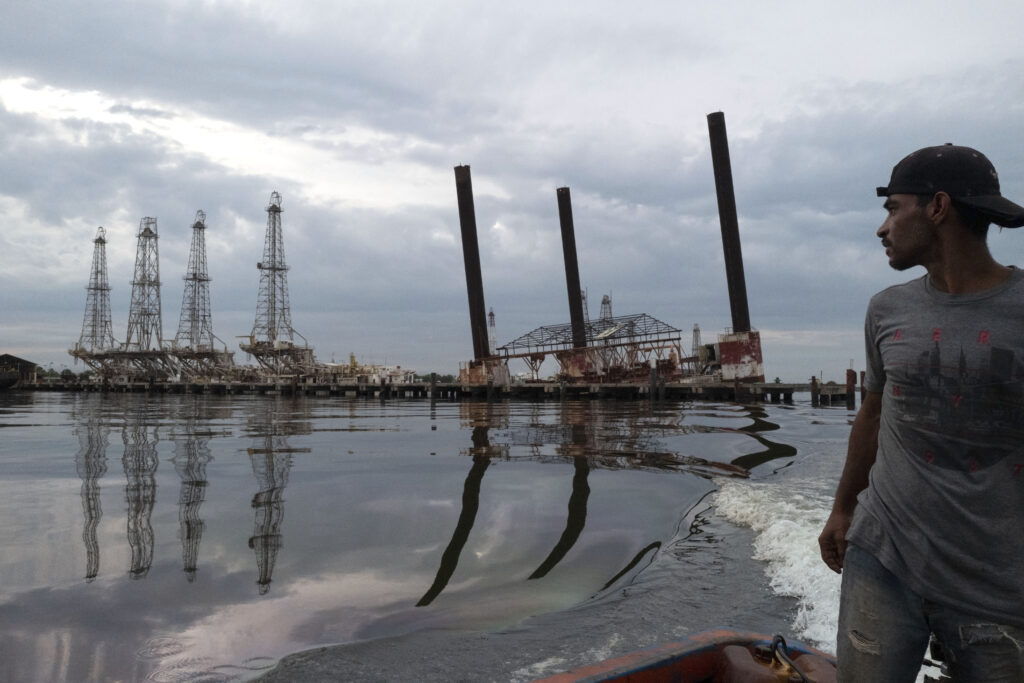
Oil extraction requires a lot of capital and know-how — particularly in the case of Venezuela’s heavy, sulfurous crude, which is difficult to pump and refine. But with Chávez diverting PDVSA funds into social spending, there was less money to invest in the oil fields. The country’s human capital was eroding just as fast, as experienced engineers and managers were replaced with regime loyalists. Meanwhile, the government kept demanding more and more concessions from multinationals operating in the country, to the point where they looked less like “concessions” and more like “extortion.”
Unsurprisingly, Venezuelan oil production slowly began to slide. By 2013, the year Chávez died of cancer, it was down to 2.65 million. For a time, this steady erosion of production was offset by the steep increase in oil prices, so Chávez never lived to see the consequences of his efforts. That whirlwind was reaped by his successor, Maduro, who saw oil prices and production go into free fall together, resulting in the largest peacetime economic contraction ever recorded.
Lately, Maduro made a few gestures toward markets, as socialist dictatorships sometimes do when economic reality becomes too brutal to ignore. But it has been too little, too late, and Venezuela still pumps less than a million barrels of oil per day.
Turning that around will require the capital and skill of multinationals who are justifiably wary. Because oil fields are expensive to develop — and because the infrastructure is hard to move once it’s in place — governments face the eternal temptation to expropriate companies as soon as the development phase is finished. Under socialism, Venezuela indulged that temptation with a vengeance.
The government could have gotten away with a moderate rewrite of the terms of its oil development deals. Instead, it went for wholesale looting, and now it won’t be enough for Venezuela to dismantle its socialist economic policies and offer oil companies a reasonable profit on new development — those things are a necessary minimum. The new government, whatever it might be, will also need to find some way to make a credible commitment that things will stay semi-liberalized and somewhat reasonable. That will mean guaranteeing physical security for foreign investors and developing complementary infrastructure and services, such as repairing the country’s degraded power grid.
If the U.S. actually wants Venezuela to stabilize, and a reversal of the flood of refugees, much more than removing Nicolás Maduro will be required. If a new democratic government takes shape and it can make long-term commitments to growth, a major deployment of U.S. influence and money will be needed. I doubt reconstruction funds and state-building were what Trump and his advisers were thinking of when they decided to invade Venezuela. But if they’d been thinking it through, they probably wouldn’t have invaded in the first place.
The post Seizing Maduro? Quick. Fixing Venezuela’s oil production? Years. appeared first on Washington Post.