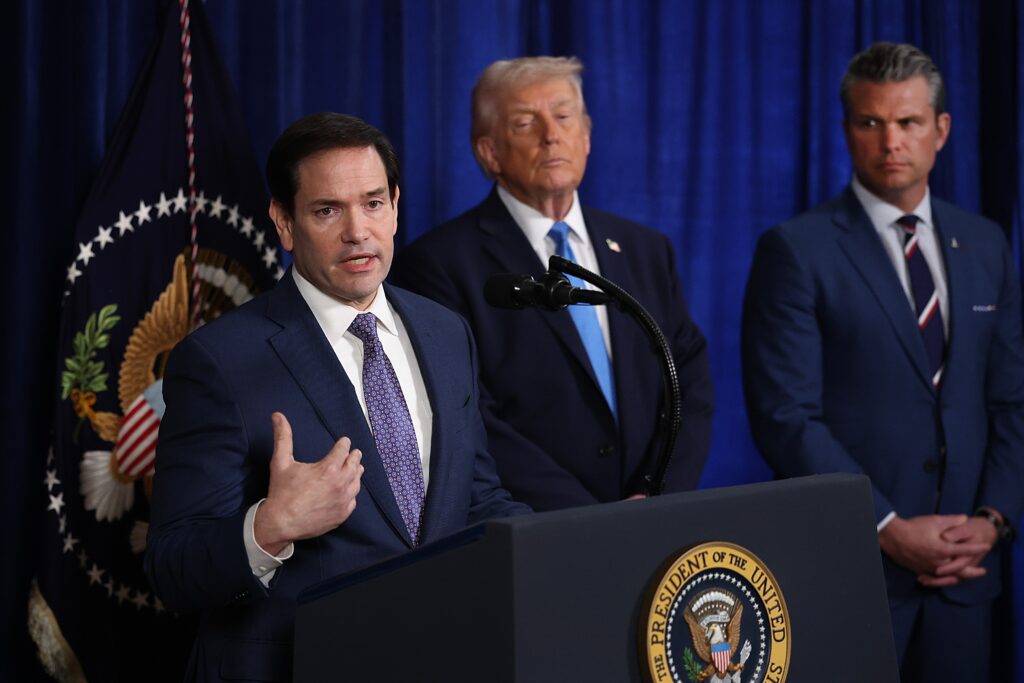
Marco Rubio has held many titles during Donald Trump’s presidency. He may have just acquired his most challenging one yet: Viceroy of Venezuela.
The secretary of state, national security adviser, acting archivist and administrator of the now-defunct U.S. Agency for International Development was central to masterminding the ouster of Venezuelan President Nicolás Maduro on Saturday, officials familiar with the planning said.
But with no immediate successor to govern the country of roughly 29 million, Trump is leaning on Rubio to help “run” Venezuela, divvy up its oil assets and usher in a new government, a fraught and daunting task for someone with so many other responsibilities.
“The task in front of him is stupefying,” said a senior U.S. official, noting the dizzying array of policy decisions related to energy, elections, sanctions and security that await. This person, like others interviewed for this article, spoke on the condition of anonymity to respond freely.
The moment marks the realization of a long-held goal for Rubio, who has voiced his criticisms of Maduro and desire for change in Venezuela for well over a decade. Those who have worked closely with Rubio, whose parents fled Cuba shortly before the Communist takeover in 1959, say the issues of the region are close to his heart.
“Marco’s parents’ experience … is hardwired in him,” said Cesar Conda, a Republican strategist who worked as the former senator’s chief of staff between 2011 and 2014.
U.S. officials say Rubio will play an outsize role in guiding U.S. policy as the Trump administration attempts to stabilize Venezuela.
His Spanish proficiency, familiarity with Latin American leaders and the Venezuelan opposition make him a natural point man for Trump, said another senior U.S. official. But this person emphasized that the administration will need to appoint a full-time envoy to assist Rubio given the vast scope of decisions and responsibilities inherent in such a task.
Trump, speaking to reporters after the operation, was vague when addressing questions about whether his administration is capable of running the Latin American country, saying “the people that are standing right behind me” will do so for a “period of time.”
The president hailed Rubio’s initial talks with Maduro’s vice president, Delcy Rodríguez.
“He just had a conversation with her, and she’s essentially willing to do what we think is necessary to make Venezuela great again,” Trump said. Shortly after his comments, Rodríguez contradicted Trump’s plans for her country, saying Venezuela “will never return to being the colony of another empire.”
The U.S. capture of the sweat-pant clad Maduro not only fulfills a long-held goal of Rubio’s but also represents a bureaucratic victory for him in an administration that includes ardent skeptics of regime change, in particular Vice President JD Vance.
“Many people were skeptical that some kind of extraction operation could be carried out without a hitch,” said Geoff Ramsey, a nonresident senior fellow at the Atlantic Council. “He will see this as a resounding success for his foreign policy strategy.”
Justin Logan, director of defense and foreign policy studies at the Cato Institute, said that while the removal of Maduro alone was unlikely to satisfy political exiles, it could help the Trump administration avoid an Iraq- or Afghanistan-style quagmire that hurts Republicans at the next election.
“The only way it’s a mass political issue is if it gets bigger and costlier,” said Logan. “As long as the blood and treasure costs are this low, you can pretty much do whatever you want.”
Besides navigating the treacherous minefield of nation-building that lies ahead, Rubio will also have to rebuild trust among U.S. lawmakers, many of whom have accused him of lying to Congress when he said the Trump administration would seek congressional approval before taking military action against Venezuela.
“Secretaries Rubio and [Pete] Hegseth looked every Senator in the eye a few weeks ago and said this wasn’t about regime change. I didn’t trust them then and we see now that they blatantly lied to Congress,” said Sen. Andy Kim (D-New Jersey).
In an interview with The Washington Post, Rubio denied that he lied and said he promised to get congressional approval only if the United States “was going to conduct military strikes for military purposes.”
“This was not that. This was a law enforcement operation,” Rubio said, referring to the indictment against Maduro in the Southern District of New York on drug charges.
When pressed that U.S. forces bombing Venezuela, seizing its leader and claiming to “run” the country would be widely interpreted as a military operation, Rubio did not relent, saying “the mission last night was in support of the Department of Justice.”
The argument failed to move some experts. Jennifer Kavanagh, director of military analysis at Defense Priorities, said that the law enforcement justification was a “convenient” excuse for the administration’s decision not to notify Congress.
The operation to capture Maduro “was extremely massive and complex,” Kavanagh added. “It doesn’t sound like a law enforcement operation to me.”
Before joining the State Department, Rubio had long indicated that he supported using U.S. military force to oust Maduro, suggesting in a Spanish language interview in 2018 that there was a “strong argument” that the United States should do so.
The next year, during renewed tension with Maduro, Rubio posted photographs to social media of deposed foreign leaders, including Libya’s Moammar Gaddafi shortly before he was executed by rebel forces in 2011.
Though Trump had entertained the idea of talks with Maduro early last year, including those brokered in the early part of his term by envoy Richard Grenell that saw several detained U.S. citizens released, people close to the administration say that his instincts largely aligned with Rubio’s harder approach.
“Rubio and the president are working hand in glove on this,” and the two of them “were really running this thing,” said one individual close to the Trump administration who has known Rubio for many years.
During a news conference on Saturday, Rubio implied that Cuba could face similar U.S. military action. “If I lived in Havana, and I was in the government, I’d be concerned, at least a little bit,” he said in response to a reporter’s question.
Though former officials and analysts said they wouldn’t expect imminent military action against Cuba, it was likely that economic pressure would increase with Maduro removed from Venezuela.
“I presume that one of the first demands that we would have as the United States with whoever is running things in Venezuela is that any support for Cuba will stop on the theory that that will then destabilize that regime and lead to a better outcome,” said Kevin Whitaker, who served as U.S. ambassador to Colombia during the first Trump administration.
Exactly who is running things in Venezuela now is uncertain. Some Latin America experts said that the United States was probably underestimating the challenge of governing Venezuela with a small U.S. footprint.
“Credible estimates of the number of boots on the ground required range from tens of thousands to well into the hundreds of thousands,” said Adam Isacson, a scholar at the Washington Office on Latin America. “In Panama in 1989, the occupying force was 27,000, and Venezuela is 12 times the size and 6.5 times the population — with a much broader array of armed and criminal groups.”
“So it is reasonable to expect the 15,000 troops currently deployed in the region to multiply by a factor of well over five, at the most conservative estimate,” Isacson added.
By leaving Maduro’s vice president, Rodríguez, in place, the Trump administration may be trying to avoid a situation like in Iraq, where the government and military was almost completely purged, because that was a “catastrophe,” said Whitaker.
A former Senate staffer who remains in touch with Rubio said that they did not think U.S. officials would be performing a formal occupation like Paul Bremer and the Coalition Provisional Authority had done in Iraq.
“We’re going to tell them: ‘Hey, this is what you have to do in order for there not to be another strike,’” said the former staffer. “That’s what [Trump] sees as running the country.”
John Feeley, a former senior State Department official and ambassador to Panama who worked on Latin America for decades, said it appears the administration is hoping initially to exercise influence over Venezuela through Rodríguez, whom he described as an “ideological communist” who was at “the heart of chavismo.”
So far, Feeley said if Rodríguez is engaging behind the scenes, “she’s negotiating with Trump to save her skin.” And it’s unclear to what extent she can sway the rest of the military and political leadership.
“The Trump administration’s hope is that after witnessing the events of today, all of those Venezuelan military leaders will be too scared to do anything other than follow Delcy’s orders,” he said. “But without boots on the ground, this is just noise.”
Feeley said he’s been stunned by “the precision and professionalism” of what the public has been told about the military operation in Venezuela. But, he said, that “stands in stark contrast to the uncertainty and lack of clarity that we heard from the president and Secretary Rubio about the future of how Venezuela is going to be run.”
Susannah George contributed to this report.
The post Rubio takes on most challenging role yet: Viceroy of Venezuela appeared first on Washington Post.