Iran’s government has in recent years weathered wave upon wave of nationwide protests challenging its rule by resorting to force. But for the first time, the country’s rulers face a more complex challenge: growing domestic unrest combined with an external military threat.
The government appears at a dead end in addressing both, with no clear strategy for reversing the economic collapse fueling protests, nor any signs that Iran’s leaders are willing to make the concessions on their nuclear program sufficient to appease Israel and the United States and ward off the risk of another round of strikes.
The protests have convulsed Iran for a week. Though they have not reached the size and scope of the last two major uprisings — one in 2022 led by women and another in 2019 set off by gasoline prices — they have rattled senior officials and drawn a prompt reaction from the United States and Israel.
President Trump threatened to intervene, saying in a social media post on Friday that if Iran killed “peaceful protesters,” the United States would come to their aid, adding, “We are locked and loaded and ready to go.”
The Israeli foreign minister and several government officials have spoken out on behalf of the protesters. Gila Gamliel, Israel’s minister of innovation, science and technology, said in a video posted on social media on Thursday, “Israel is with you, and we support you in every way possible.”
On Saturday, the U.S. military attacked Venezuela, one of Iran’s closest allies, and captured the Venezuelan leader, Nicolás Maduro. At a news conference where Mr. Trump said that Washington planned to run the South American country for the immediate future, Secretary of State Marco Rubio said that other countries should take note.
Iran’s leaders and political figures have sounded rattled and shocked. The ramifications for Tehran cannot be overstated.
Ali Gholhaki, a hard-line pundit in Iran, said in a phone interview that the dire state of the economy had played a central role in the downfall of the leaders in both Venezuela and Syria, creating a maelstrom of public discontent and dispirited security forces. “The lesson for Iran is that we must be extremely careful that the same scenario does not happen here,” Mr. Gholhaki said. “When the anti-riot police, security forces and the military are struggling for their livelihood, the defense lines collapse.”
On Friday, after Mr. Trump made his threat to strike Iran, the country’s Supreme National Security Council, the body in charge of internal and external security, held a late-night emergency meeting to discuss how to contain the protests with less violence to avoid fueling public anger. They also wanted to prepare for the possibility of military strikes, according to three Iranian officials familiar with government deliberations who asked not be named because they were discussing sensitive issues.
The three officials said that as the protests raged, senior officials in private meetings and conversations had acknowledged that the Islamic Republic had been thrust into survival mode. Officials appear to have few tools at their disposal to deal with either the pressing challenges of a tanking economy fueling unrest or the threat of further conflict with Israel and the United States. President Masoud Pezeshkian has repeatedly said as much publicly in recent weeks, at one point announcing that he had “no ideas” for solving Iran’s many problems.
“Any policy in the society that is unjust is doomed to fail,” Mr. Pezeshkian said in a speech on Thursday, his first public address since the protests began. “Accept that we must listen to the people.”
Things the government has done so far to address the nation’s economic woes, such as replacing the governor of the central bank and announcing changes to the currency policy, have accomplished little. Really fixing the economy would require major policy changes that would result in a nuclear deal with Washington to lift sanctions, and a crackdown on corruption. Iran’s government appears either incapable of such steps or unwilling to take them.
Analysts say that the country’s woes are intertwined. The economy was seriously damaged by American sanctions on oil sales and international banking transactions, imposed in 2018 when Mr. Trump exited the nuclear deal with Tehran. After the U.N. Security Council brought back sanctions in September, the Iranian currency plunged further. Rampant corruption and mismanagement have also played a role.
Adding to Iran’s troubles is the continuing conflict with Israel. Israel has carried out assassinations and explosions targeting nuclear and military structures, while Iran has armed and financed militant groups in Lebanon, Gaza and the West Bank.
Israel launched a surprise attack on Iran in June, setting off a 12-day conflict that culminated with the United States bombing and heavily damaging Iran’s nuclear facilities. This past week, the three officials familiar with government talks said, concern had been rising that if domestic instability continued, Israel would see an opening to strike again. The remarks by Mr. Trump and Israeli officials added to those fears, the officials added.
Mr. Pezeshkian held two emergency meetings with his economic advisory committee last week, asking for guidance and for written talking points if the crises deepen, according to two officials familiar with the details of the meeting who, like some others interviewed for this article, requested anonymity because they were not authorized to speak publicly. Some advisers, they said, suggested that Mr. Pezeshkian should deflect blame in public speeches and point to Iran’s dual-power structure, in which key decisions are made by the supreme leader, Ayatollah Ali Khamenei.
On Saturday, Ayatollah Khamenei took a harder line than the president, saying in a public speech that “rioters must be put in their place” and blaming foreign enemies for the devaluation of Iran’s currency and other economic problems. He did, though, acknowledge that merchants in Tehran’s bazaar had a right to protest against fluctuating prices.
The current round of unrest started this past week with those merchants shuttering their shops in protest. As the strikes spread to other cities, the government announced a four-day nationwide holiday ending Sunday to try to contain the situation. On Sunday, the majority of the shops in Tehran’s bazaar remained closed, and there were reports of scattered protests and heavy presence of anti-riot police, according to videos on social media and Iranian media reports.
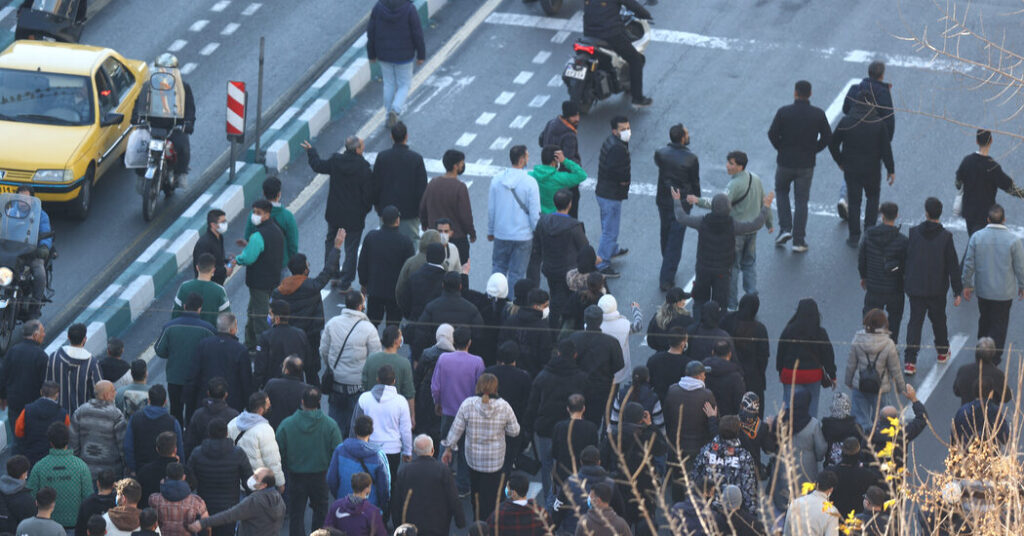
In the past few days, the unrest has turned into riots in many places, with young men attacking government buildings, clashing with security forces and setting on fire cars, motorcycles and trash cans, according to videos posted on social media, Iranian media outlets, and the BBC Persian service.
Security forces have beaten protesters and used tear gas, and in some videos from cities in western Iran, gunshots can be heard. At least eight protesters and two security agents have been killed, according to official media reports, rights groups and video footage of funerals.
Mehdi Rahmati, an Iranian analyst who advises officials on regional strategy, said in an interview, “Unfortunately, I think the government has no understanding or strategy for the domestic situation and international pressures building up.”
“There is no denying that there is raw anger,” he added. “One theory is they are letting the protesters vent their anger because we are at an explosion point.”
The Iranian foreign minister, Abbas Araghchi, privately met with some heads of government-affiliated media organizations on Thursday and called the brewing crisis a fight for the survival of the Islamic Republic’s rule and for the nation, according to two people familiar with the meeting. Mr. Araghchi told the media representatives that the prospects of negotiations with Washington were currently nonexistent and that decisions about whether to engage with Washington were not up to him, the two people said.
For a week, crowds have taken to the streets to vent anger at the government and to call for the end of Islamic clerical rule. The protests have mostly been in smaller towns and in poorer areas, and on university campuses, where people were chanting “Death to Khamenei” and “Freedom, freedom.” Some also made a broad denunciation of authoritarian rule, chanting “Death to the oppressor, whether king or supreme leader,” activists and residents inside Iran said.
But in Tehran, with the exception of the bazaar downtown, the university campus, and a few working-class neighborhoods, the city seemed normal, residents said in interviews and videos on social media suggested. Ski resorts north of Tehran were packed with affluent day trippers.
The current protests are not as large in scope and size as the uprising in 2022. The unrest at that time coalesced around a progressive women’s rights movement for ending the mandatory hijab rule, and it lasted for several months. But the demonstrations this time could still spread and turn more violent.
Fars, a news agency affiliated with the Revolutionary Guards Corps, said on Saturday that in western provinces some riots had taken the shape of “organized cells,” and “semi-militant” attacks. In one such province, Ilam, the agency reported that the agitators had guns, heavy weaponry and hand grenades. Videos on social media and Iranian media showed a crowd there wearing masks and firingassault rifles into the air while chanting, “Death to Khamenei.”
In a joint statement, 17 Iranian pro-democracy activists, including the jailed Nobel Peace Prize laureate Narges Mohammadi and the film directors Jafar Panahi and Mohammad Rasoulof, called on security forces to refrain from attacking protesters.
“The only path to saving Iran is a transition away from the Islamic Republic — a demand that is neither temporary nor suppressible,” the statement said.
Farnaz Fassihi is the United Nations bureau chief for The Times, leading coverage of the organization. She also covers Iran and has written about conflict in the Middle East for 15 years.
The post Iran’s Dual Challenge: Unrest at Home, Threat of Strikes From Abroad appeared first on New York Times.