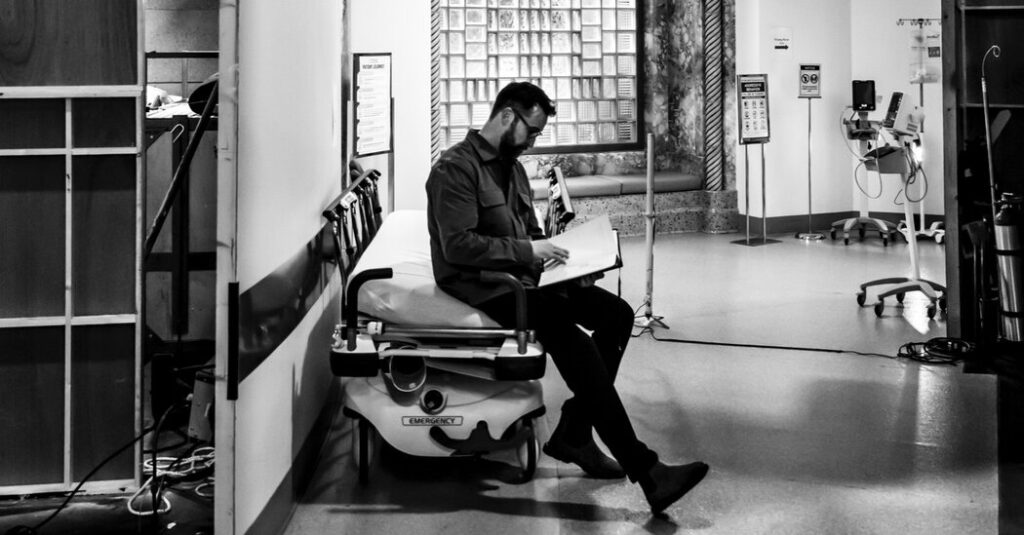
In the waiting room of the fake hospital, next to a vending machine with duct tape on the glass, I was asked to put on scrubs. I wasn’t supposed to be on camera, but the set of the TV show “The Pitt” is so real and immersive and chaotic and fluid, I was told, that it was possible the cameras would catch me anyway, if only in a reflection, so I had to look vaguely medical at all times. This was in Los Angeles, on the Warner Bros. lot, in a space called Stage 21 — a giant warehouse that, in its previous lives, during Hollywood’s glory days, housed sets for such classic films as “A Streetcar Named Desire” (1951) and “A Star is Born” (1954) and “Pee-Wee’s Big Adventure” (1985). Today Stages 21 and 22 are home to “The Pitt” — a hyper-realistic, high-intensity, critically acclaimed, surprisingly popular, award-winning medical drama streaming on HBO Max.
I was on set to watch the filming of the second season, which premieres on Jan. 8. In my scrubs, I entered the fictional emergency department. Bright lights reflected off the shiny floors. Fake patients lounged around in hospital gowns. In Bed 21, a man who looked like an evangelical painting of Jesus (long blond hair, sandy beard) was scrolling on his phone. Nearby, in a gurney, a young woman with an eye patch held a box of apple juice. The place was crowded, even by the standards of Hollywood sets. On any given day, “The Pitt” holds more than 100 people, many of them surging around in choreographed chaos: doctors, nurses, patients, social workers, security guards, receptionists, E.M.T.s. Fiona Dourif, who plays the doctor Cassie McKay, told me that the place feels like an “ant farm.”
“The Pitt” is, in many ways, a classic hospital drama. It tracks the action at an emergency department in Pittsburgh — a.k.a. the Pitt. Anyone who has grown up marinating in American TV will have the show’s basic rhythms and tropes and archetypes deep in their bloodstream. Routine ailments (fever, stomach ache) will expand into elaborate back stories. Quiet moments will be interrupted by explosions of trauma. Risky treatments (“There’s no time!”) will improbably succeed. Naïve medical students will be in over their heads — until, when things get real, they will find a way to rise to the challenge. There will be sassy nurses and belligerent family members and arrogant doctors and out-of-touch administrators and blizzards of rapid-fire medical jargon.
But “The Pitt” is also different, in big ways and small. There is, for instance, almost no music — no tinkling piano or swelling violins or husky power ballads to tell you how to feel. The show keeps you close to the action, building its meaning out of the flow of the hospital itself: the beeping, the lingo, the frenetic swirl of characters who have been thrown together by a health care system bursting at the seams.
The signature quirk of “The Pitt” is its structure. Each season covers a single day — 15 episodes spread over 15 hours — which means that every episode tracks one hour, in more or less real time. As crises mount, hour after hour, we watch everyone become increasingly frazzled and exhausted. Eyes turn red. Tempers flare. It is gripping and stressful and moving — perfect for bingeing.
All the show’s escalating drama, and its crowds of characters, tend to swirl around one man: Michael Robinavitch, known affectionately to everyone as Dr. Robby. He is played, with relaxed intensity, by Noah Wyle. Dr. Robby runs the Pitt — a place that, like many hospitals, is understaffed, underfunded and underappreciated. Everyone there is doing multiple jobs at once. In addition to saving patients, Robby trains med students, settles arguments, gives history lessons, mediates among family members, polices the pharmacy and more.
In Wyle’s blue-gloved hands, Dr. Robby is one of the most magnetic characters on TV: an expertly titrated mixture of confidence, empathy, recklessness, restraint, humility and smoking hot charm. Online and in the real world, Wyle’s performance inspires frequent outbursts of adoration: Halloween costumes and infinite thirsty TikToks and NSFW fan fiction and YouTube videos with titles like “dr robby scenes that make me pant like a dog.” (Sample comment: “Zaddy alert! Wrap me up in your sweatshirt, Dr. Robby.”) Although he is just a TV doctor, a huge part of Robby’s appeal is that he feels like something more: an ideal citizen, a fantasy boss, a philosopher-king. Toward the middle of his shift in Season 1, when he catches a senior resident belittling an intern, Robby pulls the man aside to deliver a tirade that should probably be played in the halls of Congress: “Where does it say that shaming, belittling and insulting are effective teaching tools? Let me just tell you, harassment has zero educational value.”
In the guise of a hospital show, “The Pitt” presents us with a kind of civic fan service. The emergency team, under Dr. Robby’s command, becomes a microcosm of a functional society. The real world is, yes, broken and foaming at the mouth and desperately in need of healing. But, at least while we’re watching “The Pitt,” we begin to believe that there might be someone out there who can fix it.
I spent several days on the set of “The Pitt,” wearing my loaner scrubs, paying special attention to Wyle. When I arrived, he was standing over at the nurses’ station, wearing black scrubs and cargo pants and hiking boots. His hair was expertly tousled. The YouTube commenters, I can confirm firsthand, are correct: At 54, Wyle appears to be aging into previously unexplored zones of handsomeness. His beard is perfectly unfussy — not too short, not too long — and dusted with sprinkles of gray. The creases branching from the corners of his eyes feel artisanal, like a rare and exclusive collection assembled with great skill.
Wyle and the rest of the cast were huddled up, rehearsing a scene. As he listened to his colleagues, I watched him scratching his beard, tilting his head, rubbing his neck — all of Dr. Robby’s mannerisms. Like Robby, Wyle always seems to be doing too many things at once. (There is a running gag in Season 1 in which Robby desperately needs to use the bathroom but can’t find the time.) Wyle is not just the star of “The Pitt”; he is also an executive producer and a writer. He sits in on auditions and reviews scripts and troubleshoots props. (What is the ideal viscosity of fake vomit?) He was acting in this episode while also directing it, and I watched him hustling back and forth between the monitors and the scene. Wyle talked his castmates through the choreography, just as Dr. Robby talks young doctors through their procedures: He swooped his arms around, kneaded the air with his hands, simulated camera angles. He was the man at the center of it all, playing the man at the center of it all.
Having watched “The Pitt” on TV, I was excited to be on set. I wanted to know everything. How did they make the wounds look so real? (Answer: prosthetics, Q-tips, spray bottles, petroleum jelly, various jars of goo.) Was Katherine LaNasa, who won an Emmy for her performance as the senior charge nurse Dana Evans, really like that in real life — a no-nonsense control tower of glamorous sass whose authority seems to flow directly from the center of the earth? (Yes.)
Also, most important, I wanted to know how “The Pitt” was going to follow up its first season — a nightmarish, bursting-at-the-seams 15-hour shift that featured, among many other things, a fentanyl overdose, a woman who had been pushed in front of a train, a stolen ambulance, a lady with a dead cockroach in her ear, cases of scurvy and measles and mercury poisoning, a naked man on the loose, severe burns, a bunch of rats leaping out of a patient’s clothing and then skittering around the hospital, a senior resident being dismissed for stealing medication, Nurse Dana being punched in the face and — devastatingly — the aftermath of a mass shooting.
If all that sounds like far too much — well, probably yes. (Real-world health care workers love to debate this stuff on Reddit: “It’s not quite a typical shift,” one writes. “But for a single coverage attending managing an inner-city hospital, it’s not completely outside of reality.”) For a medical TV show, however, “The Pitt” is unusually believable. From the beginning, Wyle and its creators were obsessed with realism. In the earliest stages of writing, the team brought in Joe Sachs, an E.R. doctor, to map out medical scenarios. The cast includes real nurses, and there is always a doctor on set to answer questions and ensure plausibility. Before filming, all the actors went to a two-week medical boot camp. And the show’s armies of extras are managed with clockwork precision.
“Every background performer you see,” R. Scott Gemmill, the program’s showrunner, said recently, “is a patient on a specific health journey that will be taken to the bathroom at a certain time, be fed at a certain time, go to CT or X-rays or the lab at a certain time. So it’s a second unit running in the midst of our main unit. It gives it this incredible texture and depth.”
One afternoon, I watched as they filmed a scene involving a trauma patient with a badly injured leg. Between takes, the props people kept rushing in to touch up the wound with K-Y Jelly and tongue depressors and spray bottles. (Just offscreen, there was a whole special rolling cart full of jars labeled things like “Pus Plus” and “Red Road Rash With Coffee” and “Honey Meth” and, ominously, “Brain.”) Jacob Lentz, a consulting actual-doctor, kept popping in to coach one of the young actors how to do more realistic arm palpations. (She was pushing too gently, he said, like a cat tiptoeing across a floor — you had to really get in there.)
“Where’s Noah?” someone asked. They were ready to shoot.
“Ten seconds!” Wyle shouted. He was standing, hunched over, just outside of Trauma 2, shoveling bites of lunch into his mouth out of a clamshell container sitting on top of a hamper marked “INFECTIOUS LINEN.” Still chewing, he raced back to the scene.
Noah Wyle did not plan to live this very strange life. He did not aspire to be a nondoctor who is also somehow the most famous doctor in the world. And yet that’s the situation he finds himself in. Wyle is now canonically a physician, in the same way that Bela Lugosi is a vampire and Mark Hamill is a Jedi and James Gandolfini is a mobster and Daniel Radcliffe is a wizard. He might as well have been born with a stethoscope around his neck.
Early on, Wyle didn’t even want to be on TV. His acting dreams all involved theater and film. At 22, however, he landed a part on a new medical drama called “ER.” He didn’t expect much from it. Even NBC, the show’s own network, thought that it was too gory and complicated, that its viewers were going to need subtitles for all the hospital jargon, that it would be crushed by its CBS rival, “Chicago Hope.” They slipped the “ER” pilot into a tricky time slot, up against “Monday Night Football.” Wyle figured he would dabble in this doctor thing for six episodes and then go back to his real career.
But then, in 1994, “ER” took over the world. This was back in the heyday of the so-called monoculture, before the internet swallowed everything and cracked it into splinters. On Thursdays at 10 p.m., “ER” owned America’s screens. During its peak seasons, the average “ER” episode drew more than 30 million people — a whole Shanghai of viewers. (The show’s most-watched episode, in which George Clooney saves a boy trapped in a storm drain, drew 48 million.) Its ensemble cast — including Clooney, Anthony Edwards, Julianna Margulies, Eriq La Salle, Sherry Stringfield — was glamorous and charismatic and diverse and funny. They made emergency medicine look heroic and cool.
Wyle occupied a special place right at the center of “ER.” He was the youngest of the core cast members — almost painfully young. His face looked as if two babyfaces got together and had a baby babyface. Wyle played John Carter, a wide-eyed med student from a wealthy family (his full name was John Truman Carter III) who is comically out of place in the gritty Chicago hospital. At the beginning of “ER,” Carter is the embodiment of innocence. He doesn’t know how to start an IV or stitch up a wound or even put on surgical gloves. When he sees a stabbing victim, he has to excuse himself to go outside, because he thinks he is going to throw up. In his very first scene, looking lost, Carter bounces his clipboard, nervously, right into a little dinging bell on the reception desk.
Wyle played Carter with funny, puppyish charm — but also with an emotional depth that took the character to unexpected places. In his innocence, he was a perfect proxy for the viewer. “ER” was disorientingly fast and chaotic and graphic, so when the older doctors explained things to Carter, they were also explaining them to us. (“Mark everything STAT, whether you want it fast or not”; “This is lidocaine, but call it novocaine — they’ve heard of that.”) This meant that, right from the beginning, Wyle established a close personal bond with tens of millions of viewers. He was the funnel through which America’s understanding of prime-time TV medicine was poured.
Over the years, as other cast members left “ER,” Wyle stayed. He played Carter, full-time, for 11 of the show’s 15 seasons — which made him by far the longest-running original cast member, and therefore the living embodiment of the show. During his tenure, Carter passed from innocence to experience, from med student to resident to attending physician. By the end, he could handle anything — just like Dr. Robby on “The Pitt.”
For Wyle, “ER” was an unexpected blessing. But it also totally consumed his life and career. The fame was instant and overwhelming. It was like being hit by a train — a train full of money and adulation, yes, but still a train. Wyle worked 80-hour weeks and lived almost entirely inside the alternate reality of that fake hospital. (“ER,” too, was filmed on the Warner Bros. lot, not far from the set of “The Pitt.”) He had no time for other projects. In the late 1990s, Wyle was offered a role opposite Tom Hanks as the title character in “Saving Private Ryan.” But he couldn’t take the time off from “ER.” Matt Damon got the role instead.
For a TV gig, “ER” wasn’t bad. In the show’s first five seasons, Wyle was nominated for five Emmys for outstanding supporting actor. Although he didn’t win, it seemed like only a matter of time. A film career, too, seemed like a given. “It seems inevitable that Mr. Wyle will get the kind of seductive movie offers that his co-star Mr. Clooney, the next Batman, has received,” Bill Carter wrote in The New York Times in 1996.
But he didn’t. And when “ER” ended, it really ended. Wyle remembers going back to Warner Bros., three weeks after the show finally wrapped, to audition for a Clint Eastwood film. He drove to the same gate he always did — but the guard wouldn’t let him in. When Wyle eventually managed to talk his way through, he stopped at Stage 11, for old times’ sake, to visit the ER set. It was gone. The crew had already torn it apart.
For years, Wyle searched unsuccessfully for a project that felt as big and meaningful as “ER” — artistically rich but also plugged into the public interest. He is a workaholic, and obsessive about the art of acting, so he was never going to stop, regardless of the roles that came along. He starred in a series of made-for-TV fantasy-adventure films called “The Librarian.” He played a former history professor fighting aliens in the postapocalyptic sci-fi drama “Falling Skies.” He did local theater. As the years passed, Wyle felt that he was maturing, getting better as an actor, reaching new heights. But, at least by “ER” standards, very few people were seeing his work. In the public imagination, he seemed to have been permanently frozen as John Carter. That stethoscope would not leave his neck.
Eventually, Wyle says, all of this started to wear him down. His first marriage, a relationship that began during the whirlwind of his early fame, near the beginning of “ER,” ended shortly after “ER” did. As the buzz around his work quieted down, Wyle found himself doubting his talent, his worth, his relevance. If his work was as good as he thought it was, why hadn’t the zeitgeist found its way back to him?
A few years ago, things got so bleak that Wyle was considering selling his baseball-card collection. He is an avid collector: books, records, movie memorabilia, antique suitcases. But now he was unemployed, and the bills were piling up. Wyle is a big Dodgers fan — he has a ball signed by the 1952 Brooklyn team — and one day he pulled his whole card collection out of his closet and spread it across the floor. He arranged things in a display book and had an expert come over to assess them.
Wyle credits two back-to-back crises with bringing him out of his funk and leading him toward the project that would finally replace “ER.” The first was the Covid pandemic. When the world shut down, Wyle could not work for the first time in his workaholic life. And then, in the middle of that global meltdown, he started to hear from health care workers. They still associated Wyle with “ER” — some of them told him they went into medicine because of the show. And now everything had changed. Frontline health care workers were being lauded as heroes but also drowning. They were desperate for the kind of mass cultural representation “ER” once brought. Where was Carter? they asked. Wyle started to wonder the same thing.
The second crisis came in 2023, when the entertainment industry shut down again because of actors’ and writers’ strikes. Wyle was feeling particularly low at the time — in retrospect, he says, he was “profoundly depressed” — but he went out and joined the picket lines. Suddenly, he felt useful. He marched and chanted, focusing on two targets: Netflix, the streaming giant upending the industry, and his old home, Warner Bros. At one point during the strikes, Warner Bros. put up a big “ER” poster outside the studio — and so Wyle marched there with extra force. “I was the face of the studio again while I was marching underneath it,” he said. For the first time in many years, he felt that he was part of something big and righteous — a collective doing meaningful work.
Along the way, Wyle put those two crises together. He wanted to honor the health care workers struggling to navigate the post-pandemic world, and he wanted to do it as part of a group that felt bigger than himself. He had a mantra, in those years, that he recited every day: “Please put me in the company of first-class artists with good hearts and good minds doing meaningful work.”
That was the birth of “The Pitt.” By late 2021, Wyle and two former “ER” colleagues — Gemmill and John Wells — were discussing an idea. (Wells was the executive producer and showrunner of “ER.”) What if they made a sequel to “ER” that followed Carter, all these years later, as he runs an emergency department in the aftermath of Covid? Warner Bros., which had interest in the project, met with the estate of the show’s creator, Michael Crichton — but after those negotiations broke down, the group pivoted to what they saw as an original concept, with a different fictional hospital, in Pittsburgh, and a different physician at its center: Dr. Robby. In March 2024, Warner Bros. announced a deal to stream “The Pitt.” (Crichton’s estate has sued the studio, Wyle, Wells, Gemmill and others for breach of contract and related claims, arguing that “The Pitt” is just “ER” by another name. The lawsuit is pending.)
With “The Pitt,” Wyle caught the zeitgeist again. The 15 episodes of Season 1 have each drawn more than 21 million viewers — a coup in the world of streaming. As in his “ER” days, Wyle has been making the rounds of late-night talk shows and morning shows and radio shows. Instead of having to sell his Dodgers cards, he was invited by the actual Dodgers to throw out the first pitch at a home game last season. And for the first time in 26 years, Wyle was nominated for an Emmy. This time, he actually won. He accepted the award in a custom tuxedo made by Figs, a scrubs company, and he ended his speech by dedicating the award to health care workers: “And mostly, to anybody who’s going on shift tonight or coming off shift tonight, thank you for being in that job. This is for you.”
It is impossible to overstate how much Wyle loves health care workers and how much they love him back. In the gaps between his official TV duties, as frequently as he can, Wyle likes to do what he calls his “ambassador work” — a category that can include visiting hospitals or lobbying Congress about health care reform or speaking at a national gathering of emergency doctors.
I recently tagged along as Wyle did some special ambassador work in Pittsburgh. This was roughly 36 hours after his triumphant night at the Emmys. (The show won not only outstanding lead actor, for Wyle, but also outstanding supporting actress for LaNasa and, in a major upset, outstanding drama.)
Now Wyle was walking the halls of Allegheny General — the real hospital that helped inspire the fake hospital set on “The Pitt.” The facility’s central building is gorgeous: an Art Deco skyscraper built nearly 100 years ago, when Pittsburgh was rich and hospitals were sacred temples to public health. (Its top story looks like a Greek temple; at night, you can see it shining across Pittsburgh.)
Up in the halls of the emergency department, under glaring lights, Wyle was being mobbed. It was Beatlemania, but instead of teenage girls in knee socks, the superfans were health care workers in scrubs. Everyone wanted a photo. Wyle posed with nursing students and grizzled veteran doctors. He smiled next to receptionists and the trauma team and a couple of contractors overseeing hospital renovations. He posed for photos in the X-ray room and in front of an M.R.I. tube. He was ushered into a patient’s room to say hello — and the moment he appeared, her heart monitor started beeping out of control. Wyle stayed with her, talking quietly, until her pulse calmed down.
As Wyle shook hands and posed for selfies, testimonials rang through the halls.
“You’re the reason my daughter went into medicine,” one woman told him. “She wanted to marry you.”
Hospital employees who were off that day kept FaceTiming in to say hello. Doctors held up their phones to introduce him to family members. Wyle would pretend to hug people through the screen. Someone said something that made him cry.
When Wyle met a first-year resident, he leaned in close.
“How’s it going?” he asked, knowingly.
“It’s going,” the resident said.
Wyle autographed prescription pads. He autographed the back of someone’s scrubs. People thanked him for his speech at the Emmys and complimented the realism of “The Pitt.”
“I’m an I.C.U. nurse,” one man said. “You guys did such an amazing job.”
“And he’s very picky,” the man’s colleague added.
“I shook his hand — I can die now,” a woman said.
Wyle and his team made the first season of “The Pitt” in a vacuum, with no idea whether it would find an audience. Today its actors, many of whom were relatively unknown, find themselves being recognized in the street — often by grateful health care workers. The gratitude is especially intense these days, given the dire state of the American health care system. Things were already hard in the 1990s, when Wyle was making “ER.” But now — in the teeth of vaccine skepticism and measles outbreaks and ballooning insurance premiums and private equity gutting hospitals and on and on — things have become intolerable. Every possible resource has been stretched beyond its limits. America’s immune system has been compromised. Our healers, more than ever, need healing. And that healing is part of the mission of “The Pitt.”
Season 2 was confirmed before Season 1 had finished airing. In the halls of Allegheny General, people offered Wyle thoughts and suggestions about the upcoming episodes.
“You need a pharmacist!” a pharmacist said.
“We have one this year!” Wyle said.
“You need social workers!” a social worker said.
“We’ve got a lot of social workers this year!” he said.
Like the first season, the second season of “The Pitt” will take place on a single day, with the action occurring roughly 10 months later: July 4. Cue the fireworks and cookouts and the undertones of national significance. As in Season 1, many forces will coalesce during these 15 hours. We will meet a gaggle of fresh new med students, plus a new attending physician who is enthusiastic about artificial intelligence. Frank Langdon, the doctor who was dismissed for stealing drugs in Season 1, will return for his first shift since finishing rehab. Nurse Dana, fully recovered from being punched, is back in her rightful place at the nurse’s station, coordinating the department. Dr. Robby, meanwhile, is about to take some much-deserved time off. July 4 will be his final shift before he leaves on a three-month sabbatical — during which, we learn, he is planning to ride a motorcycle across North America.
That trip, as you might expect, is controversial among Dr. Robby’s colleagues. They know firsthand what motorcycle accidents look like. But Robby insists that everything will be fine. In an early episode of Season 2, right on cue, a trauma patient arrives after a motorcycle crash. The man wasn’t wearing a helmet — which, we learn, is legal in Pennsylvania, as long as you satisfy certain safety requirements.
All eyes turn to Dr. Robby, who tells his co-workers that he wears a helmet. But the sense of danger lingers. Clearly, somewhere behind his haunted eyes, Robby is working on an impossible balancing act: public health, private risk.
I met Wyle for dinner at a historic Los Angeles steakhouse. Wood paneling, cozy tables tucked into nooks. When I arrived, he was sitting at the bar with a cocktail, reading a book. He likes this place, he told me, for lots of reasons, one of which is the lighting: dim, low, ambient. The opposite of a hospital’s fluorescent overhead blast.
In fact, Wyle told me, this is the kind of lighting he keeps in his dressing room on “The Pitt”: three lamps, nice and dim. Every morning, he wakes up at 5:30 so he can drive to work early and spend 30 minutes by himself, breathing in the soft light, watching a few minutes of whatever old movie is playing on TCM. The goal is to achieve a stillness that he will carry with him onto the chaos of the set. That way, when Wyle embodies Dr. Robby, he can be totally relaxed — not so much an actor reciting lines in a script but a human being, fully present, absorbing and metabolizing everything that’s going on, then choosing to respond in a way that just so happens to correspond to the words in the script.
Wyle’s acting is, paradoxically, both very natural and very studied. He prepares obsessively so that, in the moment, he can react effortlessly. He is a perfectionist; when a scene isn’t working right it makes him feel physically ill. Before filming “The Pitt,” Wyle wanted to understand what it really felt like to stand on his feet for 15 hours straight — so he did that, multiple times, and as he started to ache he studied his own exhaustion, making notes about the tension in his body, what hurt first, how he reacted. About halfway through a shift, he told me, you’ll see Robby start to rub his beard more, and then his neck. Toward the end, both hands will go to his head. “He’s holding his head as if it’s about to fall off,” he said.
Gemmill, the showrunner, has been working with Wyle since “ER” and told me he has been surprised by the evolution in his acting. “I knew he was good,” he said. “I didn’t know he was great.” When I asked him for a moment that really stood out, Gemmill didn’t mention any of the big ones: Robby’s nervous breakdown in Episode 13, the tearful speech to his team at the end of the shift. Gemmill said he is most often blown away by the tiny touches, verbal and nonverbal, that accumulate subtly in Wyle’s performance: the gestures and postures and glances and inflections that, taken together, make up the atmosphere of “The Pitt.”
Gemmill pointed to a moment near the beginning of the very first episode of Season 1, where Dr. Robby is giving the new staff (residents, med students) a quick orientation. He stands in the middle of a vortex of people, and as the camera swirls toward him he says, with professional jollity, “Goodmorning goodmorning, come on over.” The line is so small it hardly even counts as dialogue — and in fact Gemmill hadn’t written it in the script. But something about that improvised greeting struck him as quintessential Noah Wyle. The words rolled out with such easy warmth, and they did so much work, so efficiently. It was simultaneously exactly what Dr. Robby would have said in that moment and exactly what the show needed him to say.
At dinner, one on one, Wyle was slightly different than I expected. Watching him on set, interacting with his colleagues, I came away thinking that he was basically like Dr. Robby: charismatic, relaxed, warm, easygoing, welcoming. In private, Wyle has those qualities — but they exist in the shadow of something else. He is analytical, searching, sometimes almost painfully self-conscious. He seems to carry a lot of thoughts in his head. Wyle reads constantly, goes to therapy weekly and writes in his gratitude journal every morning. He had clearly spent a lot of time thinking about the complexities of being interviewed. He wanted to be seen, but he was also wary of being seen. The book he brought to read at the bar was “Roland Barthes by Roland Barthes” — a very French, very intellectual anti-memoir, in fragments, about the impossibility of describing the self. (“You are the only one who can never see yourself except as an image,” Barthes writes.)
When I told people I was writing about “The Pitt,” they usually asked: What is Noah Wyle like in person? And I would say: a lot like Dr. Robby — but with the “self-confidence” knob turned down a few clicks and the “self-awareness” knob cranked up to 11.
Somewhere in our conversation, I asked Wyle what it felt like to be interviewed like this.
“The first thing I think of when you ask me that question,” he said, “is exactly what I’m grappling with, with the work right now. Which is: Who does Robby talk to? And what does he say that’s honest? And when is he most honest? And with whom?”
Wyle told me about his childhood. He grew up in Hollywood in the 1970s, surrounded by show business but never quite a part of it. His route home from school took him along Hollywood Boulevard, where on the Walk of Fame he liked to find the star of Noah Beery Jr. — then put his foot over the “Beery Jr.” and imagine it said “Wyle.”
Around second grade, back-to-back traumas changed Wyle’s life forever. The first was a horrible car accident, on New Year’s Eve, that injured his parents and killed his grandmother. The second, not long after, was his parents’ divorce.
Wyle was a sensitive kid. He had been close with his grandmother. He believed, with childish naïveté, that the divorce was somehow his fault. He remembers feeling as if the solid foundations of his life had turned into quicksand.
Wyle’s parents were concerned enough that they sent him to a child psychiatrist. He remembers thinking, in one session, that his actual feelings weren’t interesting enough — so he started to make things up. He invented a nightmare to tell the therapist: He had been sitting in his treehouse with his dog, he said, when a giant boulder came crashing down a hill and crushed his family home, killing everyone inside. The therapist loved that. (Wyle didn’t have a dog or a treehouse.)
He lied outside of therapy too. Why not? If you couldn’t trust anything, if the whole world were actually quicksand, then wasn’t everyone always just making things up?
“I was a really dishonest kid,” Wyle told me. “I lied a lot for attention. I lied for status. I lied for favor. I lied for advantage.”
He lied about the pettiest things. At summer camp, a kid told him he looked like one of the characters on “What’s Happening!!” Oh, yes, Wyle said, that’s because it’s me — I am that kid on “What’s Happening!!” He bragged that he had fancy things at home that he didn’t actually have, then made up excuses why no one could see them. When a teacher asked if anyone in class had been in commercials, Wyle, who had never acted in anything, raised his hand.
I asked Wyle if he was still a liar. “I really try not to be,” he said. “I don’t really have any reason to anymore. In fact, if anything, I’m pathologically honest. I’m like an open book now, as a mea culpa. As a sort of penance.”
Dr. Robby, Wyle says, represents a new level of transparency in his work. It is the closest he has ever come to playing himself. Even the name Robinavitch comes from Wyle’s own family tree — a line of Russian Jewish anarchists, on his mother’s side, who emigrated to America in the 19th century. Dr. Robby wears the same glasses as Noah Wyle and carries the same wallet. Wyle set “The Pitt” in Pittsburgh in part because that’s where his parents met.
“I play this one really close to the bone,” he told me. “Because there’s no artifice on this show. There’s no filter on that lens. There’s no pretty lighting. It is a naked representation of what is, supposedly, reality. So the more reality I bring to it, the more authentic it comes across.”
Authenticity, of course, tends to be a hall of mirrors. Early in our conversation, when I referred to the apparent overlap between Wyle and Robby — their confidence, their charisma — he smiled and said: “a polished act.” At one point during dinner, I got up to go to the bathroom. I told Wyle, on a whim, half-joking, that I would leave my voice recorder running so he could say things while I was gone.
Later, listening to the recorder, I discovered that he had. He said he was enjoying our conversation, and that his wife would have objected to him drinking a second Manhattan. And then he started to talk about a classic Hollywood actor, Sterling Hayden — probably best remembered these days for playing Jack D. Ripper, the cigar-chomping general who sets off nuclear war in “Dr. Strangelove.” Hayden, Wyle told my recorder, was a big strapping guy, 6-foot-5, an action hero. Midway through his career, he wrote an unusually revealing memoir called “Wanderer.” “Throughout his entire professional life,” Wyle said, “he was plagued by this notion of impostor syndrome and insecurity. … I was so struck by the dichotomy between his physical self and his emotional interior. It became a real touchstone book for me.”
That, Wyle said, is what he had been thinking about when I called him charismatic.
Wyle wants viewers to understand that Dr. Robby is not just a walking geyser of charisma. He is not some sort of right-minded cartoon. Robby is admirable, yes, in certain ways, but he is also disturbed and self-destructive. He has seen too much, swallowed too much, denied too much. He is haunted by PTSD from the ghastly early days of Covid, and although he is brilliantly observant about other people’s problems, he is often blind to his own. Robby’s best qualities — ease, assurance, equanimity, lightness — are often just playacting, a form of concealing the truth from himself and everyone around him. He has been trying to hold, on his sagging shoulders, the whole weight of the collapsing health care system. This is noble, obviously, but it is also self-serving — a public good that happens to align with his own private pathologies. Dr. Robby is doing a virtuosic performance of a man who has everything under control. And Wyle is performing that performance, while also performing his own performance of that performance, in ways that can be hard to parse.
I asked Wyle what it felt like walking through that hospital in Pittsburgh, being the subject of so much attention and gratitude and admiration.
“I don’t want to sound ungracious — to say that I don’t take moments like that in,” he said. “But I don’t take moments like that in. I don’t know that I could.”
Wyle said that, back in the days of “ER,” he used to try to “regular guy” his way through fame. But these days, given how much Dr. Robby means to people, especially to health care workers, that doesn’t seem right. He wants to honor their interest. But it can be disorienting.
“At best, I can acknowledge it and appreciate it,” he said. “And at worst, it makes me want to do something self-destructive in the face of it, and not have that pressure on me.”
This brings us back to Dr. Robby and his motorcycle. Specifically, to Dr. Robby and his motorcycle helmet.
That helmet, it turns out, was a matter of some debate among the creative team behind “The Pitt.” The plan was to open Season 2 with a shot of Robby riding his motorcycle to work. And Wyle felt strongly that Dr. Robby should not be wearing his helmet. That way, later, when we see him tell his colleagues that he does wear a helmet, we’ll know that he is lying.
But not everyone was onboard. Part of it was ethical: To many viewers, Dr. Robby is purely a hero — flawed, sure, but trustworthy and admirable in a way that leaps off the screen. Was it right to start the new season with a shot of this heroic man looking cool while doing something reckless? Even if it paid off, artistically, later in the season — that’s not really how most people watch things anymore, in our era of brief clips taken out of context.
Wyle acknowledged all of this, but he was adamant. “I created a character that is now extremely sentimentally loved by a lot of people,” he said. “And I want to take that sentimentality and play with it a little bit.” He kept thinking about Gene Wilder, who agreed to play Willy Wonka in “Willy Wonka and the Chocolate Factory” only after he was allowed to add his own little flourish: When Wonka first appears, he hobbles down the steps of his chocolate factory — then suddenly springs forward into an elegant somersault. From that moment on, you can never fully trust him.
In Pittsburgh, the day after Wyle visited the hospital, the production was scheduled to shoot its motorcycle scenes. They still hadn’t made a decision about the helmet. So they decided to shoot it both ways: helmet and no helmet. They would make the final call later. For the moment, Dr. Robby would wear Schrödinger’s helmet. He would be protected and exposed — lying and not-lying.
Months after our time in Pittsburgh, when I finally sat down to watch the new season of “The Pitt,” I was eager to see which way they went. The first episode opens with some classic panoramic shots: skyscrapers, the river, the baseball stadium. And then, ripping across one of the city’s signature yellow bridges, here comes the motorcycle. Dr. Robby, as usual, is looking very cool. He is wearing Noah Wyle’s sunglasses. His tousled hair is blowing freely in the wind. No helmet.
The post Inside the Choreographed Chaos of ‘The Pitt’ appeared first on New York Times.