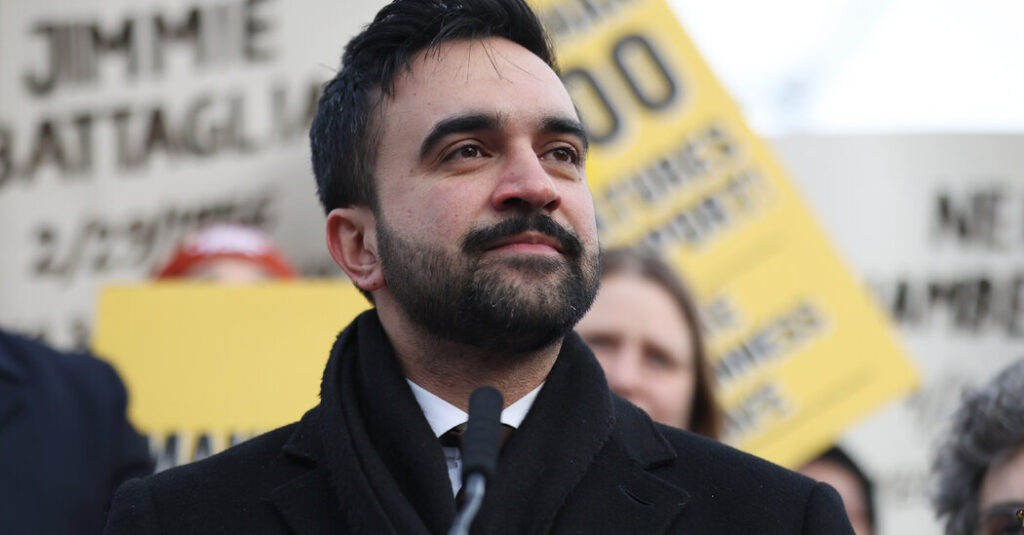
Mayor Zohran Mamdani knew he faced a dilemma, even as the confetti rained down on the jubilant crowd at his inauguration on Thursday.
Among the tasks left for him by his predecessor, Eric Adams, was a raft of executive orders that Mr. Mamdani would have to immediately reaffirm or revoke — including two politically delicate measures related to Israel and antisemitism.
Mr. Mamdani, a staunch critic of Israel and its treatment of Palestinians, knew from the moment he won the election that he would not extend the Israel-related orders, according to three people involved in the deliberations. But his team also believed rescinding them would upset some Jewish groups that Mr. Mamdani had spent months trying to reassure.
His lawyers laid out a few options in recent days, including canceling all of Mr. Adams’s orders from 2025 or taking them one by one, according to one of the people involved with the decision-making. Mr. Mamdani chose a third option: On Day 1, he would rescind every order that Mr. Adams issued after his indictment in September 2024 on federal corruption charges, allowing him to frame the choice as a matter of good governance.
As the inauguration ended, the mayor’s office rolled out a series of new executive actions related to housing with fanfare, including a mayoral visit to a Brooklyn apartment complex. His decision to undo many of Mr. Adams’s orders was relayed with no indication of how fraught elements of that act had been. He would reissue some orders verbatim, including one that established the city’s office to combat antisemitism, but the two Israel-related orders would be among those erased from the books.
But by Friday morning, Mr. Mamdani was facing direct criticism from the government of Israel, which accused him of antisemitism. It was an extraordinary charge to be leveled by the Jewish state against the new mayor of the city with the largest Jewish population outside Israel.
Had the Adams administration known its orders would pose a challenge for the new mayor?
“Short answer: Yes,” Randy Mastro, the first deputy mayor to Mr. Adams, said in an interview on Saturday.
“To rescind it comes at a cost, because it requires an explanation,” he continued, “and when there’s no rationale or explanation other than you don’t like Israel, there’s consequences for that.”
On Thursday night, a few hours after Mr. Adams sat on a dais at City Hall and watched his successor take his public oath of office, he took to X to publicize and criticize what Mr. Mamdani had done.
Mr. Mamdani, he wrote in his post, had “promised a New Era and unity” in his inaugural speech. “This isn’t new. And it isn’t unity,” Mr. Adams wrote, giving Mr. Mamdani the first controversy of his young mayoralty.
One of the executive orders that Mr. Mamdani revoked had codified a contentious definition of antisemitism that equated criticism of Israel with hatred of Jewish people, and the other banned city agencies from boycotting Israel, a form of nonviolent protest that Mr. Mamdani has defended throughout his public life.
“On his very first day as @NYCMayor, Mamdani shows his true face: He scraps the IHRA definition of antisemitism and lifts restrictions on boycotting Israel,” Israel’s Foreign Ministry wrote on X. “This isn’t leadership. It’s antisemitic gasoline on an open fire.”
A coalition of Jewish organizations in the United States, including the Anti-Defamation League, the American Jewish Committee and the UJA Federation of New York, issued a more measured response later on Friday, saying Mr. Mamdani had “reversed two significant protections against antisemitism.”
The episode may serve as a window into how Mr. Mamdani will govern. In his inaugural address, the new mayor promised to govern “audaciously” and made clear his commitment to progressive principles, including on the politics of the Israeli-Palestinian conflict.
In a section of his speech devoted to the diversity of New York, he paid tribute to “Palestinian New Yorkers in Bay Ridge, who will no longer have to contend with a politics that speaks of universalism and then makes them the exception.”
Mr. Mamdani’s speech and action on executive orders underscore a fundamental difference between the new mayor, his predecessor and a vocal swath of the city’s Jewish community that is likely to be a recurring feature of his mayoralty.
Mr. Adams is an outspoken Zionist, who relished traveling to Israel as mayor and worked to codify in city policy a view that anti-Israel sentiment and anti-Zionism could be tantamount to antisemitism. Mr. Mamdani, the city’s first Muslim mayor, believes they are separate issues, and that one can oppose the political ideology of Zionism, as he does, while still supporting Jewish people.
Mr. Mamdani’s stance on Israel has alarmed many Jewish New Yorkers and leading Jewish organizations. But he also won the votes of many other Jews who said they were inspired by his campaign and either unbothered by or supportive of his views on the Middle East. And he has repeatedly vowed to protect the security and celebrate the contributions of Jewish New Yorkers.
One member of Mr. Mamdani’s transition team said the Israel-related executive orders had come up repeatedly in private meetings with Jewish and pro-Israel groups after the election. If groups said they supported the orders, Mr. Mamdani stated his opposition to them, the person said.
After discussing the options, rescinding the Israel-related orders in the administration’s opening days had seemed preferable to dragging the process out or doing it at a later date, even though Mr. Mamdani’s team knew there would be fierce blowback.
Dora Pekec, a spokeswoman for Mr. Mamdani, said deliberation had gone into the decision.
“This was not a decision that was made last-minute,” she said. “This work was being done throughout the fall, throughout the transition, and communicated directly to the public that this was our intention, even before they cast ballots for us.”
On Saturday, Mr. Mamdani said he felt the move was a necessary part of restoring the public’s trust in the office of the mayor after the indictment of Mr. Adams in September 2024.
“I made that decision because that was the date for the first time in our city’s history that the mayor of this city was indicted,” Mr. Mamdani told reporters at an unrelated news conference. “It was a day at which many New Yorkers began to doubt, even more than they did, the motivations behind any executive order or executive action that was going to be taken.”
Josh Binderman, the transition team’s head of Jewish outreach, began speaking with supporters about the plan to cancel the orders in the days leading up to the inauguration. One Jewish leader, who spoke on condition of anonymity to discuss a private conversation, said they were aware in advance that the orders would be revoked based on ongoing conversations.
The leader said they had never expected Mr. Mamdani to keep the orders on the books.
Amy Spitalnick, the chief executive of the Jewish Council for Public Affairs, said it would have been helpful for Mr. Mamdani to roll out a plan to protect Jewish New Yorkers using the budget, personnel decisions and policy, alongside his executive order decisions.
“Right now, we’re seeing how people are taking bits and pieces of the executive order news to validate their worst fears,” she said. “Rolling this out as part of a comprehensive strategy could have helped illustrate how the administration actually intends to protect the Jewish community.”
Mr. Mamdani has criticized Israel in ways that were once seen as unthinkable for an elected official in New York City. He has decried Israel as an apartheid state. He has backed accusations made by international and Israeli human rights groups, and a United Nations panel, that it has committed genocide in Gaza.
He has said Israel should ensure equal rights for followers of all religions instead of favoring Jews in its political and legal system. He has supported the movement to economically isolate it, known as Boycott, Divestment and Sanctions. And he has said he would like the New York Police Department to enforce an arrest warrant against the country’s prime minister, Benjamin Netanyahu, who has been accused of war crimes by the International Criminal Court.
The revocation of the orders was supported by some progressives, including progressive Jewish groups who supported Mr. Mamdani’s campaign. Some had opposed them on free speech grounds, while others said they opposed codifying a definition of antisemitism that would label many of Israel’s critics as Jew haters.
Fabien Levy, who served as a spokesman for the Adams administration, said the former mayor had been motivated to issue the executive order about the B.D.S. movement in part because of Mr. Mamdani’s views, and by concerns Mr. Adams had heard expressed by Israelis during a trip to Israel.
“During our most recent trip to Israel, in conversations with dozens of people, locals questioned whether New York City still wanted to have a relationship with Israel,” Mr. Levy said in a statement. He said the orders were meant to protect the city’s investments in Israel and to signal “that just because someone or an organization is from another country, doesn’t mean they should be discriminated against.”
Reached by text in Dubai on Friday, Mr. Adams said he thought Mr. Mamdani’s “action immediately after coming into office sent a bad message.” And he said he planned to take another trip to Israel in the next few months.
“I will be returning to Isreal,” he wrote, misspelling the country’s name. “And my voice will remain strong fighting against antisemitism.”
Debra Kamin contributed reporting.
Liam Stack is a Times reporter who covers the culture and politics of the New York City region.
The post Inside Mamdani’s Decision to Revoke Executive Orders That Backed Israel appeared first on New York Times.