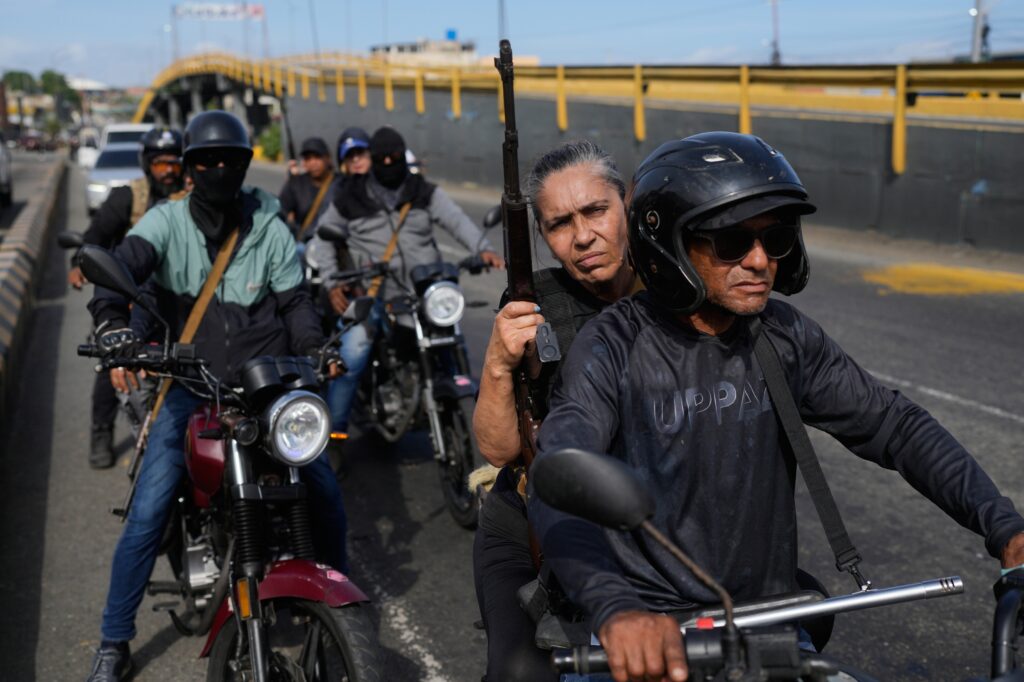
The United States will “run” Venezuela — a country of 30 million people spread over hundreds of thousands of square miles — for the foreseeable future, President Donald Trump said Saturday just hours after the shocking, early morning U.S. military assault that captured its head of state and left Latin America and much of the rest of the world reeling.
“We’re going to stay until … the proper transition takes place,” Trump said in a Florida news conference that glanced past details of how exactly that would be done.
Two side benefits, he indicated, were that hundreds of thousands of Venezuelans who had fled to the United States would now go home and that the U.S. would now be able to take over the Venezuelan oil industry.
On social media, Trump posted a photograph of shackled and blindfolded Venezuelan President Nicolás Maduro aboard the amphibious assault ship USS Iwo Jima. Maduro and his wife, both under U.S. indictment for drug trafficking and corruption, were snatched from a safe house by U.S. Special Operations forces in what senior administration officials insisted was not regime change but a law enforcement operation for which the military provided security.
The Maduros, officials said, were read their rights by an FBI official on the ground before being whisked away in a helicopter. Asked if U.S. forces were prepared to kill Maduro if he resisted, Trump said that “it could have happened.”
Trump made no distinction between law enforcement and overthrow, seeming to exult in what he called a “spectacular” operation, the likes of which had not been seen “since World War II … one of the most stunning, effective and powerful displays of American military might and competence in American history.”
“American dominance in the Western Hemisphere will never be questioned again,” Trump said. “Under the Trump administration we are reasserting American power in a very powerful way in our home region.”
Asked who would run Venezuela, Trump said, “largely the people behind me,” pointing to Secretary of State Marco Rubio and Defense Secretary Pete Hegseth. “They’re going to be a team that’s working with Venezuela to make sure it’s working right,” he said.
The vagueness of what happens next recalls the 2003 U.S. takeover of Iraq after the invasion ousting Saddam Hussein. Trump initially supported the Iraq operation, before saying he was against it as it stretched into a years-long battle with disaffected Iraqis, gave rise to the Islamic State and left thousands of American troops dead before the formal U.S. withdrawal in 2011.
Trump made no commitment to María Corina Machado, the leader of the Venezuelan opposition and Nobel Peace Prize laureate, or to Edmundo González, whom the United States and others recognized as the legitimate president after an election last year that Maduro was widely believed to have stolen. Rubio, he said, had spoken by phone with Venezuelan Vice President Delcy Rodríguez, who “said ‘we’ll do whatever you need.’ I think she was quite gracious.”
Trump said Rodríguez had been sworn in as interim president, although she told Venezuela’s state television Saturday night that “There is only one president here, and his name is Nicolás Maduro.”
The 20th century was marked with numerous U.S. military interventions and occupations in Central America and the Caribbean, but Saturday’s assault on Venezuela was Washington’s first direct and openly acknowledged military strike in history against a South American government. A strategic gamble with an unpredictable outcome in a deeply divided region, it dramatically alters the security dynamic across the continent.
In a flash, to both American foe and ally alike, the strikes have made the threat of U.S. military power indisputably real.
“This is one of the most dramatic moments in modern South America history,” said Oliver Stuenkel, an analyst of international affairs at the Brazilian university, the Getulio Vargas Foundation. “The United States now represents the biggest security threat for the simple fact that it just militarily attacked a South American country with an unclear rationale.”
Others were more direct. “For most Latin Americans, it’s insulting,” said a senior South American diplomat who spoke on the condition of anonymity so as not to draw Trump’s ire to his own country.
“Of course we understand that the might of the United States is that it can intervene in any Latin American countries in any way they want,” the diplomat said. “But this will lead to complete destruction of any kind of international law, and to a growing antipathy toward the United States” throughout the Western Hemisphere.
By Saturday morning, reaction to the strikes was already breaking along ideological lines in a region deeply polarized over security, crime and corruption. Many on the right cheered the intervention, calling the removal of the self-described socialist Latin American strongman an advancement for liberty and a blow against drug trafficking.
Argentine President Javier Milei, whose government has received a $20 billion currency swap from the United States to stabilize his country’s troubled economy, lauded the strikes. So did Ecuadorian President Daniel Noboa Azin, who has allied himself with Trump and offered to reopen a U.S. air base closed by one of his predecessors.
“For all narco-Chavista criminals, your time has come,” Noboa wrote on social media, referring to Maduro’s predecessor, Hugo Chávez. “Your structure will end up falling across the entire continent.”
Those on the left decried what they called an illegal act of military aggression. Few came directly to the defense of Maduro, who had been left increasingly isolated as his authoritarian and illiberal practices have bankrupted Venezuela, unleashed a refugee crisis and given drug traffickers increasingly free rein. But they said the unilateral strikes and his removal set a new and dangerous precedent for the region.
“The bombing of Venezuelan territory and the capture of its president crosses an unacceptable line,” Brazilian President Luiz Inácio Lula da Silva said. “The action recalls the worst moments of interference in Latin American and Caribbean politics and threatens the regional preservation as a zone of peace.”
Some analysts, however, said it would be a mistake to interpret the strikes as the continuation of U.S. military actions in other Latin American nations, whether the CIA-sponsored overthrow of Guatemala’s government in 1954, the 1983 U.S. invasion of Grenada, or the 1989 capture of Panama leader Manuel Antonio Noriega following a 25,000-troop invasion.
“This is not going to be a unified Latin American rejection of the action, like you may have seen in the ‘60s or the ‘70s,” when interventions were often influenced by the Cold War, said Eric Farnsworth, a senior associate at the Center for Strategic and International Studies think tank. “This is happening in a divided region, where nobody wanted this to happen, but where many recognized that there was no alternative to this unless you were ready to live with Maduro forever.”
Several governments and leaders in the region already have an affinity with the Trump administration — ties the White House has sought to expand and exploit over the past year.
The Trump administration has solidified relations with El Salvador’s president, Nayib Bukele, who accepted millions of dollars to imprison U.S. deportees and whom Trump called a “great friend” and “one hell of a president.” It has promised new trade and security cooperation with Ecuador and Paraguay, whose leaders are also Trump admirers. And it threw an economic lifeline to Milei, whom U.S. Treasury Secretary Scott Bessent called a “beacon” for South America.
But few disagreed over the significance of the strikes. For decades, the United States has focused its military might elsewhere, in theaters much further away. The attacks have returned Washington to a policy of unabashed interventionism in the region.
“The reaction in the rest of Latin America will be mixed between euphoria, anger and fear,” said Brian Winter, an analyst with the Americas Society and Council of the Americas.
Those in the region who condemn the strikes — most notably Lula, Mexican President Claudia Sheinbaum and Colombian President Gustavo Petro, will have to watch their backs. While Trump last year had what he called a productive meeting with Lula, he repeated at the news conference an earlier warning that Petro, whose country is a major producer of cocaine, had better “watch his ass.”
In the case of Mexico, “the fact of the matter is that large swaths of the country are under the control of narco-terror organizations,” a senior administration official said, speaking on the condition of anonymity under rules imposed by the White House.
“This is not a president that just talks,” the official said. “He will take action eventually. … I think the president always retains the option to take action against threats to our national security.’’
While Petro has called Trump a “murderer” for U.S. military strikes against alleged drug boats in the Caribbean and eastern Pacific, it’s unlikely that either Lula or Sheinbaum will want to risk a lengthy diplomatic dispute with the White House, said Matias Spektor, a Brazilian political scientist at the Getulio Vargas Foundation.
Referring to Cuba, which has depended on Venezuela for energy supplies and economic and security backing, Rubio said at the news conference Saturday that “If I lived in Havana now and I was in the government, I’d be concerned.” Venezuelan oil, he said, would not be allowed to go there.
Since he began ratcheting up public threats against Maduro last summer, Trump has offered an evolving list of charges to justify his removal through exile or force, from allowing China, Russia and Iran to gain a toehold in the hemisphere, to illegal U.S. immigrants he charged that Maduro had released from Venezuelan prisons and “insane asylums,” while asserting Venezuelan “terrorist” drug gangs were engaged in “armed conflict” with the United States.
Most recently, he has charged that Venezuela “stole” oil and land belonging to the United States when it, like many other countries, nationalized its petroleum resources decades ago.
In his news conference, Trump said he now plans to take back those assets. Asked how long he planned to run Venezuela, Trump said, “I’d like to do it quickly, but it takes a period of time.”
McCoy reported from Mexico City.
The post In Venezuela raid, the specter of U.S. regime change returns to Latin America appeared first on Washington Post.