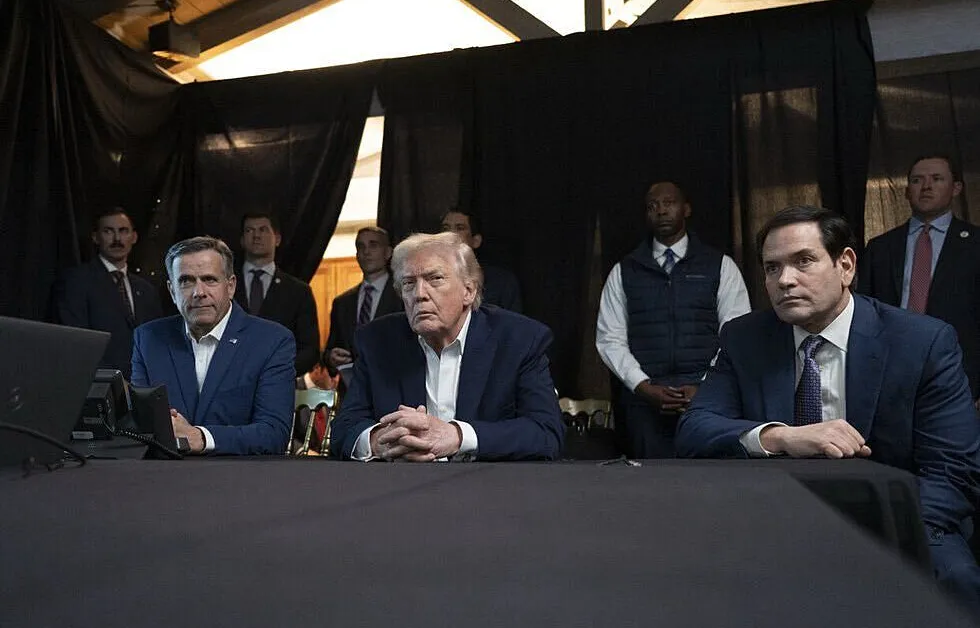
Speaking just hours after the successful operation to depose Nicolás Maduro, President Donald Trump issued a stark warning: “American dominance in the western hemisphere will never be questioned again.”
But the swift removal of Venezuela’s president, and Trump’s promise to “run” the country while extracting its oil wealth for the benefit of American companies, are likely to have ramifications far beyond the Americas.
[time-brightcove not-tgx=”true”]
Venezuela’s importance lies not just in its proximity to the United States, but also in its role as a geopolitical centre of great power competition. It is an energy superpower, a symbol of ideological opposition to the U.S., and it has forged close relations with its enemies. It has also witnessed one of the largest refugee crises in modern history—one that could worsen.
Read more: How the World Is Reacting to the U.S. Capture of Nicolas Maduro
Trump’s Venezuela gambit has the potential to impact global oil markets, reshape great-power alliances, and undermine norms around sovereignty and intervention. Leaders of other South American countries, such as Colombia, Mexico, and Cuba, are waking up to a world in which their countries’ sovereignty is not guaranteed.
Here are the ways Trump’s Venezuela takeover could change the world.
Oil and energy dominance
The United States taking control of Venezuela’s oil industry would, in theory, seem to be an economic boon for Washington. The country has the largest proven oil reserves in the world, and control of those vast resources should deliver both a significant financial benefit to the U.S.
But the reality is far more complex. Venezuela currently produces less than 1 million barrels of oil per day, or about 0.5% of global oil production, according to Rasmussen. Of those 1 million barrels, the South American country only exports about half.
Its energy infrastructure has been hampered by years of sanctions, mismanagement, and a lack of investment after Venezuela nationalized its oil industry in the 2000s.
Trump promised in his speech on Saturday that American energy companies stand ready to invest “billions and billions of dollars” to rebuild Venezuela’s oil infrastructure, but experts warn it could take years, if not decades, for them to see returns.
One more immediate effect, however, is that the U.S. would seem to be on the verge of taking control of a major energy supplier to China. Beijing has poured tens of billions of dollars into oil-for-loans deals to secure a supply that is not located in an area controlled by the U.S. In that sense, Venezuela was an insurance policy for China’s energy security.
Venezuela’s oil shipments to China, its main buyer, averaged over 600,000 barrels per day in December 2025, constituting about 4% of China’s total oil imports, according to Reuters. Just hours before his capture, Maduro met with Qiu Xiaoqi, the Chinese government’s special representative for Latin American affairs, at the Miraflores Presidential Palace.
The loss of such a crucial strategic energy partnership, one that was growing all the time, will be a strategic defeat for China and could provide the U.S. with leverage going forward.
In the short term, however, Trump appears to be trying to ease China’s fears. In response to a question about Maduro’s meeting with Chinese officials before his capture, Trump told Fox & Friends on Saturday: “I have a very good relationship with [China’s President] Xi, and there’s not going to be a problem. They’re going to get oil.”
Iran weakened
Maduro’s fall will have a significant impact on Iran, a place where the U.S. has long sought to change leadership.
Iran has been a close ally of Venezuela since the early 2000s, when the countries were led by Hugo Chávez and Mahmoud Ahmadinejad, two leaders who defined themselves on the world stage by their opposition to U.S. hegemony.
Caracas was Iran’s strategic foothold in the Western Hemisphere, and a key partner in helping it evade sanctions. Iran has for years sent refined fuel, parts and expertise to bolster Venezuela’s oil industry in return for much-needed financial support. Their partnership extended into military cooperation, with Venezuela purchasing Iranian drones and other weaponry.
That partnership could now be severed, further weakening a wobbling Iranian leadership that is under pressure since a joint Israeli-U.S. attack this summer, and ongoing protests.
Might is right
By any measure, the capture and detention of a sitting president is a norm-shattering event. Just as the Iraq War is often viewed as a catalyst for the collapse of the post-WWII rulers-based order, Trump’s brazen capture of Maduro and his stated intention to control the country and its resources could spur another shift in how powerful countries operate.
Both Russia and China could take Trump’s flouting of international norms as an invitation to do the same, or to continue doing so, in Russia’s case.
While Moscow has already made its move in Ukraine, China has been threatening for years to regain control of Taiwan. The U.S. has repeatedly invoked arguments about sovereignty to dissuade China from doing so, but those arguments will now hold less weight.
American hemisphere
The capture of Maduro marked the Trump Administration’s most forceful move yet in its pivot to projecting influence in the Western Hemisphere.
In the hours after the operation, Trump also gave leaders of other South American countries cause for concern.
During a phone interview with Fox News, Trump warned that “something will have to be done about Mexico,” adding that he had asked the country’s President, Claudia Sheinbaum, if she wanted help tackling drug cartels in the country.
Colombian President Gustavo Petro, whom Trump has also accused of being involved in drug production, also received a pointed warning from Trump.
“He’s making cocaine and they’re sending it into the United States, so he does have to watch his ass,” Trump said.
For the Communist leaders in Cuba, the small island nation that has thwarted America’s ill intentions towards it since the 1950s, the capture of Maduro is a threat to survival.
Cuba has long relied on Venezuela for most of its energy supply, and receives tens of thousands of barrels of oil at subsidised rates. Between January and November last year, Venezuela sent 27,000 barrels of crude oil and fuel per day to Cuba, Reuters reported, citing shipping data and internal documents from state oil company PDVSA.
U.S. sanctions against Venezuela led to a decline in that flow in recent months, but the partnership is credited with keeping the Cuban economy afloat.
Trump also warned its leaders in his Saturday press conference, describing it as “a failing nation.”
“The people there have suffered for many, many years, and I think Cuba is going to be something we’ll end up talking about,” he said.
Secretary of State Marco Rubio, who is seen as a key player in Trump’s Venezuela move, has spoken for years of his desire for the current Cuban political system to be overturned. On the morning after the raid, he had a pointed message for its leaders.
“In some cases, one of the biggest problems Venezuelans have is they have to declare independence from Cuba,” Rubio said. “They tried to basically colonize it from a security standpoint. So, yeah, look, if I lived in Havana and I was in the government, I’d be concerned at least a little bit.”
Sen. Lindsey Graham, a Republican from South Carolina, was more direct: “Hopefully the end of Mr. Maduro’s reign of terror in Venezuela is near, and then we can focus on Cuba, one of his greatest allies and one of the most oppressive regimes in our backyard.”
The post How Trump’s Venezuela Takeover Could Change the World appeared first on TIME.