It was one dance move too much for Venezuela’s President Nicolás Maduro.
Mr. Maduro in late December rejected an ultimatum from President Trump to leave office and go into a gilded exile in Turkey, according to several Americans and Venezuelans involved in transition talks.
This week he was back onstage, brushing off the latest U.S. escalation — a strike on a dock that the United States said was used for drug trafficking — by bouncing to an electronic beat on state television while his recorded voice repeated in English, “No crazy war.”
Mr. Maduro’s regular public dancing and other displays of nonchalance in recent weeks helped persuade some on the Trump team that the Venezuelan president was mocking them and trying to call what he believed to be a bluff, according to two of the people, who spoke on condition of anonymity because they were not authorized to talk about the confidential discussions.
So the White House decided to follow through on its military threats.
On Saturday, an elite U.S. military team swooped into Caracas, the capital, in a pre-dawn raid and whisked Mr. Maduro and his wife, Cilia Flores, to New York to face drug trafficking charges.
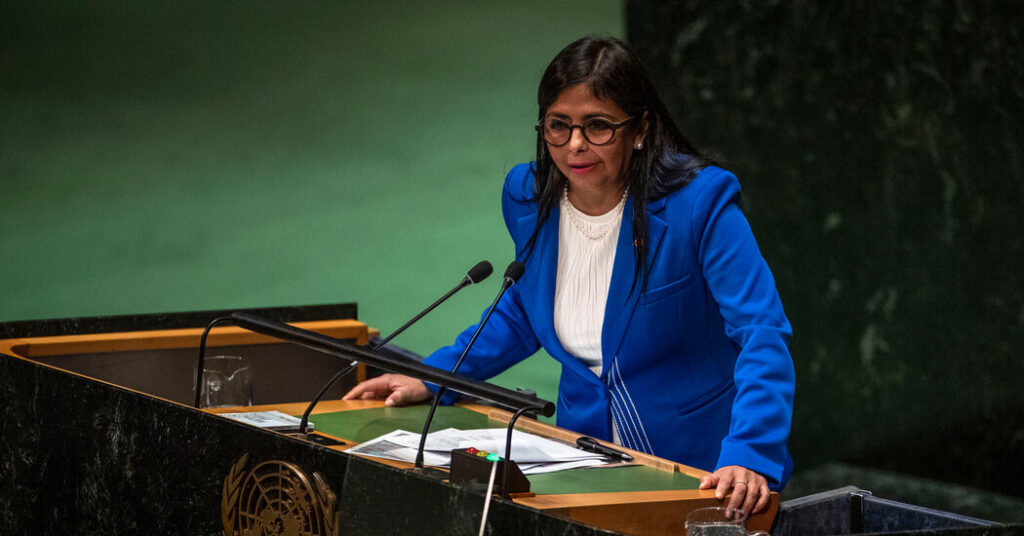
Weeks earlier, U.S. officials had already settled on an acceptable candidate to replace Mr. Maduro, at least for the time being: Vice President Delcy Rodríguez, who had impressed Trump officials with her management of Venezuela’s crucial oil industry.
The people involved in the discussions said intermediaries persuaded the administration that she would protect and champion future American energy investments in the country.
“I’ve been watching her career for a long time, so I have some sense of who she is and what she’s about,” said one senior U.S. official, referring to Ms. Rodríguez.
“I’m not claiming that she’s the permanent solution to the country’s problems, but she’s certainly someone we think we can work at a much more professional level than we were able to do with him,” the official added, referring to Mr. Maduro.
It was an easy choice, the people said. Mr. Trump had never warmed up to the Venezuelan opposition leader María Corina Machado, who had organized a winning presidential campaign in 2024, earning her the Nobel Peace Prize this year. Since Mr. Trump’s re-election, Ms. Machado has gone out of her way to please him, calling him a “champion of freedom,” mimicking his talking points on election fraud in the United States and even dedicating her Peace Prize to him.
It was in vain. On Saturday, Mr. Trump said he would accept Ms. Rodríguez, saying that Ms. Machado lacked the “respect” needed to govern Venezuela.
U.S. officials say that their relationship with Ms. Rodríguez’s interim government will be based on her ability to play by their rules, adding that they reserve the right to take additional military action if she fails to respect America’s interests. Despite Ms. Rodríguez’s public condemnation of the attack, a senior U.S. official said that it was too soon to draw conclusions about what her approach would be and that the administration remained optimistic that they could work with her.
Mr. Trump declared on Saturday that the United States intended to “run” Venezuela for an unspecified period and reclaim U.S. oil interests, an extraordinary assertion of unilateral, expansionist power after more narrow, and also contested, arguments about stopping the flow of drugs.
In Ms. Rodríguez, the Trump administration would be engaging a leader of a government that it had routinely labeled illegitimate, while abandoning Ms. Machado, whose movement won a presidential election last year in a victory widely recognized as stolen by Mr. Maduro.
And it was not immediately clear if Ms. Rodriguez would even play along. In a televised address, she accused the United States of making an illegal invasion and asserted that Mr. Maduro remained Venezuela’s legitimate leader.
To retain leverage, senior U.S. officials said, restrictions on Venezuelan oil exports would remain in place for now.
But others involved in the talks expressed hope that the administration would stop detaining Venezuelan oil tankers and issue more permits for U.S. companies to work in Venezuela in order to revive the economy and give Ms. Rodríguez a shot at political success.
Ms. Rodríguez, 56, arrives at the job of Venezuela’s interim leader with credentials of an economic troubleshooter who orchestrated the country’s shift from corrupt socialism to similarly corrupt laissez-faire capitalism.
She is the daughter of a Marxist guerrilla who won fame for kidnapping an American businessman. She was educated partly in France, where she specialized in labor law.
She held middling government posts in the government of Mr. Maduro’s predecessor, Hugo Chávez, before being promoted to bigger roles with the help of her older brother Jorge Rodríguez, who eventually became Mr. Maduro’s chief political strategist.
Ms. Rodríguez managed to stabilize the Venezuelan economy after years of crisis and slowly but steadily grow the country’s oil production amid tightening U.S. sanctions, a feat that earned her even the grudging respect of some American officials.
As Ms. Rodríguez consolidated control over economic policy and eliminated rivals, she built bridges with Venezuela’s economic elites, foreign investors and diplomats, to whom she presented herself as a soft-spoken technocrat and a contrast to the burly security officials forming most of the rest of Mr. Maduro’s inner circle.
Those alliances have borne fruit in recent months, earning her powerful champions that helped to cement her rise to power. On Saturday, her assumption of power was greeted with cautious optimism by some of Venezuela’s captains of industry, who said in private that she had the skills to create growth, if she could persuade the United States to relax its chokehold on the country’s economy.
For all her technocratic leanings, Ms. Rodríguez has never denounced the brutal repression and corruption sustaining Mr. Maduro’s rule, once calling her decision to join the government an act of “personal revenge” for her father’s death in prison in 1976, after being interrogated by intelligence agents from pro-U.S. governments.
Ms. Rodríguez’s capacity for negotiating across Venezuela’s ideological chasm could prove useful in easing tensions. Juan Francisco García, a former ruling party lawmaker who has since broken with the government, said he had some apprehensions about her ability to govern but gave her the benefit of the doubt.
“History is full of sectors and figures linked to dictators who have, at some point, served as a bridge to stabilize the country and transition to a democratic scenario,” Mr. García said.
The contradictions enveloping Ms. Rodríguez were on display on Saturday when she addressed the nation.
While Mr. Trump said that Ms. Rodríguez had been sworn in as Venezuela’s new president, it was clear that Mr. Maduro’s supporters — including Ms. Rodríguez herself if her remarks are taken at face value — still see him as Venezuela’s leader.
Spotlighting the potential challenges ahead, even the text on Venezuelan state television labeled her as vice president. People close to the government said those displays of loyalty were a necessary public relations strategy to pacify the ruling party loyalists, including in the armed forces and paramilitary groups, who were reeling from the military humiliation inflicted by the United States on their country and the destruction and death caused by the attack.
U.S. forces managed to descend into the capital largely unopposed, destroy at least three military bases and grab the country’s president from a heavily guarded compound, without any loss of American life.
Still, the Trump administration has chosen to give Mr. Maduro’s vice president a chance and to pass over Ms. Machado, who won the Nobel Prize and had at least some allies in Mr. Trump’s circle.
Ms. Machado, a conservative former member of the National Assembly from an affluent Venezuelan family, boasts decades-long ties to Washington.
She has spent the last year courting Mr. Trump’s support and trying to enlist his help in ousting Mr. Maduro. She has openly supported his military campaign in the Caribbean and mostly refrained from commenting on his policies toward Venezuelan migrants.
On Saturday, after Mr. Trump announced that the U.S. military had captured Mr. Maduro, she released a statement saying that she was ready to lead. “Today we are prepared to assert our mandate and seize power,” she wrote in a message she posted on X.
But roughly two hours later, Mr. Trump said they had not spoken. It would be “very tough” for Ms. Machado to take control of her country, Mr. Trump said, adding in his televised speech that she was a “very nice woman” but “doesn’t have the support” in Venezuela to lead.
A spokeswoman for Ms. Machado declined to comment.
“For Trump, democracy is not a concern — it is about money, power, and protecting the homeland from drugs and criminals,” said Michael Shifter, a senior fellow at the Inter-American Dialogue, a research institute in Washington.
In his speech to the nation, Mr. Trump also made no mention of Edmundo González, the retired diplomat who became Ms. Machado’s political surrogate after she was barred from running. Mr. González, who is in self-imposed exile in Spain, is considered the legitimate winner, by a wide margin, of the 2024 election, even though Venezuelan authorities handed the victory to Mr. Maduro.
Eric Schmitt contributed reporting from Washington, and María Victoria Fermín, Mariana Martínez and Isayen Herrera from Caracas, Venezuela.
Anatoly Kurmanaev covers Russia and its transformation following the invasion of Ukraine.
The post How Trump Fixed On a Maduro Loyalist as Venezuela’s New Leader appeared first on New York Times.