Zohran Mamdani’s third day as mayor of New York City was supposed to be dedicated to a long-stalled pedestrian safety plan, the kind of local quality-of-life issue he had made central to his campaign.
Instead, after the U.S. military captured Venezuela’s president and transported him to New York City to face drug charges, Mr. Mamdani found himself confronting an international spectacle that will unfold a few blocks from City Hall, at a courthouse in Manhattan — and which could become the first major test of his relationship with President Trump.
On Saturday, Mr. Mamdani posted a statement on X criticizing the military action as “a violation of federal and international law.” Then, as neighborhood activists waited for him to discuss bike lanes in Brooklyn, he idled nearby to place a brief call to Mr. Trump, during which he personally raised objections to the U.S. actions in Venezuela, he said.
“I registered my opposition, I made it clear, and we left it at that,” Mr. Mamdani told reporters, declining to characterize the president’s response to him on the phone.
The White House did not respond to a request for comment.
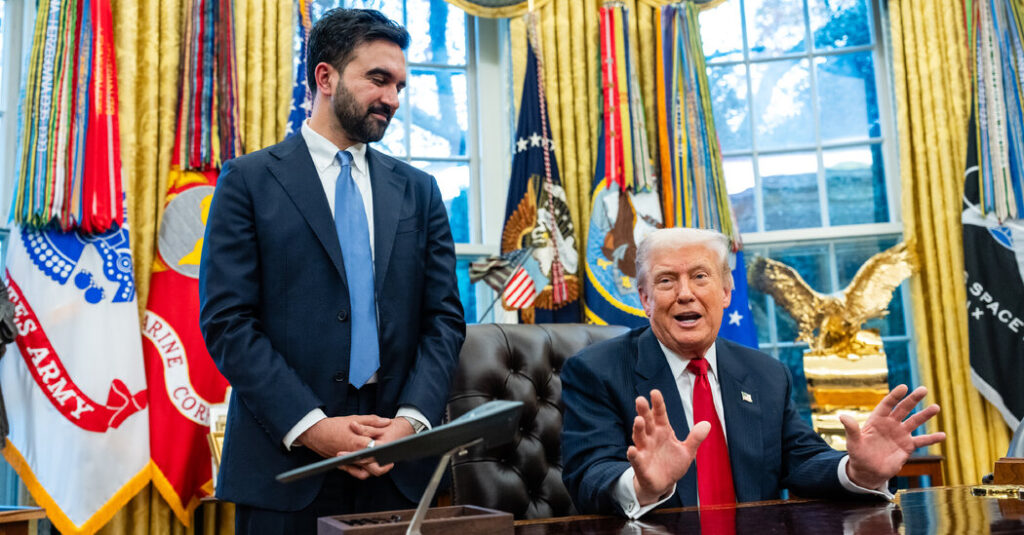
The statements marked Mr. Mamdani’s first public break with Mr. Trump since a surprisingly warm meeting in the Oval Office between the two men in November, during which Mr. Trump showered praise on the democratic socialist and called him “a very rational person.”
Neither man’s allies expected the détente to last given Mr. Trump’s pugilistic approach and the liberal views of Mr. Mamdani and the city he now leads. But a geopolitical crisis in Latin America may put the two men on a collision course far more quickly than expected, and for different reasons.
Hanging in the balance is more than personal feelings. Mr. Trump controls the spigot of federal funding for New York and could make Mr. Mamdani’s job far more difficult if he so chose. On the campaign trail, Mr. Mamdani promised both to stand up to Mr. Trump and to work with the president to improve life in the city.
New York is also home to thousands of Venezuelans, who are among the fastest-growing immigrant groups in the city. Many of them fled Mr. Maduro’s regime for New York as part of a massive influx of migrants who have arrived in the city since 2021. Mr. Mamdani vowed Saturday to dedicate resources to helping them navigate the upheaval.
Mr. Mamdani has been an outspoken critic of American support for Israel’s military campaign in Gaza, but before his comments on Saturday, he had not said much about Venezuela or U.S. policy in Latin America. Both Mr. Mamdani and Mr. Maduro describe themselves as socialists, though the policies Mr. Maduro presided over in Venezuela differ starkly from those Mr. Mamdani has vowed to pursue.
In a podcast interview last fall, Mr. Mamdani said Mr. Maduro had “done many a horrible thing.”
“Maduro’s government is one of repression, there is no question about it,” he said.
In labeling the American action unlawful, Mr. Mamdani echoed numerous other Democrats. But where other leaders in his party called Mr. Maduro an “illegitimate dictator” on Saturday, Mr. Mamdani did not directly comment on his record or standing in Venezuela.
In response to Mr. Mamdani’s comments, Representative Nicole Malliotakis, a Republican from Staten Island, wrote on X that he was “defending a murderous narco terrorist” and said, “Maybe ask some Venezuelan New Yorkers before you bring his failed socialist oppressive policies here.”
Still, the reality is that when it comes to influencing foreign policy or the decision making of the federal government, there is very little the mayor can do. He has no role in the criminal case against Mr. Maduro, which is being handled by the U.S. attorney’s office in Manhattan, an arm of the Justice Department in Washington.
On Saturday, a judge unsealed a new indictment charging Mr. Maduro, his wife, their son and three other men with cocaine trafficking and narco-terrorism crimes.
Mr. Maduro and his wife, Cilia Flores, landed in Newburgh, N.Y., on a Justice Department jet hours after the U.S. military raid on Venezuela’s capital on Saturday. They are expected to make their first appearance in Manhattan federal court soon.
It remains to be seen whether trying Mr. Maduro in New York will cost the city significant resources, such as Police Department overtime, but it would hardly be the first time a high-profile defendant had faced trial in New York City.
New York has a long history of hosting such trials, including the 2019 trial of the Mexican drug kingpin known as El Chapo and the 2025 trial of the music mogul Sean Combs. Often, they have presented enormous security challenges: When El Chapo was awaiting trial on drug-trafficking charges, the police shut down the Brooklyn Bridge to safely transport him to court.
“It is my responsibility that whatever actions the federal government takes, that they have a minimal impact on the day-to-day lives of New Yorkers,” Mr. Mamdani said on Saturday.
William K. Rashbaum contributed reporting.
Nicole Hong is an investigative reporter, focused on covering New York and its surrounding regions.
The post For Mamdani, a Break With the President Just Three Days Into His New Job appeared first on New York Times.