Dozens of people were killed and several abducted when unidentified gunmen attacked two neighboring villages in Nigeria, government officials said on Sunday. It was the first large assault on civilians since the U.S. military bombed targets in the West African country on Christmas Day, claiming it was protecting Christians from Islamist militants.
The villages had been under siege for at least the past week, forcing some residents to abandon their homes and sleep in nearby bushes, residents said. A police spokesman, Wasiu Abiodun, said that “over 30” had been killed and that “some persons” were kidnapped in one of them, Kasuwa Daji. Residents said that at least 37 were killed in that village, and five in the other, Kaima.
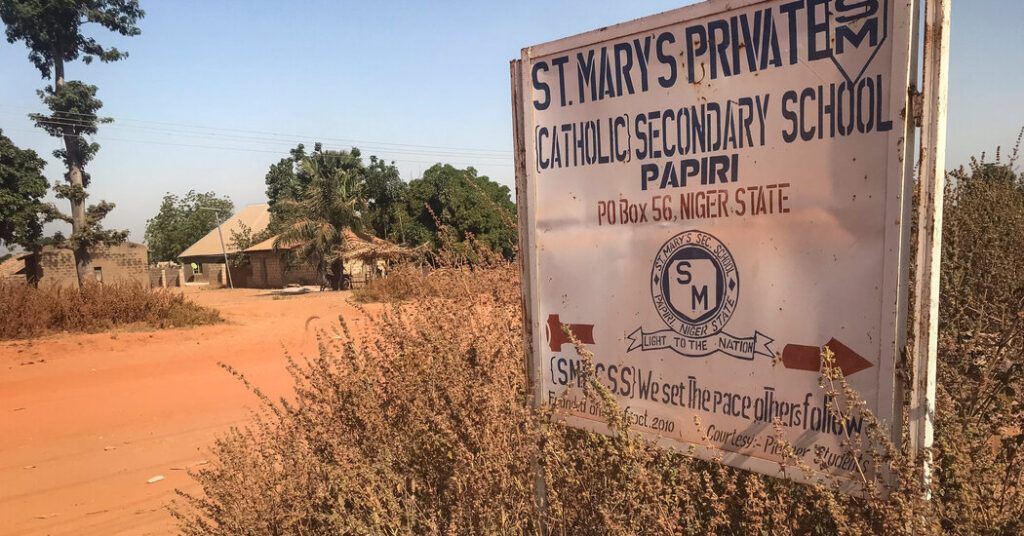
It is not clear how many people were taken hostage, but some of those abducted attended St. Mary’s Catholic School in the village of Papiri, where more than 300 students kidnapped in November were released a few weeks ago.
“For the past one week, they have been coming out of the forest and angrily attacking communities at free will because there is no security presence here,” said one resident, Abraham Peter. “The government and security agencies should come to our aid.”
No group has so far claimed responsibility for the killings, though one known as the Lakurawa, which was targeted by the U.S. strikes, is considered to be one of the main armed groups active between Nigeria’s northwestern communities and the neighboring country of Niger.
The Nigerian government said on Sunday that the attack had been carried out by “terrorists suspected to be fleeing from Sokoto and Zamfara following the United States’ airstrike on Christmas Eve,” according to a statement from Bayo Onanuga, special adviser to President Bola Ahmed Tinubu.
The Rev. Stephen Kabirat, a Catholic priest in the Kontagora Diocese, said the church in Papiri was attacked three days ago by gunmen. They destroyed some religious items inside and stole about $250 and two motorbikes, he said.
“They were looking for the priest, but luckily he escaped,” he said. “But they abducted some villagers including children.”
The attack took place in the northwestern state of Niger, the largest in Nigeria, Africa’s most populous nation. More than 200 million people live there.
It was the first large-scale killing and abduction since the United States launched more than 16 Tomahawk missiles at targets in Sokoto State, which is also in the northwest region. President Trump said the U.S. attack was directed at Islamic State terrorists “who have been targeting and viciously killing, primarily, innocent Christians.”
The strikes came after Mr. Trump designated Nigeria as a country of particular concern amid allegations by Christian groups and senior Republican politicians that a genocide of Christians was occurring there.
That claim is widely dismissed by analysts as a mischaracterization of the situation on the ground. Though the Nigerian authorities pushed back, too, in the end they cooperated with the U.S. military on the strikes. Their impact remains unclear.
The choice of the target, Sokoto State, puzzled many analysts and security experts. The militant group in Nigeria with the best- documented links to the Islamic State ison the opposite side of the country from Sokoto. That group, Islamic State West Africa Province, splintered off from Boko Haram, another jihadist group.
On Saturday, the Islamic State’s Amaq News Agency said that of ISIS’ 1,218 strikes globally last year, Nigeria alone was targeted in 368, accounting for the killing or wounding of 1,121 people. That was less than 10 percent of the 12,000 total violent deaths in Nigeria involving bandits, insurgents and local militia, according to the Armed Conflict Location and Event Data Project, an independent worldwide monitor.
For many years, communities in Nigeria have been left defenseless against armed groups and bandits, with little visible improvement despite President Bola Ahmed Tinubu’s recent move to strip government officials and other Nigerians who receive special privileges of security protection and reallocate it to rural areas.
Kefas Musa, 41, a resident of Papiri, said he had narrowly escaped the attack. About 15 minutes later, he said, he heard a convoy of over 100 motorcycles moving toward a market. Soon after, he began hearing gunfire.
“People no longer feel safe in their homes at night because of the fear of abduction,” Mr. Musa said. “Many now sleep in the bushes, while some communities have organized local security patrols made up of youths taking turns to keep watch.”
Saikou Jammeh is a reporter and researcher for The Times based in Dakar, Senegal.
The post Days After U.S. Strikes in Nigeria, Gunmen Kill Dozens of Villagers appeared first on New York Times.