They were some of the most discordant crime scene images imaginable. A blood-soaked pink unicorn. A tiny shoe. Streaks of red across the floor. Pink, purple and orange balloons. Five guns and more than 50 shell casings.
Four people were killed — three of them children, ages 8, 8 and 14.
Among the dead was Amari Peterson, a high school freshman who played football and basketball. Days after the shooting, his father, Patrick Peterson, said, “I don’t want to be one to question God.” But losing his son, he said, had left him “questioning everything about life.”
Stockton, Calif., has long suffered from gang violence, but few residents imagined it would result in children being gunned down at a 2-year-old’s birthday party. Nearly a month after the Nov. 29 tragedy, the authorities have yet to arrest a shooting suspect despite a reward for information that has grown to $130,000.
Stockton residents are looking for ways to end the violence as they grieve the latest killings, all while asking profound questions about what they wish their city to become. The port city of about 320,000 people, near a nexus of Central Valley waterways linking the region to the Bay Area and the Pacific Ocean, has long been in search of reinvention.
During the housing boom 20 years ago, Stockton gained appeal as an affordable bedroom community for commuters working in the Bay Area and Sacramento. The subsequent housing bust, however, sent the city reeling from foreclosures and, in 2012, forced it into what was then the largest bankruptcy filing by a city in American history.
Since emerging from its financial crisis, the city has shown signs of renewal. City services have returned, new parks have opened and a new glass-and-steel City Hall is taking shape on the waterfront.
But it still can’t seem to escape its past.
For decades, street gangs have terrorized the city’s streets, their violence fueled in part by poverty and the proximity to state prisons whose rivalries spilled into the community. In 1988, a movie theater owner in Stockton pulled the film “Colors,” about gang warfare in Los Angeles, after a patron was shot dead as he waited in line. The police said the killing was a product of conflict between the local chapters of the Bloods and the Crips, the two gangs featured in the film.
‘A Certain Amount of Grit’
Stockton is defined by grit. It is the word residents lean on most when asked to describe their city.
“A great amount of the population has seen the ugly side of humanity,” said Stanley McFadden, the city’s police chief. “But to rebound from that, to keep going, it takes a certain amount of grit.”
The police department said it has documented 86 gangs in Stockton and about 2,700 gang members. Gangs that were once divided along racial or ethnic lines have grown more diverse, officers say.
Stockton is also more diverse than California as a whole and ranks as one of the most ethnically diverse cities in the country. Latinos account for about 45 percent of the population, and the city also has sizable Filipino and Cambodian communities. Black people account for more than 11 percent of the population, compared to 6 percent statewide.
For generations, immigrants in Stockton have worked the surrounding farmland; more recently, logistics centers and warehouses, many near the port, have become large employers. Even as professionals arrive from the San Francisco area seeking cheaper housing, many lower-income and longtime residents commute as much as two hours each way to the Bay Area for service and gig work.
After emerging from bankruptcy, the city rebranded itself around its diversity and agriculture, promoting itself as a food mecca under the slogan, “Stockton: Stacked Full of Flavor.” It has few tourist draws, but boasts an impressive art museum, the Haggin, which has a Rodin sculpture and a Renoir painting. There are also minor league baseball and basketball teams whose venues anchor an ongoing redevelopment of the riverfront.
Once, young men in Stockton dreamed of making it big in boxing, a sport with deep roots in the city that was immortalized in Leonard Gardner’s famous novel, “Fat City.”
Today, the dream for many is rap music. Stockton’s hip-hop scene, with its growing national profile, has close ties to street gangs, the police say. One of the city’s most fearsome gangs, officers say, is EBK (Everybody Killaz), which is also a rap collective.
Police say the birthday-party shooting was gang-related, but its links to the rap world are unclear. One of Stockton’s prominent rappers, MBNel, was in attendance and was reportedly wounded.
“Hip-hop is a form of art that tells stories in communities that we come from,” said Jason Lee, Stockton’s vice mayor. “But the hip-hop that’s happening in Stockton is being used for pure evil.”
The Lure of Gangs
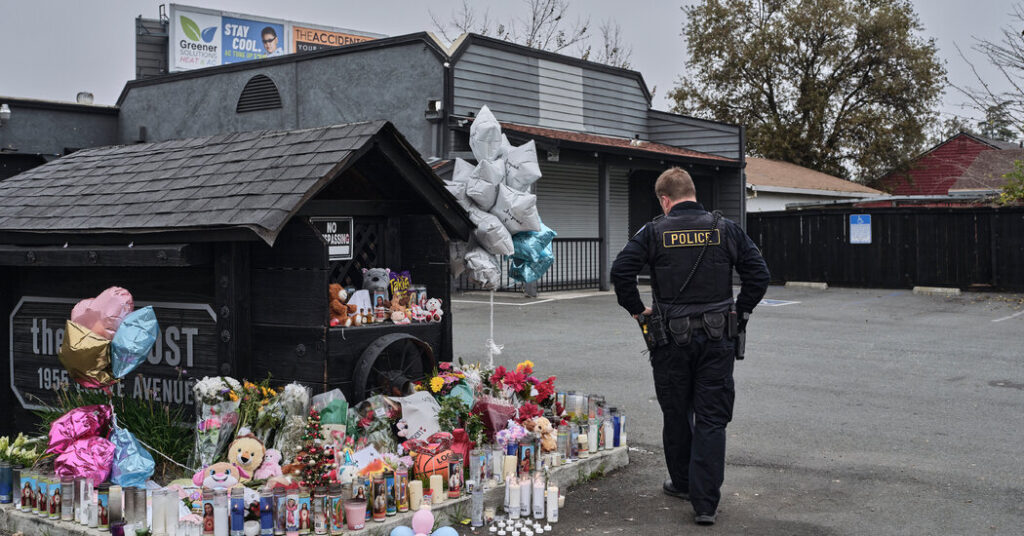
Drive around Stockton and you will see them: makeshift memorials where residents — most often young men — have been shot dead. With collections of candles and pictures of the dead surrounded by angel wings and handwritten notes, they have become permanent features of the city’s landscape, their upkeep often maintained by the mothers.
Among them is a memorial for Rafael Chavez Jr., who was shot and killed at age 17 in 2020. He was trying to sell a gun to another young man, and the transaction turned violent, the police said.
“A better future here?” said his mother, Rochelle Valverde, who lives around the corner from where her son was murdered. “No.”
She continued, “I have a 12-year-old and I refuse to let him come out and play.”
Sgt. Patrick High of the Stockton Police Department was the detective who solved Rafael’s murder. He joined the department in 2006 and left for a few years as the city’s finances collapsed, but later returned.
Patrolling the streets recently, he pointed to signs of improvement: new construction, an influx of Bay Area transplants and the expansion of a local community college. Despite the recent shooting, crime rates have improved: homicides are down 26 percent this year so far, and nonfatal shootings have declined 16 percent, according to the Stockton Police Department.
But any possibility of renaissance has been overshadowed by tragedy, once again.
“Now that’s the narrative,” he said. “Stockton, that’s the place where they shoot kids.”
The police believe gang violence led to the birthday party shooting, which occurred just outside city limits in an area under the jurisdiction of the San Joaquin County Sheriff’s Department, which is leading the investigation. The episode has shaken Stockton because it went against what officials and residents thought they understood about gangs: that the code of the streets placed innocent children off limits.
“It’s just unheard of,” said Lora Larson, the director of the city’s Office of Violence Prevention. “Typically individuals that are driving this kind of violence, they are looking for intended individuals. And they stay away from the family dwellings where kids are, or parties.”
Less than an hour after the shooting, two former gang members who work for Ms. Larson, Antonio Hernandez and Andrew Lucero, were dispatched to the hospital. Their job in such situations is to gather information and try to prevent retaliation. In the days after the shooting, they also helped move party attendees out of Stockton for their own safety.
There has been no confirmed retaliation so far. Nor have there been any arrests.
It is a reflection, officials said, of the “no snitch” culture that pervades communities where gangs are dominant. Mr. Lee, Stockton’s vice mayor, urged people to tell law enforcement what they knew about the crime, saying that when his brother was murdered nearly 30 years ago, “I couldn’t wait to go testify.”
Mr. Hernandez and Mr. Lucero also work with people who have been identified as gang members, helping them get jobs and mentoring them in an effort to steer them away from the streets.
Leonardo Barajas, 23, came to them after a short jail sentence on a gun charge. He said that being drawn to gangs was a natural part of growing up in his neighborhood. Most of his friends, like him, were raised by single mothers. He has never met his father.
“Every day being out there, I just dug myself deeper and deeper,” he said.
Mr. Barajas is now pursuing a career in dog breeding, and he has a job at an Amazon warehouse near San Francisco, joining the legions of Stocktonians who commute to the Bay Area.
Mr. Barajas estimated he has lost a couple dozen friends to gun violence, including Susano Archuleta, 21, the only adult killed at the birthday party. He said he can’t wait to move out of Stockton.
“There’s nothing here,” he said. “It’s dead here. You’re just going to grow old, that’s it.”
Trying to Heal
A week after the shooting, with a manhunt underway, Stockton leaders gathered on the waterfront for the annual Christmas tree lighting ceremony. They stood in a park named for Charles E. Weber, a German émigré who founded Stockton in the late 1840s during the Gold Rush.
While some residents felt the city should have canceled the ceremony as a gesture of mourning, Mayor Christina Fugazi and other leaders saw it as an affirmation of what the city needed: connection and healing.
“One week ago tonight, this community was shattered,” Ms. Fugazi said. She continued, “I want you to squeeze your loved ones tight. I want you to enjoy every minute that you spend with them.”
In the aftermath of the shooting, Ms. Fugazi, a Democrat, said that she was seeking help from the federal government for her city’s gang problem. It set off something of a firestorm, with liberals aghast and conservatives demanding the National Guard or a crackdown on immigrants.
She said the city needs help anywhere it can get it, and she wants to work with the Trump administration, which previously cut a grant to the city for Advance Peace, a program that tries to prevent violence by steering gang members into jobs.
Gun violence is personal for the mayor. A former teacher, she recalled the names of former students who had been killed: Isaac, Julie, Joey.
Mr. Peterson, who lost his son in the shooting, said he struggles to think about the future. After the shooting, he told a local television station how his son, Amari, had left his side at the party, briefly, to meet a local rapper.
At that moment, Amari was shot and killed. And now Mr. Peterson keeps looking for his son everywhere.
“I’m looking in his room,” he said. “I’m looking around the corner. People keep telling me he’s in my heart, but I don’t see him.”
Tim Arango is a correspondent covering national news. He is based in Los Angeles.
The post A California City Grieves Over a Shooting at a Toddler’s Birthday Party appeared first on New York Times.