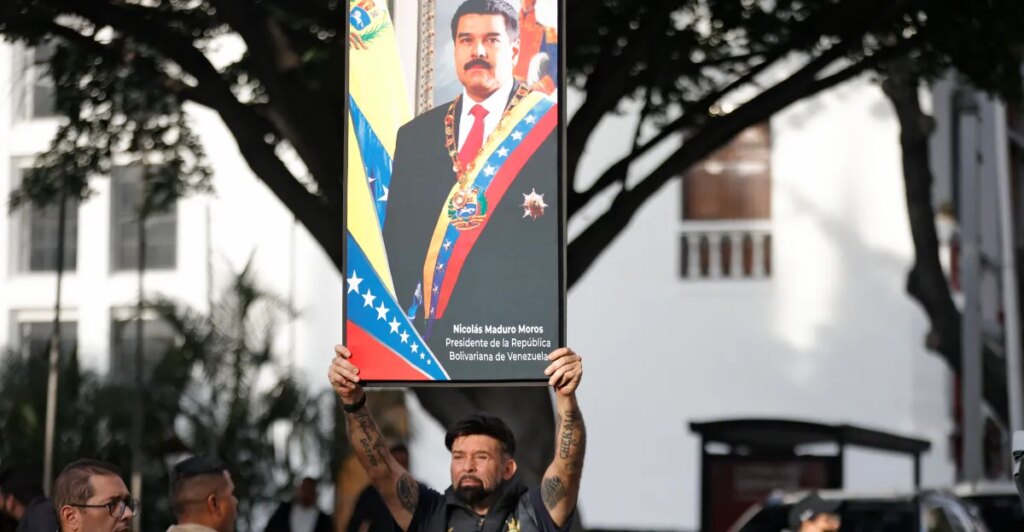
President Trump announced Saturday morning that the United States has captured Venezuelan President Nicolás Maduro, saying that the US had flown Maduro to a military ship off the country’s coast and will be taking him to New York.
The capture of Maduro was part of a military operation that included “large scale strikes” on Venezuela, Trump said.
It comes after months of escalating rhetoric and action from the US against Venezuela and speculation about US military action against the Venezuelan government. Since the fall, the US has been striking alleged drug boats. On December 30, the US government announced that the CIA had conducted a drone strike inside Venezuela.
Much is still unknown about Saturday’s military operation, the future of Venezuela, and what the US might do next in the region. But understanding what might happen next starts with how the situation escalated to this point.
What’s America’s problem with Venezuela?
Venezuela’s socialist regime has been a thorn in the side of US presidential administrations since the days of Maduro’s predecessor Hugo Chavez, who first took power in 2000. Venezuela has opposed US influence in Latin America, and allied itself with US adversaries like Cuba, Iran, Russia, and numerous militant groups opposed to US policy.
Since 2013, when Chavez died and Maduro succeeded him, Venezuela’s oil-dependent economy has been in a tailspin, with hyperinflation and mass unemployment. Organized crime and corruption are rampant, the government has cracked down on opposition parties and civil society, and Venezuelans have become the world’s largest refugee population.
Most relevant for the current crisis, Venezuela has also become a major trans-shipment point for Andean cocaine bound for the US, West Africa, and Europe.
During Trump’s first term as president, his administration took a variety of actions — overt and covert — to pressure Maduro to leave office. When he returned to office in 2025, Trump initially looked like he was going to try to have a more productive relationship with Maduro, seeking deals on detained US citizens, refugee returns, and access for US firms to Venezuela’s oil fields.
But Trump soon put a stop to those early talks and dialed up the pressure on Maduro to leave. This was likely at least partly driven by Secretary of State Marco Rubio, a longtime outspoken Maduro critic since his days in the Senate.
The US considers Venezuelan President Nicolas Maduro to be the head of a “narcoterrorist cartel.” Maduro’s regime is undoubtedly corrupt and autocratic, but not all the US allegations hold up. The administration accuses Maduro of intentionally flooding the US with drugs and criminals, and of effectively controlling prison gangs like Tren de Aragua.
While the Venezuelan government has well-documented ties to crime, Maduro is almost certainly not personally directing drug shipments. Meanwhile, Tren de Aragua, a fixation of Trump’s dating back to his presidential campaign, is almost certainly not involved in transnational trafficking. Trump has also suggested, misleadingly, that Venezuela is tied to fentanyl production.
Ultimately, different players in the Trump administration may be interested in Venezuela for different reasons, but as an emblematic country for migration, drug trafficking, and socialism, it sits within the Venn diagram of the administration’s priorities.
The post Why Trump sent in troops to capture Maduro, briefly explained appeared first on Vox.