President Donald J. Trump shocked the nation and the world early Saturday when he announced that the United States had captured the Venezuelan president, Nicolás Maduro, and intended to “run the country.”
The action came after a monthslong campaign by Mr. Trump’s administration to oust the authoritarian leader, and raised questions about the legality of what happened in the South American country.
Here’s what we know:
What happened?
The U.S. carried out “a large scale strike against Venezuela,” Mr. Trump said on Truth Social, his social media platform. Mr. Maduro and his wife, Cilia Flores, were captured during the operation, according to the president.
Gen. Dan Caine, chairman of the Joint Chiefs of Staff, said during a news conference on Saturday that President Trump gave the order to capture Mr. Maduro late on Friday. A vast array of U.S. forces began their mission, named “Absolute Resolve,” which lasted into the early hours of Saturday, General Caine said.
The operation involved 150 aircraft launching across the hemisphere, he said, and working to dismantle Venezuelan air defenses so that military helicopters could deliver troops into Caracas, the country’s capital. The entire mission took about two hours and 20 minutes, the general said.
President Trump at the news conference on Saturday said that U.S. forces encountered significant resistance. General Caine said that Mr. Maduro and Ms. Flores “gave up” and were taken into custody.
The couple was taken to the U.S.S. Iwo Jima, one of the American warships that have been prowling the Caribbean, Mr. Trump said in an interview on Fox News.
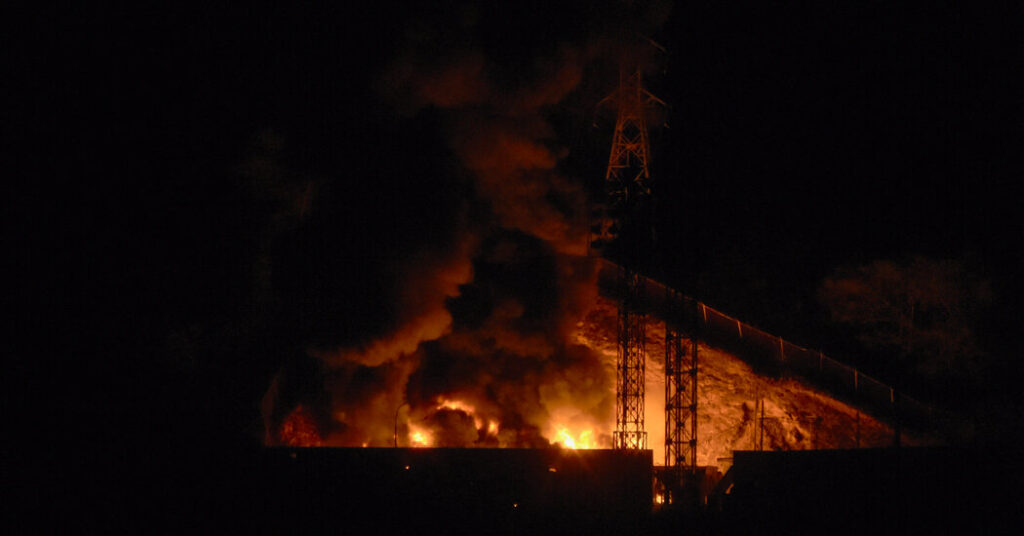
The Venezuelan government accused the United States earlier on Saturday of carrying out military attacks in the capital, Caracas, and other parts of the country after large explosions were reported at a military base in the city. Video obtained by the Reuters news agency and verified by The New York Times shows smoke billowing near La Carlota Airport in Caracas, Venezuela, as explosions ring out.
Did Trump have the authority to capture Maduro?
There are questions over the legality of the strikes. Secretary of State Marco Rubio said during a news conference on Saturday that it would not have been possible to let U.S. lawmakers know in advance. Mr. Trump and Mr. Rubio said several times that the operation was primarily an act of law enforcement, rather than the military action over which Congress has a greater purview.
The president had brushed off concerns about the constitutionality of his administration’s actions during an interview earlier on Fox News.
Sidestepping criticism of the raid and whether there was any legal justification for his administration’s actions, Mr. Trump said that Democrats who criticize him should commend the effort.
.css-1mxer6r{max-width:600px;width:calc(100% – 40px);margin:1.5rem auto 1.75rem;height:auto;margin-left:auto;margin-right:auto;font-family:nyt-franklin;color:var(–color-content-secondary,#363636);border-top:1px solid var(–color-stroke-quaternary,#DFDFDF);border-bottom:1px solid var(–color-stroke-quaternary,#DFDFDF);padding-top:20px;padding-bottom:20px;}@media only screen and (min-width:1024px){.css-1mxer6r{width:600px;}}.css-1medn6k{font-family:nyt-franklin,helvetica,arial,sans-serif;font-weight:500;font-size:1.0625rem;line-height:1.5rem;}@media only screen and (max-width:480px){.css-1medn6k{font-size:1rem;line-height:1.375rem;}}.css-1f84s5v{font-weight:700;font-size:1.0625rem;}@media only screen and (max-width:480px){.css-1f84s5v{font-size:1rem;}}.css-1f84s5v a{color:var(–color-signal-editorial,#326891);-webkit-text-decoration:underline;text-decoration:underline;}.css-1f84s5v a:hover{-webkit-text-decoration:none;text-decoration:none;}.css-1hvpcve{font-size:17px;font-weight:300;line-height:25px;}.css-1hvpcve em{font-style:italic;}.css-1hvpcve strong{font-weight:bold;}.css-1hvpcve a{font-weight:500;color:var(–color-content-secondary,#363636);}.css-214jt4{margin-top:15px;margin-bottom:9px;}@media only screen and (max-width:480px){.css-214jt4{font-size:14px;margin-top:15px;margin-bottom:10px;}}.css-214jt4 a{color:var(–color-signal-editorial,#326891);-webkit-text-decoration:underline;text-decoration:underline;font-weight:500;font-size:16px;}@media only screen and (max-width:480px){.css-214jt4 a{font-size:13px;}}.css-214jt4 a:hover{-webkit-text-decoration:none;text-decoration:none;}.css-1mxer6r{max-width:600px;width:calc(100% – 40px);margin:1.5rem auto 1.75rem;height:auto;margin-left:auto;margin-right:auto;font-family:nyt-franklin;color:var(–color-content-secondary,#363636);border-top:1px solid var(–color-stroke-quaternary,#DFDFDF);border-bottom:1px solid var(–color-stroke-quaternary,#DFDFDF);padding-top:20px;padding-bottom:20px;}@media only screen and (min-width:1024px){.css-1mxer6r{width:600px;}}.css-1medn6k{font-family:nyt-franklin,helvetica,arial,sans-serif;font-weight:500;font-size:1.0625rem;line-height:1.5rem;}@media only screen and (max-width:480px){.css-1medn6k{font-size:1rem;line-height:1.375rem;}}.css-1f84s5v{font-weight:700;font-size:1.0625rem;}@media only screen and (max-width:480px){.css-1f84s5v{font-size:1rem;}}.css-1f84s5v a{color:var(–color-signal-editorial,#326891);-webkit-text-decoration:underline;text-decoration:underline;}.css-1f84s5v a:hover{-webkit-text-decoration:none;text-decoration:none;}.css-1hvpcve{font-size:17px;font-weight:300;line-height:25px;}.css-1hvpcve em{font-style:italic;}.css-1hvpcve strong{font-weight:bold;}.css-1hvpcve a{font-weight:500;color:var(–color-content-secondary,#363636);}.css-214jt4{margin-top:15px;margin-bottom:9px;}@media only screen and (max-width:480px){.css-214jt4{font-size:14px;margin-top:15px;margin-bottom:10px;}}.css-214jt4 a{color:var(–color-signal-editorial,#326891);-webkit-text-decoration:underline;text-decoration:underline;font-weight:500;font-size:16px;}@media only screen and (max-width:480px){.css-214jt4 a{font-size:13px;}}.css-214jt4 a:hover{-webkit-text-decoration:none;text-decoration:none;}
Got a confidential news tip? The New York Times would like to hear from readers who want to share messages and materials with our journalists.
See how to send a secure message at nytimes.com/tips
“They should say, ‘Great job,’” he said. “They shouldn’t say, ‘Oh, gee, maybe it’s not constitutional.’”
Representative Jim Himes of Connecticut, the top Democrat on the House Intelligence Committee, said there “must immediately brief Congress on its plan to ensure stability in the region and its legal justification for this decision.” His remarks came before Mr. Trump said that the U.S. intended to run Venezuela.
Was anybody hurt or killed?
It was unclear on Saturday morning what could have been the death and injury toll, Venezuelan officials said in statements, but they noted that Venezuelans had been killed during the operation.
A U.S. official said there had been no American casualties in the operation but would not comment on Venezuelan casualties.
Who is in charge of Venezuela now?
Mr. Trump said the United States was going to “run the country” until a transition can take place. He gave few details of how that might work in practice, though, and his remarks mostly focused on how U.S. interests would extract and sell oil from the country.
According to the Venezuelan constitution, power should pass to the vice president, Delcy Rodríguez, who runs economic policy. Mr. Trump said at the news conference that Mr. Rubio had spoken to Ms. Rodríguez, the newly sworn-in Venezuelan president, and added that she had said she would support what the United States is doing.
“She’s essentially willing to do what we think is necessary to make Venezuela great again,” he said.
But in a live address to the nation on Saturday, Ms. Rodríguez undermined Mr. Trump’s comments, forcefully denouncing the United States and stating that Mr. Maduro was the rightful president of Venezuela.
She added that Venezuela was open to having a respectful relationship with the Trump administration, but only within the framework of international and Venezuelan law. “That is the only type of relationship I will accept, after they have attacked and militarily assaulted our beloved nation,” she said.
What happens next?
Mr. Maduro and Ms. Flores were being taken to New York to face charges, U.S. officials said. Attorney General Pam Bondi said on social media that Mr. Maduro and his wife had been indicted on drug and weapons charges and “will soon face the full wrath of American justice.”
A photo of Mr. Maduro in U.S. custody, released by Mr. Trump, shows him in handcuffs, with a blacked-out mask and headphones.
The attorney general posted an unsealed indictment, which appears similar to the 2020 indictment of the Venezuelan leader, charging him with narco-terrorism and cocaine importation conspiracies. The charges also include possession of machine guns. When combined with drug trafficking charges, those gun charges carry strong prison sentences upon conviction.
A 2020 indictment against Mr. Maduro accused him of overseeing a violent drug organization known as Cartel de los Soles. U.S. intelligence agencies had assessed that Mr. Maduro was actually at odds with one group, Tren de Aragua, and analysts said that the Cartel de Los Soles did not exist as a concrete organization. The term has been used to refer to the involvement of high-ranking military officers in the drug trade, though no evidence has been disclosed of Mr. Maduro directing the effort.
Aimee Ortiz covers breaking news and other topics.
The post What We Know About the U.S. Operation in Venezuela appeared first on New York Times.