This is what America has come to:
A disabled widow, Melinda Price, 43, set out with her walker at 4 a.m. in hopes of getting health care not covered by her Medicaid insurance. A cancer survivor, she had lost her car to medical debt, and she could not afford an Uber. So Price hobbled for nearly two hours through darkened streets to a high school in Columbus, Ohio, where medics at a health fair promised free help.
Yet American health care may be headed for a future still more bleak:
President Trump’s cuts to Medicaid and other health programs will make things worse, especially for marginalized people like Price. One study projects that 51,000 Americans will die annually as a result of these cuts.
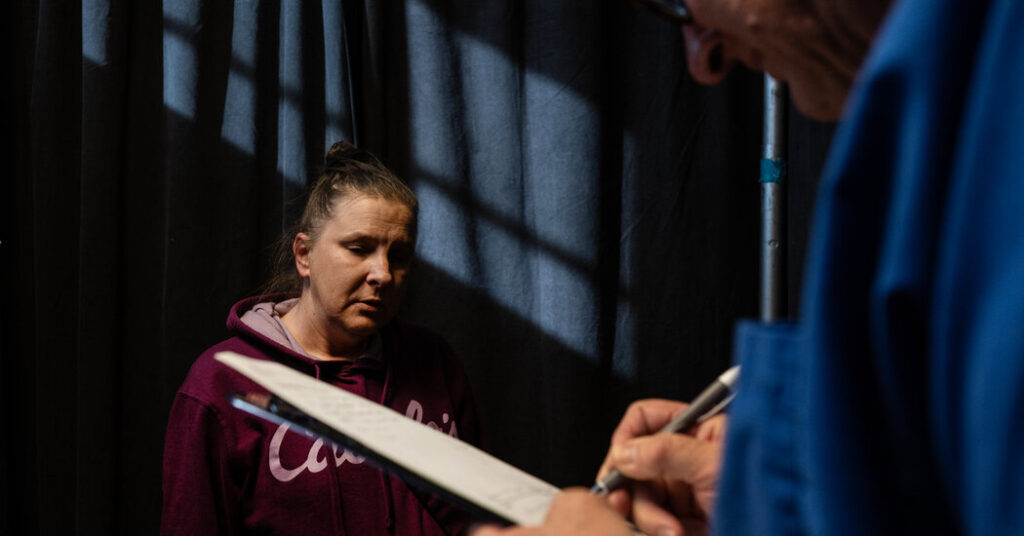
After her long walk, a weary Price waited with scores of other struggling people in the pre-dawn darkness for their numbers to be called to enter the building. Many patients were ahead of Price, having arrived the previous day and slept in their cars, so she rubbed her hands by an open fire someone had built to stave off the cold.
Price is a hardy woman who did not complain, for she was buoyed by the hope that she would finally be able to get glasses to see properly and dentures to chew food. Yet when she finally reached a makeshift examination room, a volunteer doctor gently explained that her diabetes was out of control and that her soaring blood sugar reading of 335 meant that it would be difficult to measure her eyesight and get appropriate glasses.
That’s when this stalwart woman began to cry. Frantically, tears trickling down her cheeks, she tried to explain that maybe her blood sugar was so high only because she hadn’t had anything to eat all day.
The doctor looked as if she were about to weep as well.
The health fair was organized by Remote Area Medical, a Tennessee nonprofit founded to take volunteer medics to impoverished parts of South America and Africa. But after seeing how desperate the needs were here in the United States, it reoriented itself and today mostly serves Americans. Whenever Remote Area Medical holds health fairs, vast lines form of desperate Americans, often in pain and at wits’ end — and now bracing for further cuts.
“People will die,” Price told me. “If bills go up, people will die.”
How many? A peer-reviewed article in the Annals of Internal Medicine in June projected that the huge cuts coming in Medicaid alone would lead to more than 16,000 American deaths annually. The estimate of 51,000 additional Americans dying annually comes from a more comprehensive study by Yale and University of Pennsylvania scholars that looks at the impact of a broader range of Trump policies, including not just Medicaid trims but also the end of Obamacare subsidies and a relaxation of nursing home staffing rules.
These figures derive from a well-known connection between losing insurance and dying prematurely. Experts have calculated that perhaps 15 million Americans will lose health insurance because of Trump’s “Big Beautiful Bill.” Dr. Steffie Woolhandler, who has published other peer-reviewed studies on the link between uninsurance and mortality, told me she found the 51,000 figure credible.
That would amount to one additional death every 10 minutes, around the clock.
Price knows something about unnecessary death. She and her husband, a longtime delivery driver for a pizza parlor, were getting by until he got throat cancer. Soon after, she got colon cancer.
“We had insurance, but we had deductibles and it only covered so much,” she said. “The bills were bigger than our incomes.”
The family racked up large medical debts in hopes of saving Price’s husband, but the cancer still took his life three years ago. “He could have lived a lot longer, but we didn’t have the resources,” Price told me.
Price recovered from her own cancer but was left disabled. After medical debt caused her to lose the family home, she ended up homeless for seven months before getting public housing.
All of her teeth fell out (a possible consequence of the cancer treatment she received), and she lost her sole dentures in the chaos of homelessness — along with an even more treasured possession, the ashes of a son who had died as an infant.
Price gets by on $941 each month in disability payments, half of which goes to rent. One lifeline is Medicaid, which pays for the 42 medications she takes. Another lifeline is her SNAP benefit.
We don’t think of food stamps as a health benefit, but for millions with diabetes or hypertension, healthy food can be a matter of life and death. Under Trump’s “Big Beautiful Bill,” some four million people are losing all or some of their food stamp benefit — and one study projects that some 93,000 Americans will die prematurely as a consequence by 2039. On top of that, the Trump administration has also cut back support for food banks across the country.
This is a pivotal time, for certain Obamacare subsidies for health insurance expired at the end of the year; without them, around four million people may lose insurance.
To gauge what lies ahead with Trump health care cuts, I traveled with the photographer Lynsey Addario, through Ohio, Mississippi and Alabama — and we encountered devastated families bracing for even more difficult challenges.
At the same health fair in Ohio, I met Amanda Pidrak Johnston, a 44-year-old mom who gave up her insurance this year because she couldn’t afford the premiums. She’s a diabetic who has already had two toes amputated because of diabetic ulcers but has stopped taking her diabetes medicine — because she is in the impossible position of choosing between buying medication and spending the money on the needs of her two boys.
“They come first,” she said. “They’re little.”
Pidrak Johnston adores her sons, whom she had trouble conceiving. “It took us nine years to have Kenney and then Owen, and I just want the best for them,” she told me, tears welling.
Kenney, 8, is autistic; Pidrak Johnston was deeply hurt when she learned that he had been bullied at school. She wants to spend money on programs to help him, but she has $80,000 in medical debt hanging over her already, and she and her husband, a truck driver, are about to lose their home to foreclosure. She can’t even afford to take the boys to a dentist, so she brought them with her to the health fair so their teeth could be checked.
“She’s letting herself slowly die through uncontrolled diabetes, and she can’t afford treatment for it because she favors her kids,” Chad Wittekind, a nurse practitioner who treated her, told me.
Very gently, he warned her that her blood sugar levels were perilous, and he offered some ideas about how she might get cut-rate medicines and follow-up care. Above all, he advised her to think of her sons’ broader needs: “What are they going to do when you’re dead?”
The Trump health cuts constitute a double blow because they not only reduce access to clinical care, but also undermine public health initiatives related to vaccinations or addiction. Mortality from dismantling public health efforts is hard to gauge and is not included in the 51,000 projected yearly deaths from other cuts.
Still, one study estimated that the Trump cuts will mean that an additional 101,000 people with addictions will go untreated annually.
The mortality figures also don’t account for Trump’s proposed cuts to women’s health programs or to infant health initiatives like Healthy Start. Maine Family Planning has already closed its primary care practice because of such cutbacks, and Planned Parenthood is similarly losing funding even for cancer screenings.
.op-aside { display: none; border-top: 1px solid var(–color-stroke-tertiary,#C7C7C7); border-bottom: 1px solid var(–color-stroke-tertiary,#C7C7C7); font-family: nyt-franklin, helvetica, sans-serif; flex-direction: row; justify-content: space-between; padding-top: 1.25rem; padding-bottom: 1.25rem; position: relative; max-width: 600px; margin: 2rem 20px; }
.op-aside p { margin: 0; font-family: nyt-franklin, helvetica, sans-serif; font-size: 1rem; line-height: 1.3rem; margin-top: 0.4rem; margin-right: 2rem; font-weight: 600; flex-grow: 1; }
.SHA_opinionPrompt_0325_1_Prompt .op-aside { display: flex; }
@media (min-width: 640px) { .op-aside { margin: 2rem auto; } }
.op-buttonWrap { visibility: hidden; display: flex; right: 42px; position: absolute; background: var(–color-background-inverseSecondary, hsla(0,0%,21.18%,1)); border-radius: 3px; height: 25px; padding: 0 10px; align-items: center; justify-content: center; top: calc((100% – 25px) / 2); }
.op-copiedText { font-size: 0.75rem; line-height: 0.75rem; color: var(–color-content-inversePrimary, #fff); white-space: pre; margin-top: 1px; }
.op-button { display: flex; border: 1px solid var(–color-stroke-tertiary, #C7C7C7); height: 2rem; width: 2rem; background: transparent; border-radius: 50%; cursor: pointer; margin: auto; padding-inline: 6px; flex-direction: column; justify-content: center; flex-shrink: 0; }
.op-button:hover { background-color: var(–color-background-tertiary, #EBEBEB); }
.op-button path { fill: var(–color-content-primary,#121212); }
Know someone who would want to read this? Share the column.
In a particularly devastating move, the Trump administration is seeking to eliminate all funding for Title X, which provides nearly three million low-income Americans with family planning, cancer screening, pregnancy tests and treatment for sexually transmitted infections.
In Belzoni, Miss., I watched as Destiny Glasper, 22, received her quarterly birth control shot. Glasper has no insurance, but for the last two years Title X has enabled her to get free family planning and breast and cervical cancer screenings at the G.A. Carmichael Family Health Center.
I asked her what she would do if Title X funding ended and she could no longer get free services. “I’m not sure what I would do,” she said. “I might get pregnant.”
A randomized trial published recently found that vouchers for family planning at Title X clinics reduced abortions by 12 percent over two years.
Some of Trump’s restructuring of health care takes the form of work requirements or strict reporting rules. These may sound sensible, but they create a bewildering bureaucracy. The upshot is that they typically succeed at only one thing: causing people to become uninsured.
In 2018, for example, Arkansas imposed work requirements for Medicaid. The number of people working did not increase, but 18,000 people lost insurance.
Already, the health bureaucracy overwhelms patients. Tamika Burrell, who earns $17 an hour as an aide to the elderly in Alabama, found a lump in her breast in February. So she went to her OB-GYN, who found that somehow her Medicaid plan had been changed and she wasn’t covered by that doctor. Burrell told me it took her six months to figure out what insurance coverage she had and to get an appointment elsewhere — and by that point, she had a second lump as well.
In September, a biopsy found she had breast cancer. Perhaps because of the delay, two surgeries to remove the cancerous tissue were unsuccessful. Now it appears she will need to have her entire left breast removed, and waiting increases the risk of cancer spreading.
“I’m 44 and I want my breast,” she told me. “But I want my life more.”
Republicans sometimes favor onerous restrictions out of suspicion that poor people are lazy or ripping off the government. Yes, that sometimes happens. But talk to people seeking care, and you mostly find simply bad luck.
Billy Tucker, 50, a truck driver in Mississippi, was doing fine raising two sons, now ages 8 and 9. Then in May 2024, he and his boys were nearly killed in a car accident — and now he and his children sometimes struggle to get care for physical injuries and also for his heart problems and diabetes.
“I don’t know what to do but pray,” said Tucker, a barrel-chested man who has difficulty walking and can no longer drive.
He wept, his big shoulders shaking, as he explained that he skips buying medicine for himself so he can buy groceries for his sons.
“I will always sacrifice myself,” he said.
“I have to fight, grovel, beg to get the help I need,” he added bitterly. “And now they want to make cuts.”
One of Tucker’s ailments is diabetes, an enormous burden on the entire country: Some 34 million Americans have it, generating more than $400 billion in medical expenses, a sum greater than the G.D.P. of Connecticut. It is also the seventh leading cause of death in the United States.
Paradoxically, Trump’s spending cuts may add not only to diabetes mortality but also to health costs. Experts who modeled the Trump health cuts estimated that they will cause 138,000 cases of diabetes to go untreated — meaning that instead of simply needing insulin or other medications, patients will require expensive amputations and dialysis. The same team predicted 165,000 additional cases of untreated hypertension, which is also linked to dialysis.
More than half a million Americans hook up regularly to dialysis machines to stay alive — a national health care failure. Dialysis can cost $100,000 per year.
Each year Medicare spends about $45 billion for dialysis, a vast sum greater than the total the federal government spends on pre-K and child care programs in America.
Dr. Alan J. Cohen, an endocrinologist in Memphis, estimated that 80 percent of dialysis could be prevented with better care and health education. But now, he said, cuts in health care and SNAP benefits are taking us in the opposite direction and will entail more spending.
“Who pays for it?” he asked. “You and I as taxpayers.”
Medicaid cuts, he said, will make the rest of America look a little more like Mississippi, because it always had a very limited Medicaid program. That’s not promising, for Mississippi currently has a life expectancy shorter than that of Bangladesh.
Black men in Mississippi have a life expectancy below 69 — shorter than life expectancy in Venezuela, Egypt or India.
One rare hopeful sign, Cohen and others said, is the price cuts that Trump recently negotiated for weight-loss drugs such as Wegovy and Ozempic. That was an important step forward, but people have trouble accessing even drugs they’re already entitled to.
A study in Connecticut last year, for example, found that 38 percent of diabetics ration their insulin because of cost, insurance delays or pharmacy shortages.
In my journey reporting this story, I saw heartbreaking gaps. I also saw a remarkable outpouring of goodness: Neighbors helping each other out with food and bills, churches and schools stepping up, health workers volunteering.
Melinda Price, the widow in Ohio who hiked with her walker to the health fair, told me tearily that when she lost her hair to cancer treatment, her teenage son cut off his own hair to make a wig for her. And, thanks to volunteers at the Remote Area Medical health fair, her vision was eventually tested and she did get glasses (dentures must wait).
But goodness is not a safety net. We would never build an interstate highway system by asking volunteers to go out with shovels and each pave three feet of road. Likewise, for something as vital as our health, we need a robust system that covers all Americans.
Instead, we’re moving in the opposite direction. We’re dismantling some of our tattered safety net and risking the lives of fellow Americans. We’re forcing even a hungry widow to struggle through icy, darkened streets to receive volunteer health care — and to face the prospect that her plight may soon become even more grim.
The Times is committed to publishing a diversity of letters to the editor. We’d like to hear what you think about this or any of our articles. Here are some tips. And here’s our email: [email protected].
Follow the New York Times Opinion section on Facebook, Instagram, TikTok, Bluesky, WhatsApp and Threads.
The post Trump’s Cuts Are About to Make Health Care Even Worse appeared first on New York Times.