Venezuela’s oil industry would “make a lot of money” with the United States behind it, President Trump said Saturday in a news conference to confirm the capture of the country’s president, Nicolás Maduro, who is facing federal drugs and weapons charges.
“We’re going to have our very large United States oil companies, the biggest anywhere in the world, go in, spend billions of dollars, fix the badly broken infrastructure, the oil infrastructure, and start making money for the country,” Mr. Trump said.
He said the country’s oil industry had been “a total bust,” for a long time, adding, “They were pumping almost nothing by comparison to what they could have been pumping.”
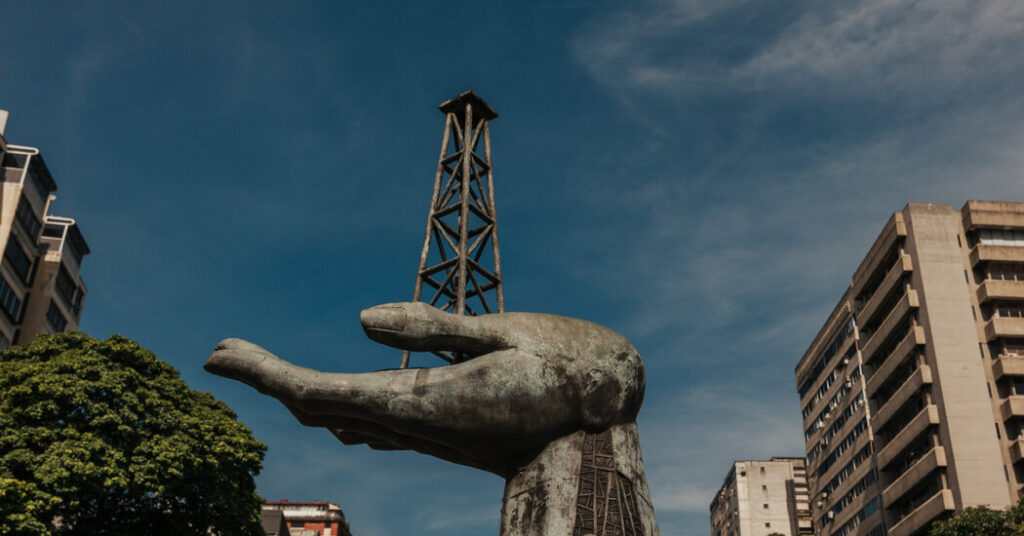
Mr. Trump appears to be counting heavily on U.S. intervention in the oil industry to help transform Venezuela, a proposition that could prove to be complicated and expensive.
How much oil does Venezuela produce?
Venezuela claims to have more than 300 billion barrels in the ground, the largest reserves of oil of any country. But it is struggles to produce about one million barrels a day, or around 1 percent of global production.
What is the state of the oil industry in Venezuela?
The industry has seen some recovery in recent years, but output is well below the more than two million barrels a day that Venezuela was producing in the early 2010s.
The national oil company, known as PDVSA, lacks the capital and expertise to increase production. The country’s oil fields are run down and suffer from “years of insufficient drilling, dilapidated infrastructure, frequent power cuts and equipment theft,” according to a recent study by Energy Aspects, a research firm. The United States has placed sanctions on Venezuelan oil, which is now exported primarily to China.
What role does Chevron play in the country’s oil production?
Chevron is the main Western company still operating in the country and produces about a quarter of Venezuela’s oil. Early in this century, when other companies were forced out, Chevron stayed, figuring that conditions might eventually improve.
Roughly half of Chevron’s production is exported to the United States.
On Saturday, Chevron said it was trying to ensure the safety of its employees and its operations in the country after Mr. Maduro and his wife, Cilia Flores, were arrested and removed in the U.S. military action.
The oil giant, based in Houston, has conducted operations in Venezuela since 1923 and has maintained five onshore and offshore production projects there. “With more than a century in Venezuela, we support a peaceful, lawful transition that promotes stability and economic recovery,” said Kevin Slagle, a Chevron spokesman. “We’re prepared to work constructively with the U.S. government during this period, leveraging our experience and presence to strengthen U.S. energy security.”
What would U.S. control of the country’s oil production mean?
In theory, if U.S. oil companies were given a free hand in Venezuela, they could help gradually turn the industry around. “But it’s not going to be a straightforward proposition,” said Richard Bronze, head of geopolitics at Energy Aspects.
Analysts say increasing Venezuelan production will not be cheap. Energy Aspects estimated that adding another half a million barrels a day of production would cost $10 billion and take about two years.
Major increases might require “tens of billions over multiple years,” the firm said.
Rebecca Elliott and Ivan Penn contributed reporting.
Stanley Reed reports on energy, the environment and the Middle East for The Times from London. He has been a journalist for more than four decades.
The post The Venezuelan Oil Industry Trump Is Planning to Revive appeared first on New York Times.