The fliers began appearing around campus in early December.
“THE WORLD W/Out A PHONE,” they read, in heavy text that had been plunked out on a typewriter.
The posters were pasted in dorms at St. John’s College in Santa Fe, N.M., a small and rigorous liberal arts school in the foothills of the Sangre de Cristo Mountains. Each one outlined an agenda for six days of abstinence from smartphones and other devices connected to the internet.
“A period of fasting,” the fliers promised. “A self-study. A challenge.” Students who were game were instructed to report to Murchison, a dorm on the edge of campus, at 6 p.m. that Sunday.
Mary Claire Fagan was waiting for them, stirring a vat of simmering pork pozole in the dorm kitchen. Ms. Fagan, 26, a junior, said that she and other students talked all the time about craving a break from their phones, which pulsed all day long with distractions. They debated giving them up, but doing so seemed inconvenient and isolating.
Maybe the solution was to try it together. She made the flier using a teal Smith Corona typewriter that sat on a window sill in the dorm’s common area and hung copies around campus.
She had just sent her family group chat a heads-up that she would not be responding to their texts for the next several days. “My dad said, ‘And that’s different from when?’” she said.
In an effort to safeguard young people from the ills of digital life, policymakers around the world have been instituting forced distance between teenagers and their tech. Australia banned social media for those under 16 in December, and New York joined more than a dozen other states in banishing cellphones from the classroom this fall.
Some young people, though, are not waiting for government intervention to re-evaluate their closeness with technology. On the dorm’s staircase that evening, 20 St. John’s College students who had decided to take part in Ms. Fagan’s experiment nibbled on zucchini bread and dashed off last messages to their friends.
The undertaking was being called a “tech fast,” and there had already been some debate over which technology was actually the problem. Most people in attendance said they were interested in cutting back on smartphone use and social media, not, say, shutting off the overhead lights. “We should maybe call it an ‘electronics fast’ or something, but that sounds less cool,” said Jackson Calhoun, 21, a sophomore.
Ms. Fagan thought that the exercise should be choose-your-own adventure. She passed out commitment cards that allowed participants to select which items they wanted to leave behind, and why. They could also check off exceptions like “computer use in the library” and “calling my mother.”
Then she put a question to the group: Why are you here?
“This last week, I’ve spent seven hours playing Brick Breaker Cash,” said Orlena Downs-Mayo, 19, a sophomore, referring to a mobile gambling game. “And I’ve won no cash.”
She continued: “I think that I’m going to have so much more time without a phone.”
One by one, students spoke about feeling alienated from each other by their devices. They described turning to Instagram to numb themselves in moments of stress and sadness, or trying to lessen their reliance on their smartphones only to be tugged back in.
Matteo Ponzi, 19, a sophomore, said he hoped that the students might fill the void left by their smartphones with in-person activities, like listening to music as a group. Students followed him into his dorm room and dropped their devices into his hard-sided suitcase.
He clasped it shut, climbed on his desk chair and slid it onto the tippy-top shelf of his closet. “Let’s just see what happens,” he said.
‘Looking 4 Eliza’
The first challenge was waking up on time for class on Monday morning.
Most of the students participating in the fast were used to being roused by their iPhone alarms. The ones who didn’t have alarm clocks set up a system of wake-up calls carried out by students including A.B. Garrett, a sophomore who knocked on a classmate’s door at 9:30 a.m. on Monday.
“I heard ‘Ugh,’ and then shuffling, and then ‘Thank you!’” Ms. Garrett, 19, said afterward. “It was a little weird, but it was fun.” She poured a glass of orange juice and drank it outside instead of doing her typical morning scroll.
Naomi Weiss relied her internal clock to wake her up in time for her Greek class. (“A little risky,” she said.) Ms. Weiss, 20, a sophomore, said she had long felt stuck in a game of digital Whac-a-Mole — she would delete Instagram, only to find herself mindlessly scrolling through Google Maps.
Her goal for the week was not to win, exactly. “Instead, we should be trying to figure out why we’re stuck playing this game,” she said.
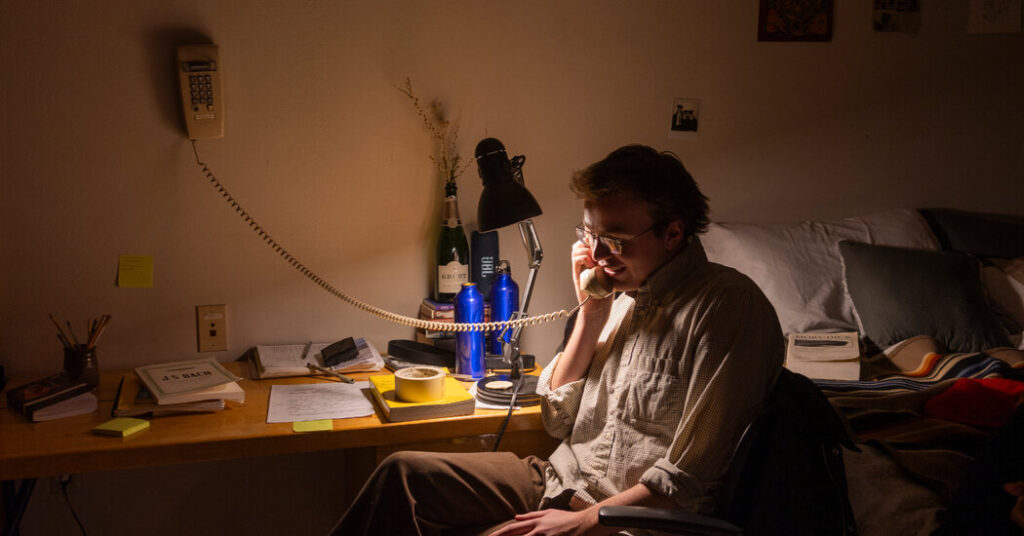
St. John’s College, which has another campus in Annapolis, Md., is in some ways an ideal setting for such an exercise. The school’s Great Books curriculum is focused on reading original works of thinkers like Archimedes, Descartes and Einstein. Classes are discussion-based — no laptops allowed — and each dorm room on campus is equipped with an oatmeal-colored landline.
Several students participating in the fast said they could feel their focus sharpening. Still, the end of the semester loomed, and Samuel Gonzalez was considering just how tech-free he could go without taking a hit to the quality of his final papers.
“Unfortunately, there’s a practical reality that I have to produce 30 pages of writing in the next two weeks,” said Mr. Gonzalez, 29, a senior who was carrying his copy of Einstein’s “Relativity” to class. He briefly pictured himself writing them on a typewriter, then decided to use his laptop, so long as it was in the school library.
Others were realizing just how much they relied on their phones to track one another down. Ms. Weiss had lent Mr. Ponzi a pillow, but could not find him to get it back. Ms. Garrett was out of breath from racing around campus, trying to find a friend who had borrowed her car keys. In the dining hall, students had set up a blackboard where they could exchange notes.
“Looking 4 Eliza,” Ms. Garrett had written by Monday afternoon. “Did you find Eliza?” someone else followed up. “Eliza must be found!”
For these members of Gen Z, navigating life with landlines and sticks of chalk was something of a novelty. For much of the school’s faculty, it had simply been the college experience.
Sarah Davis, the dean of the Santa Fe campus of St. John’s College, remembered students gathering to watch “E.R.” in her freshman dorm at Harvard. She had enthusiastically supported the phone-free experiment; she thought it was a good sign that young adults’ instincts were telling them to examine the hold that technology had on them.
“It’s not just depriving ourselves, it’s actually investigating parts of ourselves that may not be fully expressed when we have so much of our time directed in this one way,” she said.
The weeklong fast was not Ms. Fagan’s first such experiment. In 2023, she had set out to establish a tech-free dorm in Murchison, where she is a resident assistant. More than a dozen students who moved in began what she described as a “beautiful negotiation” over the rules. For example: Were boomboxes OK, or did students who wanted to listen to music need to pull out their acoustic guitars?
From the beginning, it was hard to find consensus, and Ms. Fagan said she was not interested in becoming the phone police. Over that first year, Murchison’s focus shifted from being anti-tech to “pro-community,” with organized group dinners and theater performances.
The idea of a screen-free dorm also bumped up against some realities of modern campus life, in which course schedules, financial aid information and work-study opportunities are often communicated online, said Carol Carpenter, the vice president for communications and marketing at St. John’s College.
The administration was figuring out how to balance its support for students’ exploration with its responsibilities as an institution, Ms. Carpenter said.
“What happens if we need to text all the students and faculty — say something horrible is happening — and say, ‘You need to shelter in place’ or ‘You need to get to this building’?” she said. The emergency protocols at St. John’s included physical alarms and human emergency coordinators assigned to each building that could reach students who were not accessible by text, she added.
The day after the students’ weeklong fast concluded, two students at Brown University were killed by a gunman while studying for an economics class. St. John’s is always reviewing its security protocols, Ms. Carpenter wrote in an email afterward, “and the Brown event is on our minds. If students organize future tech fasts, we will heartily support them so long as they’re voluntary.”
It had become clear to college leadership that St. John’s could be an ally to students who wanted to keep tech from seeping further into their lives.
“There’s a hunger for this,” she said.
307 Unread Messages
By midweek, students said they felt more immersed in the world around them. They met up to hand-write letters to family members and discuss “Self-Reliance,” the poem by Ralph Waldo Emerson. (“Oh what is Heaven but the fellowship / Of minds that each can stand against the world / By its own meek and incorruptible will?”)
They could not text one another to say they were running late; they had to make plans in person and actually show up for them. Sometimes they found themselves reaching for their pockets reflexively, as if a phantom iPhone might still be there.
Everyone had hit some snag or another.
Annie Frost, 23, said she was happy about how little she craved her devices. But she was running low on clean laundry, and most of the machines on campus were operated via smartphone. “We’ve set ourselves up to not be able to put screens aside,” added Ms. Frost, a sophomore.
The students were also reckoning with the fact that smartphones were more necessary for some than others. Eliza Kaufman, 20, a sophomore who has jobs in the campus mailroom and as an R.A., had kept her phone accessible in case one of her residents had an emergency. When it came time to deposit her paychecks, she realized she could not do it efficiently without her mobile banking app.
“As college students, we are privileged — we are in an intellectual space where this kind of thought experiment and life experiment is one that’s supported,” she said. “But there is still a divide between — I mean, I’ve got to work, and so I’ve got to use technology to some degree.”
Over and over, they were asked to defend the decision to give up their devices. Friends wanted to know why they were ignoring texts. Ms. Kaufman asked her music tutor — the school’s term for a professor — to borrow a metronome so that she could practice Bach’s Prelude in C Major at tempo.
“He was like: ‘Why do you need a physical metronome? Just get an app,’” she said.
The teacher, Andy Kingston, said he had since come around to the idea of the experiment, so long as the students recognized that theirs was not the first generation to reckon with a wave of technological advancement.
“Why was Plato so upset about the invention of writing?” he said. He urged them to consider: “Is this a qualitatively different technological moment that they’re living through from all the ones they’ve read?”
By the end of the week, there had been some cracks in the students’ resolve. Chaz Nomura, 20, had fallen back on his phone twice: to text his mother an invitation to the sophomore play that weekend, and to print sheet music for his Christian fellowship group. He felt guilty, as if he were doing something illicit. “I was like, ‘Oh, is anyone going to see me?’” he said.
But even with minor compromises, most students said they had gotten to know themselves better without their phones butting in all day long. Some had a fresh appreciation for boredom and inconvenience.
The week was “more intense than I expected it to feel,” Ms. Weiss said. “When I’m in a situation where I have nothing to do, I cannot find someone to hang out with other than the people who are around me. In not being able to communicate over distance, I have to be more invested in communicating where I am.”
The tech fast ended with a makeshift awards ceremony around a campus firepit on Friday night. Rubber band balls were awarded to students who strayed from their own rules but managed to bounce back. One student wrote a poem in honor of Ms. Kaufman, who finally tracked down a metronome.
Then came the tough question: Now what?
When Ms. Fagan looked at her phone again, she had 307 text messages. She said she had not emerged from the week confident that she could give up her smartphone forever. “There’s sacrifices made to try and live without the technology” she said, “and most people around the fire were like, ‘I don’t want to make all those sacrifices.’”
She planned to keep the phone out of her dorm room. Other students felt ready to make more drastic changes: Ms. Weiss hoped to push for Murchison dorm to shut off its Wi-Fi permanently. (A couple of residents had already lodged their objections.) Mr. Ponzi bought a flip phone.
He had wanted to check his smartphone on Thursday, but once he picked it back up, he saw that most of the notifications that had piled up were basically meaningless. “I was like, ‘Oh, I hate this,’” he said. He said he hoped the fast would encourage others to experiment with altering their digital lives, even if that did not mean overhauling them.
On Sunday night, two days after the fast had technically ended, there were still a few smartphones lingering in the suitcase where Mr. Ponzi had stashed them. Their owners had not yet bothered to pick them up.
Callie Holtermann reports on style and pop culture for The Times.
The post One Week Without Smartphones on a College Campus appeared first on New York Times.