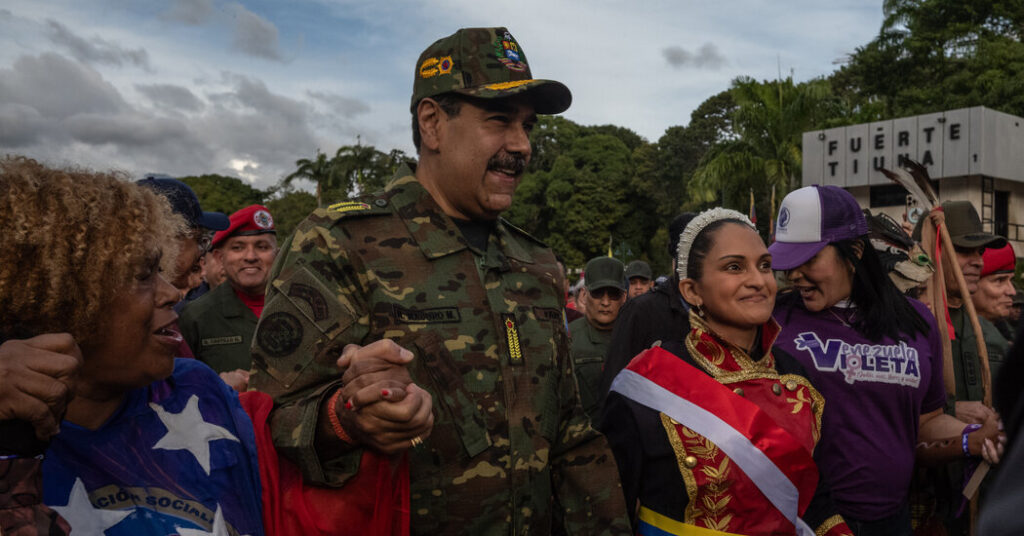
Nicolás Maduro, the president of Venezuela captured in a military raid on Caracas, faces charges in the Southern District of New York, where prosecutors have targeted him for years.
The U.S. attorney general, Pam Bondi, posted the new indictment on social media on Saturday. It charges Mr. Maduro with narco-terrorism and conspiracy to import cocaine, among other charges. His wife, Cilia Flores, is also charged in the cocaine conspiracy.
Mr. Maduro, the indictment said, “allows cocaine-fueled corruption to flourish for his own benefit, for the benefit of members of his ruling regime and for the benefit of his family members.”
“The defendant now sits atop a corrupt, illegitimate government that, for decades, has leveraged government power to protect and promote illegal activity, including drug trafficking,” it continued. “That drug trafficking has enriched and entrenched Venezuela’s political and military elite.”
In an earlier post, Ms. Bondi said that Mr. Maduro and his wife would “soon face the full wrath of American justice on American soil in American courts.” President Trump said that the couple was being brought to New York.
Though the charges against Ms. Flores are new, Mr. Maduro was previously indicted in Manhattan in 2020 on similar allegations. With those charges pending, Secretary of State Marco Rubio referred to Mr. Maduro last year as a “fugitive of American justice.”
The 2020 indictment said that Mr. Maduro had come to lead a drug trafficking organization, the Cartel de los Soles, or Cartel of the Suns, as he gained power in Venezuela. Cartel de los Soles has been an ironic nickname for the Maduro administration’s military officers, who wear suns on their epaulets.
The earlier indictment named six defendants. The one unsealed on Saturday also names six, but they are almost entirely different, including only two men from the earlier charges. They are Mr. Maduro and Diosdado Cabello Rondón, who is the minister of interior, justice and peace, a member of the armed forces and vice president of the ruling party.
The others charged include Mr. Maduro’s son, Nicolas Maduro, known as Nicolasito; a former minister of the interior and justice, Ramón Rodriguez Chacín; and Héctor Guerrero Flores, who prosecutors said was the leader of Tren de Aragua, a gang that the Trump administration designated last year as a foreign terrorist organization.
The inclusion of Mr. Guerrero Flores, who was indicted in a separate case last month, would appear to reflect the White House’s repeated assertion that Mr. Maduro worked with narco-terrorists, including Tren de Aragua. American intelligence agencies have disputed that conclusion.
The charges against Mr. Guerrero Flores do not tie him directly to Mr. Maduro, but rather to “members of the Venezuelan regime” and “an individual he understood to be working with” it.
Southern District prosecutors had long targeted Mr. Maduro, and the investigation that led to his 2020 indictment was overseen by Emil Bove III, a prosecutor who years later became one of Mr. Trump’s criminal defense lawyers and whom the president this year appointed to the federal bench. One of the other prosecutors was Amanda Houle, who now leads the office’s criminal division.
The indictment says Mr. Maduro’s wife, Ms. Flores, along with her husband and other defendants, “partnered with narcotics traffickers and narco-terrorist groups” that were sending cocaine from Venezuela to the United States through countries like Honduras, Guatemala and Mexico.
It also says Ms. Flores attended a meeting in 2007 where she “accepted hundreds of thousands of dollars in bribes to broker a meeting between a large-scale drug trafficker and the director of Venezuela’s national antidrug office, Néstor Reverol Torres.”
The trafficker later arranged to pay monthly bribes to the antidrug official, in addition to about $100,000 to ensure safe passage for each flight transporting cocaine — a portion was then paid to Ms. Flores, the indictment says.
Though the circumstances of Mr. Maduro’s capture in a military raid were extraordinary, the American legal system has experience in arresting South American leaders and putting them on trial. Manhattan prosecutors have a saying — “you can’t suppress the body” — meaning that once a person is in custody, a case tends to move forward regardless of the circumstances of the arrest.
In 1989, the United States invaded Panama and compelled the surrender of Gen. Manuel Antonio Noriega, Panama’s military leader, who was taken to Florida and arrested by agents with the Drug Enforcement Administration. Three years after his surrender, Mr. Noriega was tried, convicted and sentenced to 40 years in prison.
In 2022, the former president of Honduras, Juan Orlando Hernández, was arrested by law enforcement officials from his own country in connection with a U.S. extradition request. He, too, was brought to the United States, where he was tried, convicted and sentenced.
Late last year, Mr. Trump abruptly pardoned Mr. Hernández, saying that the case against him — which had also been overseen by Mr. Bove and had been built over several presidential administrations — “was a Biden administration setup.”
The case against Mr. Hernández and the 2020 charges against Mr. Maduro bear a significant resemblance. Both leaders were accused of using their governments as vehicles for the exporting of cocaine into the United States. And both were charged with conspiring to possess machine guns, which, combined with drug trafficking charges, carries potentially lengthy prison sentences.
Mr. Maduro’s 2020 indictment has been pending in the Manhattan federal court before Judge Alvin K. Hellerstein, a veteran of nearly three decades on the Southern District bench.
Appointed by President Bill Clinton in 1998, the judge is best known for overseeing the many lawsuits filed after the Sept. 11 terror attacks, by families of the dead and workers at ground zero.
More recently, Judge Hellerstein, 92, has presided over Mr. Trump’s attempts to move his Manhattan criminal conviction into federal court, a matter that is pending.
Jonah E. Bromwich covers criminal justice in the New York region for The Times. He is focused on political influence and its effect on the rule of law in the area’s federal and state courts.
The post Maduro and His Wife Face a Fresh Indictment in Manhattan appeared first on New York Times.