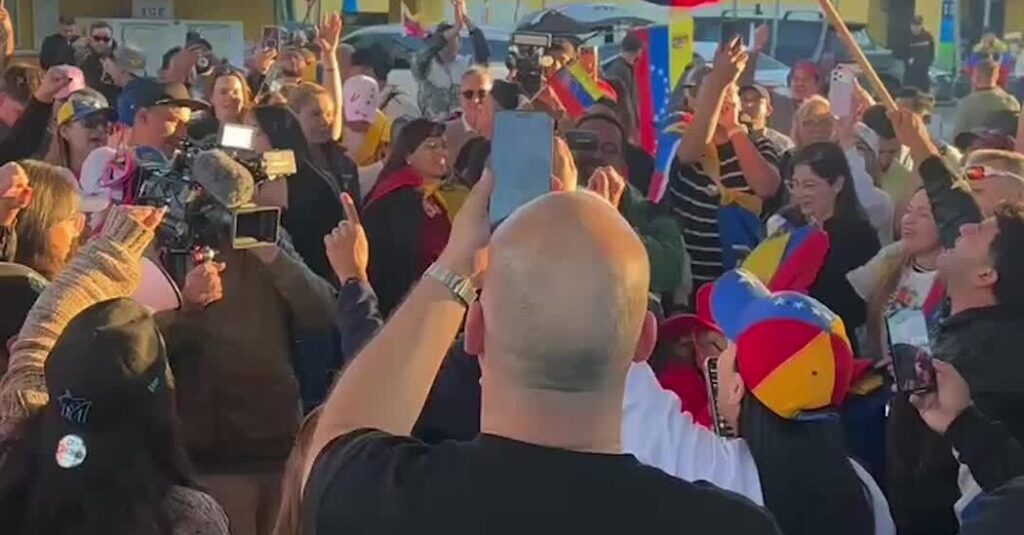
The party broke out before sunrise in the heavily Venezuelan city of Doral, Fla., west of Miami: Venezuelans and Venezuelan Americans blared music, honked car horns and danced to celebrate the capture of Nicolás Maduro, the Venezuelan leader.
“¡Viva Venezuela libre!” one man waving a Venezuelan flag yelled as he drove by El Arepazo, a Venezuelan arepa shop in a gas station where Venezuelans often gather for political or sporting events.
South Florida is home to the largest Venezuelan community in the United States — some 40 percent of Doral’s residents are of Venezuelan origin — and the vast majority are opposed to Mr. Maduro. Millions of people have left Venezuela in recent years amid economic chaos and political repression.
Some immigrated here more than two decades ago. Others are more recent arrivals. Many of them watched anxiously over the last few months as President Trump escalated his threats and boat strikes against Venezuela and wondered how it would all turn out.
“I can’t believe it,” said Mariannys Milano, 45, as she wiped tears outside El Arepazo early on Saturday morning. She had hardly slept, she said, after calling and texting her family in eastern Venezuela all night. “I have so many emotions. I feel like throwing up. I feel joy.”
At one point, a couple of hundred people stood in the middle of the gas station, which was closed and guarded by police officers, to sing traditional Venezuelan songs and the Venezuelan and American national anthems. The arepa shop was still closed, so some people ducked into the neighboring convenience store to pick up coffee or the occasional celebratory beer.
Several people said they were anxious about what would follow with Mr. Maduro out of power, though they all said they were optimistic.
“I don’t know what’s going to happen,” said Tibisay Mejía, 51, who immigrated in 2015. “But this is the beginning.”
Patricia Mazzei is the lead reporter for The Times in Miami, covering Florida and Puerto Rico.
The post In South Florida, Venezuelans Revel in Maduro’s Capture appeared first on New York Times.