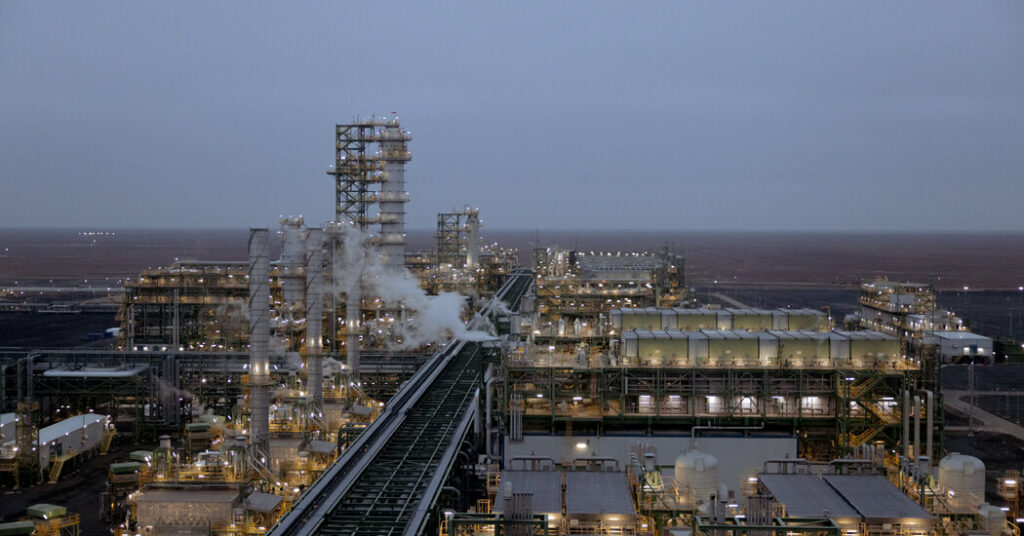
More than two miles below the windswept steppe of western Kazakhstan, porous rocks composed of the skeletons of coral and other ancient marine life form the matrix for one of the world’s most prolific oil fields.
Tengiz, as the field is known, has been producing oil for more than three decades, helping to nurture Kazakhstan, Central Asia’s largest economy.
The oil field has also contributed handsomely to the earnings of Chevron, the American oil giant, which owns 50 percent of the company that operates Tengiz, known as Tengizchevroil, or TCO.
The participation of Chevron and Exxon Mobil in TCO and other projects in Kazakhstan also provides the country, which shares a 4,750-mile border with Russia, with an important tie to the United States.
These days, those relationships are being tested just as Chevron and its partners have completed a $48 billion expansion of Tengiz.
Recently, Ukraine has attacked the main oil export route from Kazakhstan through Russia, a 940-mile pipeline that includes flows from the Tengiz field, as part of an effort to crimp Moscow’s earnings from energy. Chevron and the Kazakhstan government are also beginning what could be difficult negotiations to extend their agreement on the oil field, which is set to expire in 2033.
These talks are important for Chevron, which has built relationships in Kazakhstan over decades, and whose free cash flow, a profit metric, from Tengiz is likely to be around $4 billion for 2025.
They may be even more crucial for Kazakhstan, not least because Tengiz has played such a large role since the early 1990s in helping the country gain its economic footing. Kazakhstan became independent in 1991 with the collapse of the Soviet Union.
“It’s huge for Kazakhstan,” said Kate Mallinson, a partner at Prism Strategic Intelligence, a firm that advises that country and others in the region. “It’s really symbolic, that relationship with TCO,” she added.
During a recent visit to Tengiz, the field’s operators were savoring the completion of one of the largest oil projects ever: the expansion of output by about one-third to one million barrels a day.
Typically, output from oil fields declines over time, but Tengiz is far from depleted. “Where you have large oil fields, they typically get larger,” said Clay Neff, Chevron’s president for exploration and production.
According to TCO, the field contains 25 billion barrels of oil. Korolev, an adjacent field that would be considered very large almost anywhere else, contains another 1.6 billion barrels.
In 2016, the field’s size helped persuade Chevron and its partners to embark on one of the largest oil projects ever, drilling new wells and adding giant compressors and other equipment to further boost output.
A decade later, at a cost of an estimated $48 billion — about $11 billion above initial projections — the facilities seemed to be operating smoothly.
Andrew O’Connor, manager for production operations at Tengiz, explained that the field had produced below its potential in the past because its processing facilities were insufficient. “We were plant limited,” he said in an interview at Tengiz. “We now have increased the capacity of the plants to better match the reservoir.”
As you drive around the site near the Caspian Sea, its vast size becomes apparent. Landmarks like power plants and immense processing units come into view and then recede.
The oil-bearing rocks lie below a swath of scrubby grassland 13 miles long and 12 miles wide, pocked with the occasional salty pond.
This spread, coupled with a column of oil that extends roughly a mile from top to bottom, is “what makes it one of the largest fields in the world,” said Stephen Conner, general manager of operations at TCO.
Tengiz is among the world’s top 10 fields in production, according to Wood Mackenzie, an energy consulting firm.
It originated as a reef in a tropical sea more than 300 million years ago. At that time, the area that is now western Kazakhstan was a “magical place,” said James Bishop, a Chevron earth scientist. Later, oil migrated into the rocks and was trapped by layers of salt from evaporating seas.
The area, known as the Pricaspian basin to geologists, also spawned other giants, including one called Kashagan, that could eventually produce even more oil than Tengiz. “We have big neighbors,” said Alexei Vyssotski, manager for reservoir management at TCO.
Despite the blessing of these resources, Kazakhstan’s oil industry faces challenges.
Kazakhstan is landlocked. Exports from Tengiz and other fields, including some crude from Russia, flow through a pipeline that loops around the north end of the Caspian Sea and winds up at Russia’s port of Novorossiysk on the Black Sea.
Chevron, a part-owner of the pipeline, and other companies have managed to keep the crude flowing throughout the war in Ukraine.
But Ukraine has used drones to target this route along with other Russian energy infrastructure, and in late November succeeded in knocking out one of the three tanker loading facilities at the Black Sea port, which forced an output cutback at Tengiz of around 30 percent.
Last year, the higher production levels from Tengiz also created tension between Kazakhstan and its partners in the OPEC Plus oil cartel. Kazakhstan, though, has been reluctant to rein in the output of international investors like Chevron or of smaller domestic producers. “Kazakhstan has no easy options” for OPEC Plus compliance, said Craig Saunders, senior research analyst at Wood Mackenzie.
The talks on extending the agreement governing Tengiz are likely to have greater lasting impact than these disputes. In an indication of how important these talks are to both parties, Kazakhstan’s president, Kassym-Jomart Tokayev, met with Chevron’s chief executive, Mike Wirth, three times in 2025.
“We are off to what I would characterize as a good start to the negotiations,” Mr. Wirth told financial analysts in October.
Mr. Tokayev is an experienced diplomat who came to power in 2019 after the resignation of the country’s longtime leader Nursultan Nazarbayev, who brought in the international oil companies. He now has the tricky task of pleasing those of his constituents who want a better deal while not disrupting the revenues the projects produce.
While Chevron would be wary of losing what amounted to an estimated 13 percent of its global production in 2024, Kazakhstan has more at risk, analysts say.
Chevron dominates TCO with a 50 percent holding. Other partners include Exxon Mobil (25 percent), KazMunayGas, a Kazakh company (20 percent), and Russia’s Lukoil (5 percent).
Tengiz plays an enormous role in the Kazakh economy, accounting for almost 10 percent of its gross domestic product, according to S&P Global Commodity Insights, a research firm. TCO is Kazakhstan’s largest oil producer, accounting for more than 40 percent of the country’s output in the first half of 2025, and is also its largest taxpayer.
“The performance of a sizable segment of Kazakhstan’s economy is at stake,” wrote Matthew J. Sagers, head of Eurasian Energy at S&P Global Commodity Insights.
Some industry experts say that it would be difficult to replace the management and technical skills that Chevron brings to Tengiz, which is considered a demanding field because of high pressure and the presence of large amounts of toxic hydrogen sulfide gas, among other factors.
“TCO is a prime example of how to work on enormously large oil and gas fields that are technologically complex,” said Talgat Imangaliyev, a Kazakh oil professional.
Under pressure from the government, locals already account for more than 90 percent of TCO’s 4,000 employees. “Our first role is to mentor,” said Bevin VanGilder, a West Virginian who is deputy manager for production at Tengiz. “We want to make sure that there’s good leadership in place to be able to take over the operations.”
TCO helped build modern water and natural gas systems, as well as housing like the apartment building where Utebay Dyussenov, a recently retired project consultant, and his wife, Gulzada Dasheva, an information technology professor, live. TCO “laid the foundation for a new kind of city,” Mr. Dyussenov said.
TCO has also pumped money into local businesses and social programs, especially around the city of Atyrau, Kazakhstan’s oil center.
For instance, TCO supports a local charity called Biz de Adambiz, which translates to “we are also human,” that helps people with severe disabilities, often resulting from car accidents, to live more normal lives.
The group’s founder, Gulnaz Kosmurziyeva, who was injured two decades ago in a car accident, has become an advocate for disabled people. The foundation’s scope would need to be pared back sharply without the oil company’s backing, said Ms. Kosmurziyeva, who has become a local political figure through her work. “I think in Atyrau, we live very well in comparison to other regions,” she added.
Stanley Reed reports on energy, the environment and the Middle East for The Times from London. He has been a journalist for more than four decades.
The post How Kazakhstan Aims to Tap More Oil Riches Below Its Grassy Plains appeared first on New York Times.