My mother often asked me, “Am I on a ship?”
“No, Mum, you’re not,” I’d assure her. “You’re high on dry land.”
More and more, though, her dementia created the illusion that she was on a ship, unmoored, her illness cleaving a distance between us. I knew in time that she would fall off the edge of the horizon.
It is only later, long after she’s gone, that I understand she may have been describing a real drift she perceived but could not articulate.
Research shows that people with dementia often harness metaphor to communicate experiences in their desperate bids to remain engaged. They might substitute an unexpected word for the conventional, or invent words and phrases. There’s a surprising magic in the patois of the condition.
One study looked at the narratives of nine people with early-onset dementia and identified over 1,000 metaphors they used to describe the illness. The study’s author, Flaminia Miyamasu, an associate professor of medical English at Tsukuba University Faculty of Medicine in Japan, told me that many of the metaphors conveyed existential disintegration, images of “loss, fragmentation, vanishing.” Others spoke of “monster, fog, violence.”
Among the most common metaphors Dr. Miyamasu uncovered were ones referencing journeys. “I wonder how much longer I am to carry on traveling,” one participant puzzled. And, incredibly, many expressed being at the mercy of water: “I feel as though I am on a ship in rough seas.”
Looking back, I wonder if I could have listened harder to my mother, done a better job translating dementia’s strange dialect. I found that when I approached my role as her caregiver with more interest and greater patience, it was a less trying job.
Gaps in my mother’s language began to reveal themselves long before I was aware she’d embarked on her ship. I have learned since that dementia’s changes are subtle, but language can be an early clue. It can also be a reminder, according to Dr. James Rowe, a cognitive neurologist at Cambridge, of how creative the brain is at finding “on-the-fly solutions when the mental dictionary lets us down.” Memory and insight are lost early, one physician told me, but creativity, style and imagination, even when dramatically changed, persist.
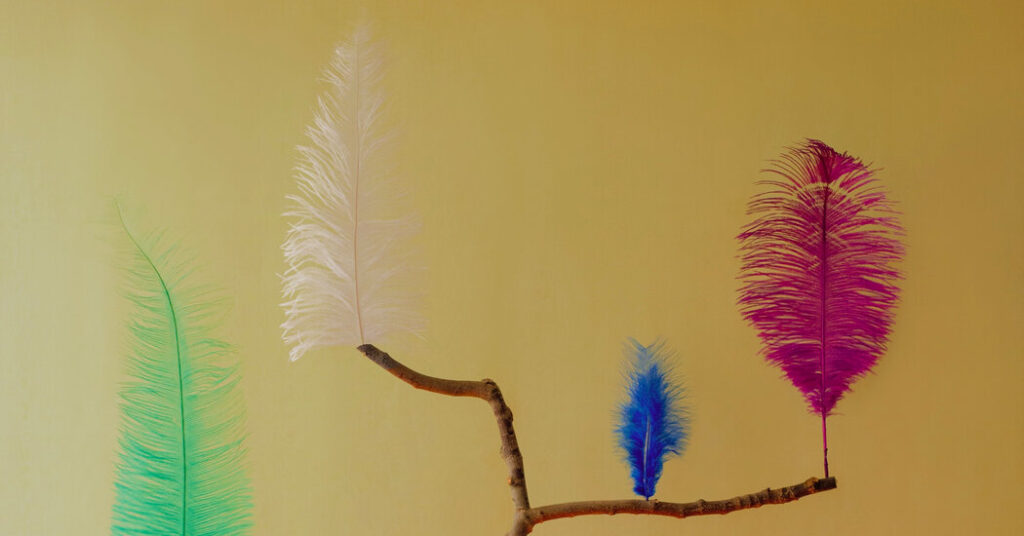
I witnessed this in Mum: “What can I see underneath that plant’s feathers?” she asked over breakfast one morning, pointing toward lemongrass in a pot.
“Leaves, Mum, you mean beneath its leaves,” I remember saying.
Alzheimer’s disease, which accounts for up to 70 percent of dementias and affects more than seven million Americans over 65, is marked early by atrophy in the temporal lobes, regions that play a crucial role in supporting semantic knowledge: our comprehension of words and concepts. As the disease progresses, this knowledge becomes fragmented and increasingly difficult to retrieve. But even as the language networks of the brain become less efficient at coming up with the meaning of words, the associations, sounds and images that words evoke can remain partly intact.
“That’s why your mother could creatively substitute ‘feather’ for ‘leaf,’” Dr. Sabina Brennan, the author of “Still Me: A Neuroscientist’s Guide to Caring for Someone With Dementia,” told me. “Feathers float like leaves, and their shapes are similar.” The brain will reach for whatever resources it still has, she said.
It’s also why, when my mother was completely naked as I readied her for a shower one day, she demanded, “Wait! Where’s my helmet?”
I laughed: “You mean your shower cap?”
“I do,” she giggled.
Just like leaves and feathers, ships float, too. Mum started to slide faster from my view.
When she began describing mornings spent “doing the filing,” it didn’t take my siblings and me long to realize what she meant: “Ah! The dishwasher,” we concluded. The careful stacking of dirty plates into racks, the gathering of clean cutlery, sorting it into drawers — we saw the connection. Hindsight lends insight: Here was my mother trying to drop an anchor.
I worried afterward: Did I put as much effort into understanding her as she did in trying to make herself understood?
Devastatingly — and then, curiously, when I knew it was pathological and not personal — my mother forgot me along with the words for “leaves” and “shower cap.” She furiously resisted the fact of our relationship, so I gave up asserting my position. Instead, I assumed whatever guise her dementia assigned me that day: niece, friend, caregiver. Experts have told me that you should join people with dementia in their reality. Don’t try to drag them back to ours.
Still, I wondered, why could she find workarounds for words but not for me?
The recognition of somebody involves networks that integrate memory, emotion and identity. And in dementia those networks become disrupted, often unevenly. It’s why a person may trust one family member but not another; it’s why my mother’s dementia tossed me overboard long before my brother and sister.
“It’s not because the bond has disappeared,” Dr. Brennan reassured me, but because the brain’s ability to connect the feelings that attach the word ‘daughter’ with a face has been fractured.
When I gave my mother time to find her words and the space to speak without correction, she took me on extraordinary flights of fancy. She became the raconteur, regaling me with stories of how she had skied in deserts, what it felt like to be a thousand years old and to have sleepovers with the Queen of England.
One evening, when dementia had taken almost everything from her — appetite, taste, balance, continence, liberty — Mum told me, “I feel as if I am in prison.” Then, a few days later, she asked, “Will the journey be a long one?”
Something in me understood what she was really asking: How much time do I have left?
“I don’t think so, Mum,” I told her. “I don’t think it’ll be long now.”
She died three days later.
Anthea Rowan is a journalist specializing in dementia and brain health.
The Times is committed to publishing a diversity of letters to the editor. We’d like to hear what you think about this or any of our articles. Here are some tips. And here’s our email: [email protected].
Follow the New York Times Opinion section on Facebook, Instagram, TikTok, Bluesky, WhatsApp and Threads.
The post Dementia Made My Mom a Poet appeared first on New York Times.