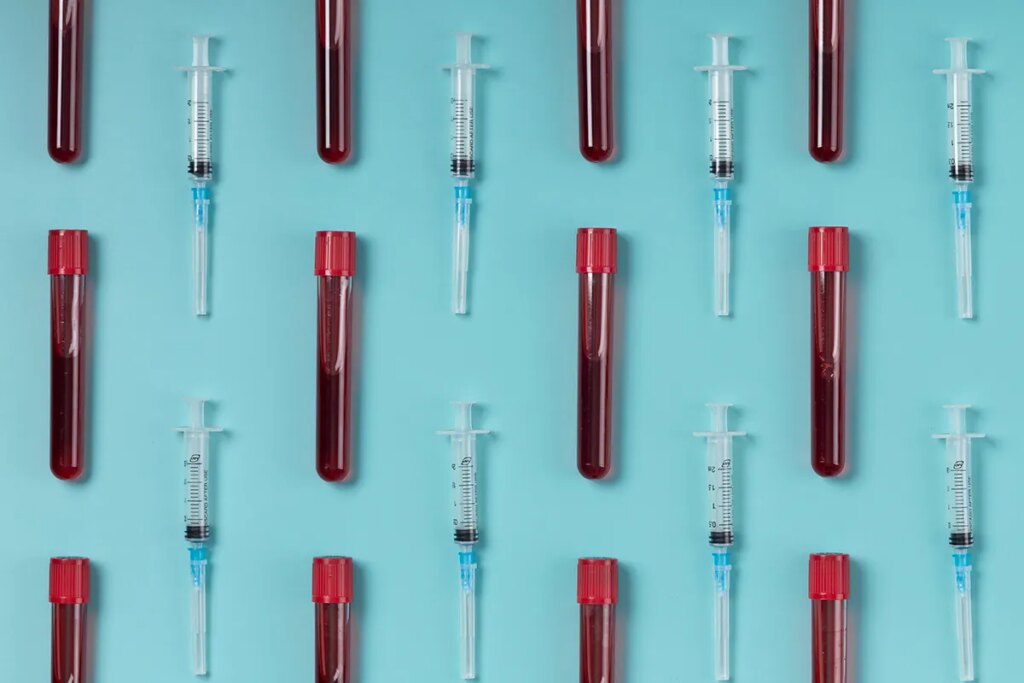
Hey, Theranos? Ever heard of it? Erstwhile founder and current felon Elizabeth Holmes may have drastically overstated her claims by saying you could take a bunch of affordable health tests with one drop of blood, but the company was trying to address a real problem. Many people get a panel of blood tests as part of their routine wellness check, and they’re not fun at all. Blood tests are inconvenient to schedule. You have to fast for at least eight hours beforehand for many of them, and it’s hell if you’re scared of needles.
This year, fitness tracker companies like Oura and Whoop began offering blood panels as part of their subscription services, albeit with an additional surcharge. Ultrahuman also offers a blood panel called Blood Vision, which we have not yet tested because the Ultrahuman ring is no longer sold in the United States. It’s also worth noting that both of these tests are available only in the United States as of the time of this writing and exclude Arizona, Hawaii, North Dakota, South Dakota, and Wyoming, which have stricter laws restricting direct access testing without a physician’s order.
I booked through the respective apps, starved myself (OK, didn’t eat or drink caffeine for eight hours) for multiple test dates, and had my blood drawn for 11 total vials at the same Quest Diagnostics, where the technicians probably decided I had some weird Twilight fetish. (Disclosure: Both Oura and Whoop covered the out-of-pocket cost for me, and both the devices and the tests are HSA- and FSA-eligible.) I compared these labs to others I had done with my doctor. Here’s what I discovered.
Print It Out
The first thing you’ll notice when you take a consumer blood panel instead of through your doctor is that, well, you have to book the tests through that company’s app. Both Oura and Whoop bill this as a more convenient feature, but if you already have a primary care doctor, it’s not. (I realize that having a primary care doctor in this country is already a fairly big hurdle.) My doctor orders labs for my annual exam; I just walk down the hall and get them done as part of my yearly checkup.
I booked my Health Panels test through Oura, but after not eating all morning and waiting for 15 minutes in a small, grim room in the back of a Safeway, the lab technician told me she could not find my lab order. I suggest downloading your lab order from the company as a PDF, printing it out, and bringing that hard copy to your appointment.
For my yearly checkup, given my general state of health, my primary care doctor ordered a basic blood panel with three tests comprising 20 biomarkers—that’s a complete blood count, A1C to check for diabetes, and a lipid profile, which includes your cholesterol levels and indicates your future likelihood of heart disease.
Oura’s test cost $99, and the comprehensive panel measures 50 biomarkers—more than twice what my doctor ordered. In addition to the lipid panels, blood count, and A1C, it includes other panels like blood glucose, insulin, potassium, sodium, total protein, and triglycerides. These results took longer to come back than I expected. The first set of results came in after 24 hours, but it took almost two weeks to get my full results and doctor-interpreted report.
While most of my results were optimal, there was an alarming one: My blood test for lipoprotein (a) came back at 214 nanomoles per liter (nmol/L). (The normal range is <30 nmol/L.) This indicates a seriously elevated inherited genetic risk for cardiovascular disease, like heart attacks or stroke, that is largely not affected by diet, exercise, or lifestyle.
Add It Up
Whoop’s test, in comparison, starts at $349 for two per year, and unlike with Oura, you can upload tests done through your doctor’s office to the Whoop app for free. Whoop’s Advanced Labs costs more because it offers 65 biomarkers instead of 50, and some of these tests are extremely expensive, like a vitamin D test and various hormone tests.
Again, most of my results, even the hormone ones, came back as being optimal. Whoop did catch a few items that Oura missed, like being very low in iron and vitamin D. That’s an easy, actionable fix with a daily multivitamin, and I’m glad Whoop caught it.
However, Whoop also flagged that I have elevated levels of lipoprotein (a), albeit at a much lower (but still elevated) 165 nmol/L. It was very scary to read both that result and the clinician interpretation, which said that my 10-year plan is to “not have a stroke.”
Granted, this is also not news to me; both my grandmother and my mother had strokes in their 60s. I have brought up this family history with my primary care doctor, who said that she was not that concerned for me—I don’t have diabetes, I’m the same weight I was in high school, and I work out four to five times a week. Last year, she suggested that a good long-term goal for me would be to ensure my diet has 30 grams of fiber every day. I have eaten a lot of kale since then.
I sent her these results and scheduled another follow-up appointment. I’m pretty sure she’s going to say the same thing, but maybe I should ask about statins.
In the End
“People underestimate the psychological impact of tests that advise us of future health conditions,” wrote Suzanne O’Sullivan in an email. O’Sullivan’s book The Age of Diagnosis is about the constant health monitoring that preys on “the worried well.” (Guilty!)
“We assume we will respond positively while underestimating the burden of living in fear of a future disease. Not everybody, but some people will find their life overshadowed by that fear,” she continued. “The knowledge becomes a burden instead of a blessing.”
I’m not sure what the psychological impact of those lipoprotein tests would have been had I not already known what the result was likely to be. O’Sullivan mentioned the surprising cases of patients who refuse genetic testing for inherited conditions. There’s nothing I can really do about my situation, except for the things that I was doing anyway.
I asked Oura’s chief medical officer, Ricky Bloomfield, what gap in health care coverage he sees the company’s Health Panels addressing. “We see a lot of different Oura users,” Bloomfield said over Zoom. “There are some members who are interested in learning more about their health in different ways; we’ve seen that there are a few people who, for whatever reason, have lost trust in the current health system and don’t have a doctor but still want to learn more about their health.”
But several of my results meant that I would need to see a doctor for treatment, I reminded him. I cannot get treatment for whatever conditions I discover through the app. “Well, you’re already on your way to doing the things you need to do,” Bloomfield said. “Then yes, you probably don’t need this.”
Oura’s price point is $349 for the ring itself and $72 for the yearly subscription, plus $99 for Health Panels, for a total of $521. Whoop’s is $324 for a year’s premium subscription, which includes the Whoop MG wearable and $349 for two Advanced Labs, for a total of $673.
I think Whoop’s test is worth it. The extra $152 is not that much, considering that it’s easy enough to pick up a daily multivitamin with iron and feel that much better and less fatigued. (Of course, that equation on which tracker to pick changes when you consider Oura’s other features and whether you’d rather wear a smart ring than another wristband.)
But it’s worth considering if you, too, are psychologically ready to handle having the knowledge of a possible condition that you might not know about. “These sorts of test results are really hard to interpret,” O’Sullivan said. “Trust that your national screening program recommendations have your best interests at heart and do what they recommend.”
The post Blood Feud: Oura’s Health Panels Versus Whoop’s Advanced Labs appeared first on Wired.