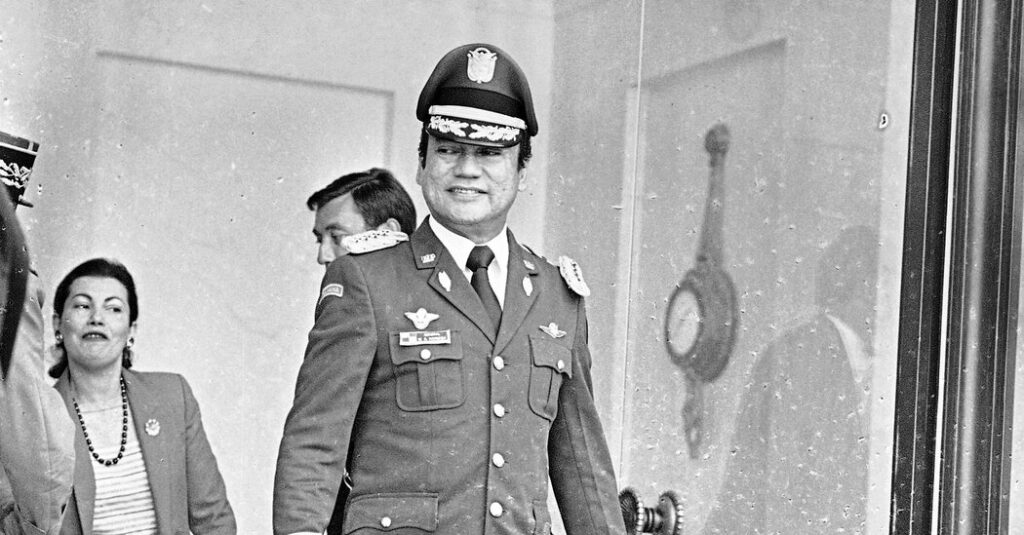
The last time the United States deposed a Latin American leader was in 1989, when U.S. forces captured Gen. Manuel Noriega in Panama. That episode holds some striking parallels to the capture of Nicolás Maduro of Venezuela on Saturday, with some major differences.
In December 1989, President George H.W. Bush sent U.S. troops into Panama with the goal of capturing Mr. Noriega, who had been the country’s military dictator for about six years. Mr. Noriega went into hiding in the Vatican’s Embassy in Panama City, where he was eventually captured, taken to the United States, tried and imprisoned.
Mr. Noriega, like Mr. Maduro, had been indicted on federal drug-trafficking charges. He was accused by U.S. officials at the time of taking millions of dollars in bribes from drug traffickers and turning Panama into a capital of international cocaine smuggling.
Months before both leaders were captured, the United States built up its military presence around their countries.
In Panama, President Bush sent nearly 2,000 soldiers and Marines to reinforce the 10,300 service members already there. The troops also began conducting military exercises, which U.S. officials said was part of their rights under previous treaties. But many saw it as an attempt to put pressure on Mr. Noriega.
As part of the pressure campaign on Venezuela, Mr. Trump has been building up forces in the Caribbean for months, and authorizing strikes on boats that the administration has said are run by drug traffickers. Many legal experts say these strikes are illegal and amount to extrajudicial killings of civilians.
The two Latin American leaders, however, had very different responses to the U.S. pressure campaigns.
In Panama, the National Assembly, under the control of Mr. Noriega, declared the country at war with the United States shortly before U.S. troops invaded. As the assault to capture him began, he fled with his mistress in an unmarked Hyundai and went into hiding, briefly emerging at a Dairy Queen before taking refuge at the embassy of the Holy See.
He was captured after a standoff that went on for days with U.S. troops, who surrounded the building and used speakers to blast heavy metal from bands like Black Sabbath and Guns N’ Roses until he surrendered.
Mr. Maduro, however, told a Spanish journalist as late as this week that he was eager to work with the United States to avoid conflict, including on drug policy and oil agreements.
Mr. Trump said during an interview on Fox News that Mr. Maduro wanted to negotiate in the final days before U.S. forces captured him — an offer that Mr. Trump said he rejected.
“I didn’t want to negotiate,” Mr. Trump said. “I said, ‘Nope, we got to do it.’”
Mr. Trump said that the military repeatedly rehearsed the operation using a replica of Mr. Maduro’s safe house. Gen. Dan Caine, the chairman of the Joint Chiefs of Staff, said the operation benefited from detailed information about his whereabouts collected during months of intelligence gathering.
Around 27,000 troops participated in the operation in Panama, and 23 U.S. troops were killed, along with an estimated 314 Panamanian soldiers and 202 civilians.
U.S. officials said the operation in Venezuela involved 150 aircraft. Since November, the United States has had around 15,000 military personnel in the Caribbean.
It’s unclear how many casualties were involved in the operation on Saturday, but Mr. Trump, speaking on Fox News, said no American troops were killed. He suggested, however, that some service members were injured.
Michael Crowley contributed reporting.
Jonathan Wolfe is a Times reporter based in London, covering breaking news.
The post Before Nicolás Maduro, There Was Manuel Noriega appeared first on New York Times.