Although they came from a small town in northern Ontario, the Dionne quintuplets were among the first global celebrities and multimedia stars. But their story — they were the first known quintuplets to survive infancy — did not have happy endings like the three films based on their lives.
Annette Dionne, the last surviving sister, died at 91 on Dec. 24, bringing their story of unparalleled celebrity, and extraordinary exploitation, to a close. Her death followed that of her sister Cécile, who also died at 91, by about five months.
Jane Gross, a former reporter for The New York Times who died in 2022, wrote both of their obituaries.
[Read: Annette Dionne, Last of the Celebrated Quintuplets, Dies at 91]
[Read: Cécile Dionne, Who Found Fame and Despair as a Quintuplet, Dies at 91]
My mother, Helen Austen, was 7 when the quints were born. When I was growing up, she told me that the five girls from Corbeil, Ontario, provided an escape from her life in Dauphin, Manitoba, during the Great Depression. The youngest of seven daughters born to Ukrainian immigrants, she followed the lives of the Dionne sisters through newsreels, radio, newspapers and magazine articles.
She read, watched and listened as movie and stage stars made their way to Corbeil, near North Bay, to meet the Canadians who had become celebrities at birth. Amelia Earhart, the pioneer of long-distance aviation, came to see the girls six weeks before her disappearance.
In newsreels, the sisters appeared in fancy dresses and played identical pianos with identical toys often arrayed around a room. The five girls were used to advertise a wide range of products.
The exploitation grew from there. After their father tried to make them into exhibits at a fair in the United States, the province of Ontario took the girls away from their family, including their other siblings, and made them “wards of the king.” The government legally became their parents.
It built Quintland, a sort of human zoo, where about three million people paid to see the girls put on display three times a day. They were separated from other children, most of the world really, as part of a “scientific” upbringing.
A trust fund based on the admissions to Quintland and the advertising sponsorships was supposed to sustain them as adults. But when they turned 21, they discovered that much of it had been spent on things like the policing of Quintland and toilet paper for its visitors. The sisters also said that, before they reached that age, they had been treated like “slaves” and sexually abused by their father, Oliva.
In 1998, Anthony DePalma, then The Times’s Canada correspondent, told the story of the sisters’ fight for compensation from the Ontario government.
[Read from 1998: The Babies of Quintland Now: Broke, and Bitter]
Annette, Cécile and Yvonne, who was still alive at the time, and the family of their deceased sister Marie prevailed and received a $2.8 million settlement from the province.
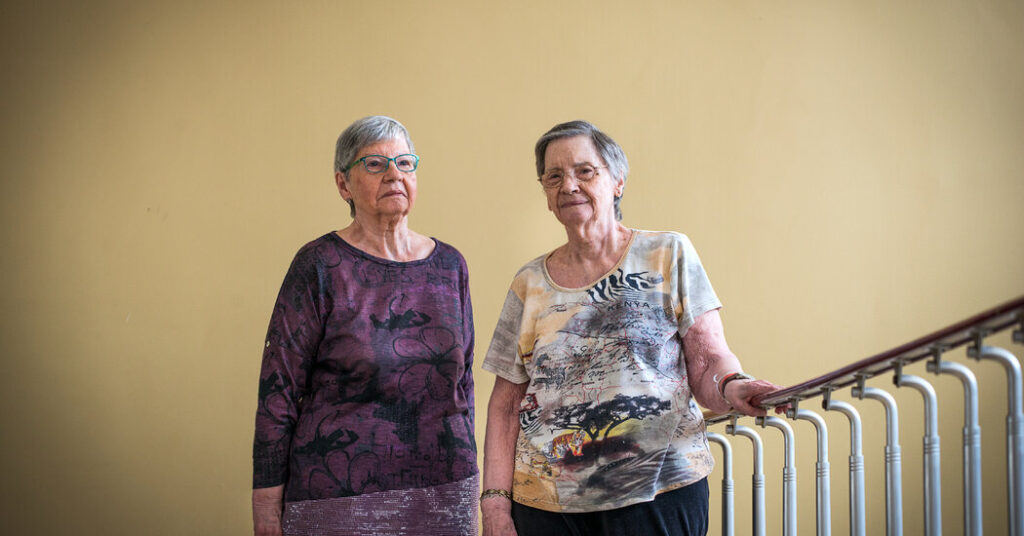
In 2017, I met Annette and Cécile during what would prove to be the final fight of their lives. They broke from their privacy to speak out against plans by the City of North Bay that would have effectively destroyed the house where they were born. It had become a long-neglected tourist attraction and moved to a desolate parking lot on the Trans-Canada Highway.
[Read from 2017: 2 Survivors of Canada’s First Quintuplet Clan Reluctantly Re-emerge]
They were both gracious and patient with my questions. And one of their answers surprised me: Initially, life in Quintland was as my mother had imagined it to be.
“Paradise,” Annette said of life in the Quintland compound.
“Was it ever,” Cécile agreed, as they both laughed.
“It was fun,” Annette added. “We heard the people speak and laugh, but we couldn’t see them.”
But it was a false paradise.
“It wasn’t good for the children to be like that, to be shown like that, playing naturally and knowing that other people were looking,” Cécile said, the sisters’ laughter now over. “It was sort of theft from us.”
Ultimately, the house was reopened as museum after being moved to an attractive waterfront park.
Annette and Cécile were remarkably free of rancor and resentment when we met. But they were firm in their belief that no other children should be exploited as they had been.
“I think the museum staying in North Bay will help to block making foolish choices, like what they did to us,” Annette told me. “And it will never to be repeated again.”
Looking over, Cécile asked her, “You believe in that?”
“Oh, yes.”
“Ah, good for you,” Cécile said. “I’m not sure of that.”
Trans Canada
-
Norimitsu Onishi and Vjosa Isai have looked into the back story of Ryan Wedding, a former Olympic snowboarder who the authorities say has become one of the world’s biggest drug lords. “He was different than any other subject I’ve ever arrested,” a former F.B.I. agent told them. “He was extremely arrogant. I think he felt he was invincible.”
-
Matina Stevis-Gridneff, our Canada bureau chief, discusses the “Trump effect” on elections around the world.
-
As part of a series on evolving attitudes toward medically assisted death, Stephanie Nolen tells the story of Claire Brosseau, a 48-year-old living in Toronto who is desperate to die. Ms. Brosseau suffers from debilitating mental illness that decades of treatment have not tamed.
-
The “What You Get” feature in Real Estate has looked into what $750,000 will buy in New Brunswick.
Ian Austen reports on Canada for The Times. A Windsor, Ontario, native now based in Ottawa, he has reported on the country for two decades. He can be reached at [email protected].
How are we doing? We’re eager to have your thoughts about this newsletter and events in Canada in general. Please send them to [email protected].
Like this email? Forward it to your friends, and let them know they can sign up here.
Ian Austen reports on Canada for The Times. A Windsor, Ontario, native now based in Ottawa, he has reported on the country for two decades. He can be reached at [email protected].
The post A Story of Extraordinary Celebrity and Terrible Exploitation Ends appeared first on New York Times.