This is an edited transcript of “The Ezra Klein Show.” You can listen to the episode wherever you get your podcasts.
At the beginning of the year, I always like to do a couple of episodes on things that I am working on in my own life. Resolutions episodes, you might say.
Something I’ve been working on over these past months and years is being able to sit with doubt. And not just doubt — being able to sit in the wonder of uncertainty. Because the first person we believe is ourselves: the stories we tell, the things we think we already know.
Maintaining an openness and a curiosity is important politically. It’s also very important in my work as a podcast host. But it is, above all, a spiritual practice — a practice of remaining present in the fundamental unknowability of this life and this Earth.
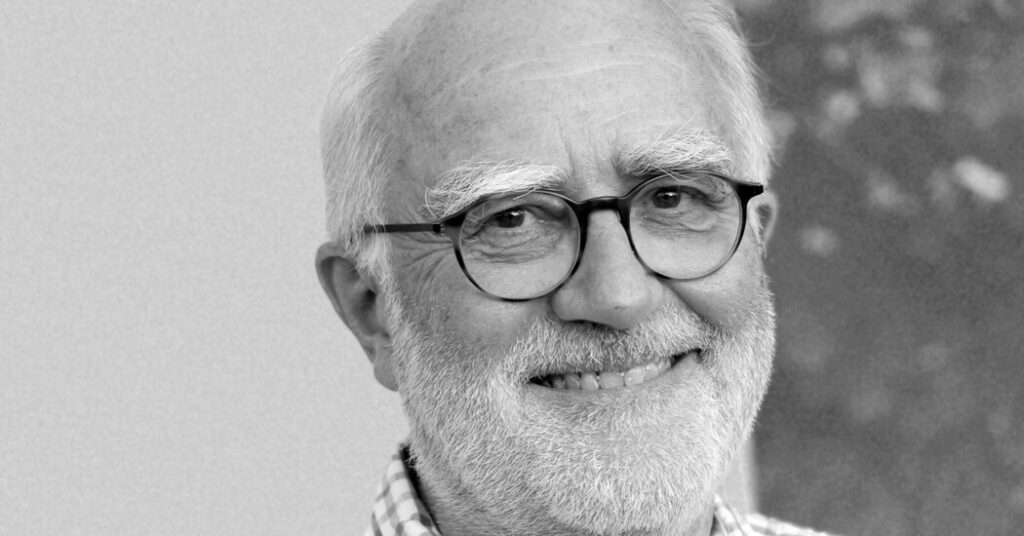
Stephen Batchelor is the author of many books on Buddhism and meditation, including this book he wrote with his wife, Martine Batchelor, called “What Is This?” which is from a Seon meditation retreat that they held some time ago. Seon meditation works around the question, “What is this?” — asking it again and again, allowing this feeling of doubt to arise in you and then sitting with that and seeing what it might reveal.
Batchelor’s latest book is “Buddha, Socrates and Us: Ethical Living in Uncertain Times.” There he draws on a different tradition of doubt — Socratic questioning — and explores the wisdom that Buddhist and Hellenistic philosophy might offer us today.
So I wanted to invite him on the show to talk about doubt as a practice and what it could open for us personally and, even, politically.
Ezra Klein: Stephen Batchelor, welcome to the show.
Stephen Batchelor: Thank you, Ezra.
From the age of 27 to 31, you say you sat facing a wall for 10 to 12 hours a day, asking the question, “What is this?” repeatedly. So I guess the obvious first question is: Why did you do that?
[Laughs.] Well, I became a Buddhist monk when I was 21 years old.
I was involved with a Tibetan tradition that put a great deal of emphasis on studying the texts, studying logic, epistemology and trying to get a clear, conceptual understanding of what Buddhist philosophy was really about. At a certain point, I found that this kind of inquiry, as fulfilling as it was, did not really delve deep enough into my existential experience, as it were.
I felt an increasing longing to be able to actually put all the books aside, all the things I had learned, all of my knowledge about Buddhism, and go to a place where I could just go back to the primary questions of what it means to be human, basically.
I went to South Korea, and there I entered a Zen monastery. The teacher had one simple instruction — ask yourself this question: “What is this?” And nothing else. Just get to grips with that primary question of your life.
Initially, of course, the mind comes up with all kinds of clever answers. But after a while, hour after hour, the mind kind of gives up, and you find yourself in a state of puzzlement, curiosity, wonder, perplexity — in which a lot of my knowledge of Buddhism was just gently put to one side.
A very good way of summing this all up is an aphorism that we find in Zen Buddhism: “Great doubt, great awakening. Little doubt, little awakening. No doubt, no awakening.”
Drop me more into the existential experience of doing that. What is it like to sit staring at a wall for 10 to 12 hours a day, asking the question, “What is this?”
These retreats are 90 days in the summer, 90 days in the winter. It’s a long period of time. But what happens in the first couple of weeks is that the mind still keeps coming up with all these clever answers and theories. Maybe even a little enigmatic, Zenish kind of poetry — or whatever — comes up. But at a certain point, that quietens down, and you just come to rest in that quality of amazement and astonishment that you’re here at all and you’re in this moment.
It’s not that the wonder or the questioning is just going on between your ears. It’s not an intellectual question. It might start out in that way, but at a certain point, you can actually let go of the words altogether. You don’t need to keep repeating: “What is this? What is this?”
You begin to discover what they call the sensation of doubt — an actual physical feeling that extends right down into your belly. And that embodied quality of wonder or questioning then begins to actually infuse your day-to-day consciousness more and more.
It becomes part and parcel of your fundamental experience of being conscious. The world is not something you just take for granted so much anymore — or meeting another person is not just a social interaction.
But underlying that encounter with nature or people or animals, you begin to be more and more attuned to the sheer strangeness that this is all going on at all: the world, other people, my cat, whatever it is.
That opens up a quality of relationship with life itself that I found deeply nurturing. It somehow reconnected me with the organic foundations of my life, but not in a way that I just let go or stopped thinking.
You don’t. As a human being, you are always thinking, in a way. But this provides an embodied framework, in which to maybe think from your belly rather than think from your head.
I worry that somebody listening can think I’m asking this from a point of gentle making fun. So I want to say that “What Is This? Ancient Questions for Modern Minds” — the book by you and your wife, Martine, about a series of talks you both gave at a Seon retreat — is one of my favorite books on meditation. I reread it every couple of years and have spent a lot of time doing this practice. And one of the reasons I wanted to have you on is that I’ve been doing it a lot lately.
My experience of it is: Right at the beginning, when I start doing it again, I get that sensation of doubt, that sensation of freshness in looking at the world. And then, fairly quickly, my mind becomes dulled to the question.
So I’m curious: If you’re talking to somebody whose experience with meditation is counting their breath, restarting every time they lose track, what is the actual instruction of this? How do you do it? But also, how do you keep it from just becoming a chant?
What is important is to drop the question into the meditation at the point where the mind has already stabilized — either through observing the breath or just through the silent sitting practice itself.
Once you find yourself and you feel in your body a groundedness, a harmony, a balance, a calm, then you very gently ask yourself: “What is this? What’s going on?”
Allow yourself not to repeat the question but to somehow settle into the silence in which the question is asked, and to let yourself just listen to whatever responses might come up.
You listen to your body, you listen to the world, and at a certain point, I think you become rather disinterested in finding an answer, to be honest. Because there is no answer.
In the end, that’s the secret, which I shouldn’t perhaps have told you.
Oh, so we don’t have to do it now?
[Laughs.] The point is not to come up with an answer that makes the teachers say: Oh, very clever. You pass.
No, it’s actually about making that quality of inquiry, questioning, wonder, curiosity more and more permeate into your consciousness as a whole, whether you’re meditating, whether you are working, whether you’re doing whatever you do.
I find doubt to be a very healthy and very difficult emotion to cultivate in my meditation practice, in my politics. I think people often hear it as skepticism, which can be good but can also be negative, particularly if only externally directed — if you’re skeptical of what everybody else believes, but you’re quite certain of what you believe.
So I think I’ve latched on to this meditation because I think the strengthening of a muscle of internal doubt is an important virtue, actually.
Doubt has really been structured across your books. It’s been very present for you. What is the definition of doubt to you, and what is the use of it?
Doubt, even in Zen Buddhism, is understood to have two quite separate meanings. There’s the doubt that actually inhibits you from doing anything. For example: I’m not sure if this practice is really going to work. I’m not sure if I really believe all this stuff about Buddhism.
We’re not talking about that kind of doubt, that vacillation, that uncertainty, which is kind of inhibiting, but rather a quality of doubt that somehow lies at a much deeper place within your experience. I might call it an existential doubt.
One way in which we might think of it is being uncertain about the great matter of birth and death. It’s a kind of existential uncertainty, the capacity to make your life into a question for yourself, rather than relying upon the certainties or quasi certainties about: I know who I am. I’m this person. I’ve done that. I’m this important Buddhist. Or whatever.
To just let that go and recognize that, although certainties can be comforting and uncertainty can be discomforting — as I think Voltaire said at one point: Uncertainty or doubt is uncomfortable, but certainty or no doubt is stupid.
I find that in your books, and in that answer, sometimes there are two different things that you’re describing cultivating.
One is doubt about, as you put it, the great matters of life and death: What is the nature of being here?
And then there is also the reminding yourself that you are here. The writer Kim Stanley Robinson turned me on to this idea in sci-fi of cognitive estrangement — that one thing science fiction does is estrange you a little bit from the world as you know it by shifting something.
And I find sometimes this practice can give me a useful kind of estrangement: Oh, it’s strange that I’m here. But then sometimes what it’s doing is helping me remember: Oh, my children are playing, and it’s a sunny day. It’s pulling me out of this other set of thoughts and worries and stories running through my head.
This is a moment in politics where I don’t actually understand where it is going. It’s not certain in the way that it can feel to me dreadful or promising or whatever my interpretation might have been.
How do you think about that difference between these two kinds of doubt the meditation can facilitate: existential doubt versus a more tangible, almost literal awareness?
Well, I think they’re not two separate things.
Uncertainty gives you space. It gives you the time to ponder, to reflect, to think, to not just believe in what your mind is telling you.
It’s helpful perhaps to think of doubt as operating along a spectrum, maybe with the practical doubts that we have all the time, like: Where are my kids? Or: What is that person up to on that building? Or whatever. It could be quite necessary and useful to work with that.
But when we get into the realm of, say, politics or a really difficult emotional situation you have in a relationship, what you might notice is that when you’re confronted with those sorts of challenges, your immediate reaction is to come up with some fixed view, like: This is terrible. Or: These people are awful. Or: It’s all my wife’s fault.
It’s interesting to notice how automatically we latch on to these convictions. I think that is actually an inhibitor, not only in meditation, but also in negotiating the social and political world in which we live.
We perhaps would arrive at more appropriate judgments if we were able to pause. If we were able to notice what is rising up and determine if this is just a reactive habit or if this is something that is really emerging as an authentic response to the actuality of the situation. To get a bit of space, to get a bit of distance and also groundedness in your own bodily sensations, what you’re really feeling in your gut.
It’s very similar, in fact, to what you go through in the process of meditation. You need to quieten down in order to hear the question — and the question might be an issue in our political life, for example — rather than just react to it.
You brought up the word “reactivity” there.
Yes.
Another idea threaded through your books, which builds on a well-known idea in Buddhism, is the idea of the four tasks. Talk me through them.
The four tasks are a way of understanding the primary logic of the Buddha’s teaching — or the dharma, as we call it. It derives from the Buddha’s very first discourse.
These tasks are, first, to embrace life, to embrace suffering. In other words, to resist the tendency whenever something disagreeable is happening to recoil away — but be able to say yes to life. It’s very much an affirmation of the reality you find yourself in that given moment. That’s the first task.
The second task is to let our reactivity be. So if you’re in a difficult situation and anger is your initial reaction, to notice the anger, to be mindful of the anger and to watch the anger arise. And also, if you leave it alone, to let the anger fade away. That’s the second task: letting reactivity be or letting reactivity go.
The third task is when your mind is beginning to calm down and not be so reactive that you come to appreciate a nonreactive space within you. The third task is to dwell in that nonreactive space.
In the Zen practice I’ve just been talking about, this means to dwell in that sense of not knowing, of questioning, because questioning itself is a nonreactive state of mind, at least in the context of, say, wonder. To dwell in that, to really get to feel it in your body, to become intimate with your own nonreactive potential.
That nonreactivity is really, in classical Buddhist language, nirvana itself.
What’s that like, man? [Laughs.]
[Laughs.] It sounds a bit grandiose, perhaps, but it’s something we already all know.
It’s odd — I find that people I know who have no interest in meditating have had experiences where all of their muddled and worried thoughts, for some reason, just die down. People might find this in doing sports, for example — running every day. They might find it by going for hikes in the countryside or just working in their gardens. There are all manner of activities we do that have nothing to do with meditation in a formal sense but are moments whereby, suddenly, we find we are at peace with ourselves. That, to me, is the nonreactive space.
I think it’s dangerous to present it as something exotic and spiritual. I feel nirvana in these moments of stopping, and in that stopping, suddenly feeling at peace with ourselves and in harmony with our world. It may only last a few seconds, maybe longer. But that’s nonreactivity. It’s not something we just get from meditation.
And sometimes they come upon us out of the blue: One day, you sit down on a park bench, and for some reason that you cannot explain, you find yourself still and quiet. The mind’s chatter has died down. And in that moment — and this is the other side of nonreactivity — the world reveals itself more luminously.
The problem with reactivity is not that it causes you suffering, although it often does, but that it actually inhibits you from experiencing the wonder of life itself.
When you’re on a meditation retreat, you sit for a few hours during the day, and then you go out into the garden, and the colors are brighter, the sounds are more engaging. There’s something about the sheer joy and mystery that we’re able to encounter. The world is rendered more vivid and bright.
Nonreactivity feels like a sort of inner peace, a quieting down. And in the doing of that, the world is subtly transformed in a way that brings forth its richness and its wonder.
But that is not the end of the path. That is actually, in my understanding, where the path begins.
So the fourth task is to cultivate a way of life, to cultivate a path. That means that this nonreactive space is not a nirvana in the sense of the enlightenment or the goal of the path, but it’s actually the most appropriate space for making more useful and effective judgments and choices.
It’s a way of life that is not driven and inflected by these instinctive, reactive patterns, these conditioned responses of our society. Instead it allows you to respond to life in a way that is in alignment with your basic values.
Let me try to go through those in pieces.
The first task you describe as saying yes to life. People have often heard it as something like: Life is suffering. Or: There will always be suffering.
So what I hear you saying, on some level, is accepting life as it is.
That’s correct. But not accepting with resignation — acceptance could be seen as a rather passive, noninvolved kind of relationship to things, but I don’t see it that way at all.
Particularly in the framework of these four tasks, the acceptance of life — being able to say, yes, this is the situation I’m in — doesn’t mean that the situation is good or has to be somehow not responded to at all. It’s just the way the world is. It’s that capacity to actually own up not only to the external situation you’re in but also to how you habitually react to those external situations.
You get locked into a certain pattern, and your mind goes round and round and round in the same old thoughts. It’s very circular and repetitive.
So to say yes is to establish a basis from which one can then make a more appropriate response.
I don’t think this is just to do with Buddhist practice. It has to do with how to lead a fully flourishing life.
I always want to zoom in on the verbs here. I think a lot of mischief hides in them for people — or confusion, for me, specifically.
For example, you’ll hear: Accept this is the situation you are in.
But I often am in a situation and think: Time to accept it.
Then I think: OK. Accept it.
And nothing happens. [Laughs.]
That’s right. No, that’s true.
What is supposed to be happening there? The verb “accept” is doing what for you? What action is taking place?
Well, it’s a bit like questioning, in a way. Like when you ask the question, “What is this?” — it can be what in Zen they call a dead word, or it can be a live word.
“What is this?” repeated as a mantra is a dead word. But “What is this?” asked from your gut is a living word.
So I think we can make the same distinction between acceptance: “Accept things as they are” could be an encouragement not to do anything and just to be a passive recipient of whatever life is throwing at you, with no recourse to do anything else. That would be a dead word.
But what would be the living version of “accept”? That, to me, would be an embrace or a willingness to be in this world despite all of its problems and difficulties and things you don’t like. To be able to encompass that, to comprehend it in a way that you somehow acknowledge that this, at this moment, is your total experience. And this is where any answer or response to the situation will have to come.
.op-aside { display: none; border-top: 1px solid var(–color-stroke-tertiary,#C7C7C7); border-bottom: 1px solid var(–color-stroke-tertiary,#C7C7C7); font-family: nyt-franklin, helvetica, sans-serif; flex-direction: row; justify-content: space-between; padding-top: 1.25rem; padding-bottom: 1.25rem; position: relative; max-width: 600px; margin: 2rem 20px; }
.op-aside p { margin: 0; font-family: nyt-franklin, helvetica, sans-serif; font-size: 1rem; line-height: 1.3rem; margin-top: 0.4rem; margin-right: 2rem; font-weight: 600; flex-grow: 1; }
.SHA_opinionPrompt_0325_1_Prompt .op-aside { display: flex; }
@media (min-width: 640px) { .op-aside { margin: 2rem auto; } }
.op-buttonWrap { visibility: hidden; display: flex; right: 42px; position: absolute; background: var(–color-background-inverseSecondary, hsla(0,0%,21.18%,1)); border-radius: 3px; height: 25px; padding: 0 10px; align-items: center; justify-content: center; top: calc((100% – 25px) / 2); }
.op-copiedText { font-size: 0.75rem; line-height: 0.75rem; color: var(–color-content-inversePrimary, #fff); white-space: pre; margin-top: 1px; }
.op-button { display: flex; border: 1px solid var(–color-stroke-tertiary, #C7C7C7); height: 2rem; width: 2rem; background: transparent; border-radius: 50%; cursor: pointer; margin: auto; padding-inline: 6px; flex-direction: column; justify-content: center; flex-shrink: 0; }
.op-button:hover { background-color: var(–color-background-tertiary, #EBEBEB); }
.op-button path { fill: var(–color-content-primary,#121212); }
Know someone who would want to read this? Share the column.
It sometimes feels to me like the distinction here is: You can be in a situation, and you can either face up to it or not.
There is a well-known meditation that has a structure of: I’m of the nature to grow old. I’m of the nature to grow sick. I’m of the nature to lose people I love. I’m of the nature to die.
And I know that’s true, but I don’t face up to that being true all that often.
That’s exactly the point. We all know we’re going to die, in theory. We might even worry about it sometimes. But I don’t think we really know.
Another meditation that has been very effective in my life, which I learned from my Tibetan teachers, was a contemplation of death — that death is certain, but the time of death is uncertain. So, once again, you have this tension of certainty/uncertainty: The one certain thing is totally uncertain as to when it’s going to occur.
In other words, when you start thinking about death in a more contemplative way, as in that little exercise the Tibetans have, over time, your relationship to death becomes much more, paradoxically, alive. With each breath you are taking one breath less.
So to experience something like death or old age from that contemplative perspective gives it a whole different meaning. It forces you to think: Well, how do I want to live if I could die at any moment?
I’m beginning to really feel that, and I think Buddhist meditation has helped me learn to live on that cusp. It inevitably forces me into a deeper ethical relationship with how I want to flourish as a person — what kind of world, what kind of society, I would wish for future generations to be able to enjoy.
Meditation at that point becomes a bridge to allowing us to engage in our world and in our lives with a greater sense of depth and less of a sense of just jumping from one topic to the other in a superficial way.
So the next task is: Let reactivity be.
Yes.
You also used another term: “Let go.”
Yes.
“Let go” is maybe the verb structure that I find the most frustrating across Buddhist literature. [Laughs.]
Because I’ll have those feelings and be like: Time to let them go. And then nothing will happen.
Yes, exactly.
But you’ve also said it as “Let it be.”
Yes.
I’d like to dwell in that difference for a minute. “Let go” feels like one thing, and we hear it all the time: Let go of these things that are not serving you.
I don’t find that is a tool in my tool kit. But letting be? Maybe a bit more so.
Well, you have to remember that traditionally, in 99 percent of Buddhist books you read, the word I’m translating is usually translated as “abandon.” It’s much stronger. It’s actually “reject” — get rid of greed, hatred, these things. Abandon them.
But I found that way too aggressive.
I think in Western pop Buddhism, they don’t use that as much. [Laughs.]
No, they don’t. Western pop Buddhism has tended to pick up on the idea of letting go. But letting be, I find, works way, way better.
This is, I think, at the core of mindfulness practice: If you feel jealousy or anxiety arise in your mind, you just notice it. You don’t believe it and get caught up in its narrative — and you don’t try to repress it or deny it, either. You just let it be.
“Let it be” works really well. And it works well also because the whole heart of any mindfulness intervention is to actually see things for what they are — transient, contingent — and just let them follow their own natural course. And not immediately, but over time, they slowly diminish.
Even if they don’t diminish, you become more and more centered in the nonreactive quality of mindfulness. As soon as you are mindful, you are already being nonreactive. You’re noticing rather than reacting. You’re observing. And that’s what frees you from entanglement in these often very powerful thoughts and emotions that surge up within us.
In my very unawakened, amateurish attempts to work with all this, I have found it helpful for me to think about the thing you’re not supposed to be doing. I sometimes think of it as trying not to act from it.
That’s right. Exactly.
I had an experience the other night that I think is useful to discuss here because it’s a small example.
I was on a bunch of group chats, and this particular group chat had gotten into an argument, including with me, at like 11 p.m.
[Laughs.]
I had already meditated that night, and I found myself getting upset and feeling like I needed to defend myself — my chest getting tight and feeling hotter. And I thought: Well, I should let this go. I should be nonreactive.
But then nothing happened. [Laughs.]
The best I was able to do was actually not to be nonreactive. It was not to react. And in not reacting, I didn’t make things worse. I learned some things. I found the experience of trying to watch the way my body was reacting at least somewhat interesting.
But it was unpleasant. And it led me to this inquiry — in some ways, it’s one of the things that led me to this conversation — about what it actually meant to be nonreactive.
Was it to have negative feelings but not feel negatively while having them? Because that didn’t seem to be working.
Or was it just to be feeling negatively and not doing anything, like white-knuckling your way through your feelings? Which I’m able to do. I’m able to white-knuckle my way through into not reacting to certain things.
Or is it something else? How do you actually understand the experience of nonreactivity?
Well, what you said also is part of it. At times, if you’re practicing being nonreactive, it will be a white-knuckling thing at times. You may find you don’t have the inner capacity to just remain calm and joyful and so on at all. It overwhelms you.
But what I think meditation allows over time is you slowly start to cultivate a more embedded sense of the feel of nonreactivity.
This is where we come to task No. 3. It’s learning to dwell and to feel and to sense in the body what nonreactivity feels like. It’s to become somehow intimate with that quality of your embodied experience.
So it’s not nonreactivity as an idea of something you may or may not do. You begin to feel this nonreactive quality infusing your body.
Before you get to the place where you could feel that, let me hold here. Because there are times when you’re not feeling that.
And this is actually an important place for people. Because on one level, this is a conversation about meditation and Buddhism. But this is a podcast that spends its time in politics, and I have been thinking about how you maintain some clarity and some internal space, if only to think well and make good decisions at a time that is very overwhelming.
One thing I’ve noticed across many years of meditating and doing these practices is that I’m often reacting to a sensation in my body. I think I’m reacting to a situation, but I’m not. I’m reacting to how I’m feeling.
With that text-message thread that I’m using as my example here, I was reacting to try to release pressure in my chest, and it wasn’t going to do that. [Laughs.] It was going to increase it. Because nobody was going to chill out at 11:15 p.m., furiously texting each other.
And I feel like this is one of the interesting realizations of meditation over long periods of time: How much of a situation is just pretty modest sensations — a bit of tightness in the chest, a feeling of buzzing in the extremities. And you’re like: That’s the whole thing that’s driving me right now? I just feel a little bit weird?
That is, I think, one of the great insights that we find in the Buddhist tradition. The Buddha realized precisely that we don’t react to the external object. We react to how the external object or person makes us feel — what is sometimes translated as “feeling tone.”
To pay more attention to how the environment and also your own inner stuff is actually affecting your underlying tonality, whether that’s pleasant or unpleasant or neutral or whatever — that’s something that is understood as simply a given. That whether you’re the Buddha or whether you’re me, the reality is that if you are threatened, let’s say, by someone with a knife, that will trigger a survival reaction, which is entirely necessary and valuable. There’s no problem with that.
But there are lots of other reactive patterns that are not helpful. They’re often loop tapes of fears that you might have inherited from your family or your past experience. And these things surge into your mind, as I’m sure you’ve probably noticed, and you get trapped in these little loop tapes of worrying about something or feeling angry about something.
So it’s a question of learning how to recognize these patterns and conditions that keep repeating. That’s very important. But it’s also a question of how to open up a space within that noticing, in which you realize that the mindfulness, your attention to that reactivity itself, is not reacting.
Over time, you learn to somehow strengthen that nonreactive dimension of attention or mindfulness so that becomes more and more a stabilized point from which you can then deal with these difficulties — whether it’s personal, whether it’s political.
And in that way, I feel you open up more and more of a capacity to be with it. Also — as we would say in stoicism, for example — to recognize what it is about your situation that you cannot change and what it is about your situation that you can change.
I cannot change the fact that I feel angry, for example. Saying, “Don’t be angry,” is not going to work. But I can notice that is a given in my life at that point. I can let it be. I don’t need to get entangled with it or believe its narrative. And it’s within that nonreactive space that you can exercise those judgments.
Can I change this? Or do I have to accept it for what it is? That, I think, is the challenge of what we call the practice.
How do you think about the places where being what I would call too regulated or judicious — or letting the emotions pass by and only speaking from a grounded place — can actually make it harder or more unlikely to deal with things that are difficult?
I think about how, in many relationships in my life, it has often been important to lose my emotional self-control. Not in a sense of getting incredibly angry or anything in that direction. But there are things normal me doesn’t deal with, and things that people can’t see in me — forms of hurt or upset or need — that the part of me that meditates daily is trying to keep stable and level.
And levelness is good, but there’s much that levelness doesn’t address.
When people go to therapy, the therapist is not trying to keep them incredibly solid. In fact, I find that the best therapists I’ve had are often trying to push me out of my window of emotional regulation so that I am reacting to an emotion that I find very unpleasant. And to the extent that I let things be, I tend to let it go away so that I don’t have to deal with it.
I think it is a quite valid criticism of Buddhism and meditation in general — that it can be used as a strategy of avoidance. Like the business of using meditation as a way to numb yourself to the world. I’m sure that happens. Why not? You’ve come to dwell in your own kind of spiritual bubble.
And that to me is not an appropriate response to the situation. The goal of this four-task practice is not to rest in some blissful nirvana state at all. It’s actually to be able to respond more effectively to the world in which we find ourselves — the suffering and the confusion and so on that’s going on.
So you understand from the outset that this is a practice that is not giving absolute value to stillness and emotional equilibrium and so on. It’s getting you into a space where you can then make the judgment to respond.
And it could be that you need anger. I don’t think anger is necessarily a bad thing. For example, you might have a mother with a little child, and the little child keeps running out into the road, so she says: Come back, come back, come back — and gets really angry with the child. But that’s the appropriate thing to do. It’s perfectly good for the welfare of the child.
So I think one has to get out of this idea that there’s an a priori set of good reactions or good responses that Buddhism — or any other religion — approves of.
I think we have to find an ethic in which we’re much more situational — that what counts in an ethical situation is not following the Buddhist rulebook or the Jewish rulebook or the Christian rulebook, but actually finding your own voice, finding your own way of being with that situation in an authentic and hopefully effective way that is both in tune with your own deepest values and also responds as optimally as you can to the situation at hand.
But being fallible, human, mortal creatures, we very often get it wrong. Because you can spend all the time you like trying to make the appropriate judgment as to what to do in a difficult situation. But we all know from experience that no matter what your motives are, you can end up making the situation worse.
In other words, we don’t know the future. So it’s also therefore recognizing that any kind of judgment or choice you make in your response is going to be a risk. I think of this as an ethics of risk, and accepting the fact that it’s a risk.
But it’s important to learn from the mistakes you make: We make mistakes. We’re fallible. I make mistakes. I’m fallible. I can get really worked up about things. I’ve done all this meditation for years, but I still get really fed up with some events in my life, and I’m not particularly proud of that. But I recognize that’s simply the way I’ve been conditioned, as it were. It’s my biological, social, whatever conditions that have led me that way.
So I don’t judge the quality of my meditation or my Buddhist practice in such a way that certain things just don’t happen anymore. As a human being evolved in the way we have, greed and hatred and violence and so forth are built into our makeup. We have to accept these things for what they are — not demonize them, not think of them as evil, but simply as the way that we have evolved.
But we have the capacity to live with that, to make better choices, to have disciplines that can stabilize a part of our attention. And then we learn from the consequences of what we’ve said and done. And we may find that that shows us something that we haven’t done particularly well. Or it shows a certain weakness in ourselves or whatever.
So it’s an ongoing practice. This idea of enlightenment that Buddhists have is often not very helpful because it gives you this idea that if you do this enough, you’ll get to some point and suddenly all your problems will be over. But it doesn’t work like that. I think what the Buddha describes is a process of waking up. And that’s something that will go on until our last breath.
I want to turn a bit more directly into politics here. Because if the fourth task is to live out your values, politics is one of the places where people try to do that — and that isn’t exactly a zone of blissful nonreactivity.
You talk about that in your new book, “Buddha, Socrates and Us.” You call our political culture highly opinionated — and that being opinionated itself is a reactive state.
What do you mean by that?
I think it’s helpful to think that the opinions and views we hold are not isolated, reified beliefs, but rather points within a spectrum from certainty to uncertainty in which I live the whole of my life.
I’m a writer, I’m a thinker, and I’m very concerned about holding a position that makes sense to me in terms of my values and that is rationally defensible in terms of my overall philosophy of life.
But at the same time, I’m also aware that over the years — and maybe even from year to year — those opinions can become more nuanced, more refined, and I might even let go of some of them altogether.
So I think our journey through life is really about learning to negotiate and continuously put into question some of the views and opinions that we hold in such a way that we don’t let them become things in which we get trapped.
And opinions can very often just keep us completely blocked. We feel this feeling of stuckness, I find.
When we talk of reactivity, we normally speak of either wanting something or craving something or being averse and hating something. But Buddhism also includes this other thing called confusion, which is very difficult to really understand what that means.
What I now understand it to mean is that one of the principal forms of reactivity that we experience as human beings is, in fact, our opinions and our views. So when, for example, we’re having a conversation and someone doesn’t share our political perspective, very quickly, once the conversation has gone past the polite stage, we find ourselves reacting incredibly — simply because we are so convinced of the rightness of our own opinions and views.
So opinionatedness, to me, is on an equal stance with hatred and with greed. It’s a space in which we cling, quite desperately at times, to the rightness of our political and religious views.
So reactivity is not just a personal thing. I think there is a collective reactivity, which is that the culture to which we belong holds certain values.
So if we are with Buddhists, for example, they’ll collectively react against, say, killing animals. In other words, we also internalize the reactive behaviors of our ancestors, of our educators and so forth and so on.
Now that doesn’t mean that we shouldn’t think or we shouldn’t have views about anything. Obviously not. But we should perhaps learn to live more lightly with our convictions and to notice when the conviction turns into a kind of sclerotic hold on things that we just take to be normative.
This is such an interesting tension, speaking as an opinion journalist.
[Laughs.]
It’s one I struggle with all the time. Too many of us who are politically engaged, ethically engaged, ask the question: Is that my opinion, or is that my ethical perspective? Is there even a difference?
It feels like acting ethically often requires acting from a point of view: They are doing this. This is bad. It will hurt people. I’m trying to stop them from doing that.
On the other hand, there is a tension between that and uncertainty and doubt. A tension between believing you have come to the right moral answer and being open and nonreactive to people having answers that are different than the one you came to.
You’re trying to balance this in the book. You’re balancing it in Buddhist ways and in ways that reflect the Socratic approach. So talk to me a bit about that tension.
When I meet someone with an opinion that conflicts with my own, I notice in myself a withdrawing from the engagement, a sort of barricading myself into my own particular view. And that’s where it becomes problematic.
Often I form judgments about people on the basis of just one or two things they say. And I think that’s an extremely disrespectful way to deal with another person — to treat them simply as the incarnation of their own opinions and views and their political stance or their religious beliefs.
I think that as soon as you make that fixed separation, you’ve basically abandoned any genuine dialogue or conversation or inquiry. I found that this capacity to be alert to my own tendency to freeze and hold on a fixed opinion and feel somehow angry immediately if someone contradicts it — by opening up that space, it also opens up a kind of humility in which I recognize I need to know more about what this person believes.
You create a very interesting distinction in the book between justice, which you say treasures certainty, and care, which treasures uncertainty.
Talk me through that.
That’s an idea that I picked up very much from the feminist ethicist Carol Gilligan, and it’s sometimes called a feminist ethics of care. She draws the distinction in a way that I’ve found to be very helpful.
Justice and care seem to be, again, poles of a spectrum rather than two totally separate things. And Gilligan recognizes that an ethics of justice tends to be what she talks of as male: You have a system of law, you have rules, and you make your ethical judgments in terms of whether that’s in accordance with the law, whether it’s in accordance with the rules of your religious society or so on. So you are more concerned with an abstract model of what is right and wrong that you then use to make real-world decisions.
Now we often find that justice alone can be cruel. You may believe, for example, that abortion is wrong under all circumstances without paying any attention to the plight of that particular woman and her unborn child. It’s just wrong by definition. It’s never allowed.
On the other end of the ethical spectrum, you have an ethics of care, which we could also call a situational ethics. In other words, what drives my ethical response to a particular instance of human suffering is to understand, as best I can, the uniqueness of the moral dilemma — let’s say for the woman who has a pregnancy and wishes to terminate it or may risk dying, or whatever it might be.
So to try to respond not by trying to find out what is the right thing to do but to respond to that situation in a way that is the most loving, caring thing to do: How can I respond to this situation in a way that can minimize the suffering of this person and optimize their capacity to find a resolution to live a better life? It may not fit neatly into some categories of justice — right, wrong, good, fair, unfair — but it is responding to the actual deep experience of that suffering person at that moment. I seek to respond to that caringly and lovingly, which might include recognizing that, in her case, to proceed with an abortion would be the appropriate thing to do in that situation.
I think this loops back to the conversation we were having about doubt.
One way I’ve come to think about doubt as a political emotion — not speaking primarily of it as a spiritual orientation — is that it’s like an inch of light or space between you and your certainty in your own views. And it’s that inch of space into which other people and their views can come in.
One reality of this age is that, as politics becomes more high stakes, as the parties become more different, as people become more in conflict with one another, it’s easier to feel quite sure. And I think that sense of certainty is really the enemy of curiosity.
Curiosity is a very essential democratic emotion. And doubt of oneself is just enough to maintain a conversation: Am I sure of how this will all turn out? Am I sure I understand this position, this moment, this situation?
If you have certainty, then there’s no reason for a conversation.
That’s right.
That has become, for me, a very important branching path in politics. It’s a reason I found myself doing these “What is this?” meditations right now — to maintain enough self-doubt and a curiosity about others, in order to maintain a conversation.
I’m not saying I do it well or do it all the time, but it feels very important.
And maybe this gets to the other side of your book, which is about Socrates, who’s much more of an explicit political actor, talking about high-stakes political topics with people in his time. But always from this place of probing.
Yes, exactly.
Why him? For you, however many books you’ve now written, why turn to Socrates? Why turn to that kind of more philosophical, almost gleefully undogmatic approach to questions?
As you’re suggesting, what Socrates is famous for is this relentless probing of the interlocutor’s mind and understanding — and also the relentless probing of his own mind, his own understanding, of what the virtues are.
His analysis of the virtues very often ends up in what he calls aporia, which is a suspension of opinion and views.
So Socrates will often say: Actually, I don’t know what justice is. I don’t know what wisdom is. But on the other hand, I will never cease inquiring about them.
I found this very helpful. A clear definition of justice may always elude us, but that doesn’t mean that we cannot benefit by constantly asking ourselves what justice is.
I think what Socrates comes to in the end is recognizing that justice, for example, or wisdom are not things that you can define abstractly, but they are qualities of human life that are enacted in real-world situations.
When we see a person in a situation acting justly, we intuitively know that was a just or a wise or a courageous thing to do. But that doesn’t require us to have some a priori definition of what that virtue is.
And that’s very similar to when the Buddha describes what he calls samma ditthi, which could be translated as “right view,” as it often is — the right or the complete or the authentic view, perhaps.
So an authentic view is one in which you do not reduce your understanding to a definition about which you then claim certainty. But rather, it’s a constant, ongoing quest into what the virtues are — what it is to be good, for example — with an understanding that you are probably always going to be asking that question as long as you are a living, ethical being.
After all the reading I did of Plato and Xenophon and others, I really arrived at this sense that what united the Buddha and Socrates is that they both embodied an ethics of uncertainty. An ethics that is not founded on some metaphysical certainty, like the belief in God or in the law of karma, for example, but is very much about responding appropriately to the particular situations in life we have, in a way that is acknowledging the centrality in our life of certain values or virtues — and yet values or virtues that we cannot actually define.
Is there comfort in all this or only discomfort?
Something we so want and seek — from religion, from spirituality, from politics — is certainty. Like: Tell me there is life after this. Tell me there is meaning to all this. Tell me I have the right answers. Tell me this person will do the right thing.
There’s a beauty to the radical ethic or spirituality of uncertainty that you’re offering here and that you offer throughout your books. But where does it leave you standing?
What is this? [Laughs.]
I have found, and I continue to find, that understanding life as a work in progress, as an open-ended journey to some final goal that we do not perhaps even know — to put it bluntly, really — this approach makes me feel more fully alive.
It enlivens me. It keeps me on my toes. And I feel in our world today, which is so caught up in these binary conflicts that seem sometimes overwhelming, politically or religiously, that there must be another way.
I think Socrates is a very good guide to help us perhaps let go of some of our certainties, or at least release our grip on them — to allow the openness that there may be other ways of seeing these things that we may not agree with, but they have their validity, they have their role in this world, too. And really, to try to establish some kind of culture in which there’s far greater tolerance of difference among different communities, among different individuals, religious groups, political groups.
I think we are witnessing extreme polarization in our world at the moment, and this may be one approach to perhaps overcoming that polarization — or at least to lessen its power over us.
But in the end, I don’t know. All I can do is trust what I believe — I have a view, obviously — and to somehow try to live that.
Then always our final question: What are three books you’d recommend to the audience?
One book I’d recommend is called “Children of a Modest Star: Planetary Thinking for an Age of Crises” by Jonathan Blake and Nils Gilman, which is a wonderful reflection on how we need to imagine a form of governance that has executive authority beyond the nation-state itself.
They’re struggling to find an effective way where different nations can come together to address issues like climate change and other issues that really cannot be managed by national governments alone.
They’re not promoting a world government, but they are suggesting a form of subsidiarity, a political concept where different areas of responsibility are nested in larger and larger ones. So I found that book extremely inspiring.
Another book — this is a Buddhist one — is called “Work Like a Monk: How to Connect, Lead and Grow in a Noisy World” by my friend Shoukei Matsumoto, who is a Pure Land priest in Japan. It’s simple, it’s down to earth, and it’s basically based around a hypothetical conversation between a business person living in the world and a priest living in a temple in Japan. It’s really good.
And finally, a book called “The Second Body” by the novelist Daisy Hildyard. It’s not a piece of fiction — it’s an essay on what she calls the second body. It’s a highly imaginative way of understanding that our physical body, which is sitting on this chair right here, is actually only a relatively small part of my wider body, which extends across the world in, let’s say, the waste that I produce, the plastic bottles that end up in the stomachs of whales or the working conditions of a garment factory worker in Bangladesh. This is an extension of my own body.
This is a short essay, and I found it was really brilliant. I’ve read it a couple of times, and it’s not making an argument so much as presenting a picture of our world in which we begin to feel that our own flesh-and-blood body is not all the body we have, but it is actually far more extended. And by recognizing the impact of our own particular physical life on this Earth, we can perhaps have a greater empathy for worldwide suffering, both economically and climatically.
Those would be my three books.
Stephen Batchelor, thank you very much.
Ezra, thank you very much, indeed. It was a wonderful conversation.
You can listen to this conversation by following “The Ezra Klein Show” on the NYTimes app, Apple, Spotify, Amazon Music, YouTube, iHeartRadio or wherever you get your podcasts. View a list of book recommendations from our guests here.
This episode of “The Ezra Klein Show” was produced by Kristin Lin. Fact-checking by Michelle Harris. Our senior engineer is Jeff Geld, with additional mixing by Isaac Jones. Our executive producer is Claire Gordon. The show’s production team also includes Marie Cascione, Annie Galvin, Rollin Hu, Emma Kehlbeck, Jack McCordick, Marina King and Jan Kobal. Original music by Pat McCusker. Audience strategy by Kristina Samulewski and Shannon Busta. The director of New York Times Opinion Audio is Annie-Rose Strasser. Transcript editing by Sarah Murphy and Marlaine Glicksman.
The Times is committed to publishing a diversity of letters to the editor. We’d like to hear what you think about this or any of our articles. Here are some tips. And here’s our email: [email protected].
Follow the New York Times Opinion section on Facebook, Instagram, TikTok, Bluesky, WhatsApp and Threads.
The post This Question Can Change Your Life appeared first on New York Times.